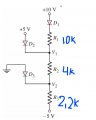
I ve got this circuit
,Assump that both D1, D2 conduct, V cut in all diodes 0.6V, I calculate V1=5-0.6=4.4V, then VR1 = 10-0.6-V1=10-0.6-4.4=5V, =>Ir1 =5/10=0.5mA positive means it follows the forward bias D1,is this correct?
And you were given those resistor values? - I thought perhaps you have calculated them from somewhere.
Yes - there is 5V across R1, so the current is 5V/10k
And you were given those resistor values? - I thought perhaps you have calculated them from somewhere.
Yes - there is 5V across R1, so the current is 5V/10k
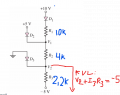
D2 disconnected thus I remove the branch with D2, I also remove branch with D3 because no current through D3, the current through the R1, R2, R3 is = (10-(-5))/ (10+4+2.2) = 15/16.2=0.93mA
hi lin,
Yes,
A point to remember that the D2 diode will create a 0.6V voltage drop from the +5V.
Are there any more questions you need to ask for this topic.
E
hi lin,
Yes,
A point to remember that the D2 diode will create a 0.6V voltage drop from the +5V.
Are there any more questions you need to ask for this topic.
E

 Facebook
 Google
 GitHub
 Linkedin