Minimum current to power 1W LED

MisterBill2

Joined Jan 23, 2018
27,552
Just use a 4.5V max 5-450 mA adjustable CC power supply that uses a BJT and potentiometer. This will allow you to get control over the brightness and find the ideal amount of current. In addition, CC will give you ideal life time and less power losses.
You really should have some resistance to limit the current because LED devices are very non-linear in the portion of the forward voltage to current curve once they approach the rated current. A rather low resistance, ten to 27 ohms, can prevent a lot of grief. An increase of just a very few millivolts can produce a large current increase.
 

-live wire-

Joined Dec 22, 2017
959
Yeah. They are completely non-linear. But CC would adjust the voltage to get a desired current. It is sensitive to fV changes based on temperature. So there would be no problems.
 

Thread Starter

Bhope691

Joined Oct 24, 2016
38
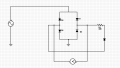
OK, thanks for the above. I created the below simple circuit.

The AC source is my homemade generator. The resistor R1 value is 446 ohms and 100W. The diode after the resistor is an LED. The voltage recorded from the voltmeter V is the rectified voltage out of the bridge rectifier.

If V is recording 30VDC RMS can I assume that the current flowing through the resistor and LED is 0.067A RMS.


upload_2018-5-2_14-43-39.png
 

Colin55

Joined Aug 27, 2015
519
It is classified as pulsing DC and depending on the frequency, the reading could be ANYTHING.
I like using big wattage resistors too, for 1 watt LEDs.
 

Tonyr1084

Joined Sep 24, 2015
9,744
My guess at what he means by "could be anything" is that at any given moment the sine wave will be at an infinite number of positions ranging from zero volts to positive volt peak and to negative volt peak.

Actually you don't need full wave rectification. Not unless you're going for very high light output. Using a single diode - in your case, just the LED and its associated resistor you'll get half wave rectification. Meaning the light will see forward current roughly 50% of the time. Every time the sine wave goes positive greater than the forward voltage of the LED current will flow.

For the sake of argument, assume you have 30 VAC RMS. Using just a resistor and the LED you'll still get the 30 Volts RMS value but the LED will only conduct when current is forward going. At 60 cycle, you're not going to see any flickering unless you move the LED at high speed across your field of view. Since that's unlikely, the LED will simply emit its light and will appear to be at full brightness. Going full wave rectification you're going to gain very little extra light. So little you'll probably not be able to tell any difference.

So you have 30 volts source. Assuming your LED has a forward voltage of 3 volts, you have 27 remaining volts to deal with. Using a 470Ω resistor, 30 ÷ 470 equals 0.0638 amps (call it 64 mA). Actually, that's rather high. And most LED's won't handle that much current. But if you're using a special high wattage LED then I could be wrong about you burning out your LED. 64 mA times 30 volts equals 1.9 watts. Call it two watts. A 100 watt resistor is - to say the least - overkill. WAY over kill. Anyway, build it however you choose. But running a 2 watt load, I'd use a 5 watt resistor just for safety margin.

Also keep in mind that every diode you pass current through will have a voltage drop of about 0.7 volts (typically). A full wave bridge will drop an additional 1.4 volts. That could be a good thing in your case. If we run the numbers and subtract 3 volts forward (LED) and an additional 1.4 volts (bridge) you're running just about 25.5 volts. We could be more accurate, but suffice is to say - 25.5 volts through a 470Ω resistor equals 54 mA. Why 470 ohms? Just guessing here but I bet you have a 470 ohm resistor. You measure it at 446 ohms because of its tolerance. Probably a 10% resistor. Could even be a 20% and you're getting 446 ohms. That's (54 x 30 =)1.62 W. Way more than any LED I've messed with can stand.

Recap: No need for full rectification. You can if you desire. No need for 100 watt resistors. You can if you desire. Running your LED at 2 watts (or even 1.6 watts) - if it is designed to handle it then you're good. If not - make a wish upon the magic smoke when the Genie gets out of the LED.
 

Thread Starter

Bhope691

Joined Oct 24, 2016
38
Tony, thanks for the reply. The LED is a 3W power LED.

You mention

Also keep in mind that every diode you pass current through will have a voltage drop of about 0.7 volts (typically). A full wave bridge will drop an additional 1.4 volts. That could be a good thing in your case. If we run the numbers and subtract 3 volts forward (LED) and an additional 1.4 volts (bridge) you're running just about 25.5 volts. We could be more accurate, but suffice is to say - 25.5 volts through a 470Ω resistor equals 54 mA
Could you explain why we subtract the voltage drops across the diodes and LEDs from the total output (30V) from the bridge rectifier, and not the voltage drop across the resistor?

If the voltage drop across the LED is 3V isn't the power through the LED 3V x 54mA rather than 30V x 54mA?
 

Colin55

Joined Aug 27, 2015
519
It started as a 1watt LED. Now it is a 3Watt LED.

If you have 30v , you should shove the 30v into a module that takes all the voltage and converts it to 3.6v at 900mA and you will only have to shove 100mA into the module.
 

Tonyr1084

Joined Sep 24, 2015
9,744
Could you explain why we subtract the voltage drops across the diodes and LEDs from the total output (30V) from the bridge rectifier, and not the voltage drop across the resistor?
All the voltage drops (resistor included) have to add up to the supply voltage. You subtract the known voltage drops of the diode(s) from the main voltage in order to figure how many volts will be dropped across the resistor. That's important because you need to know that so you can calculate for the current you intend to set up for. Failure to account for the voltage drops across the LED(s) and any other diodes will cause your circuit to run at a lower wattage than intended. That's not a bad thing but you don't hit your targeted setup.
 

Tonyr1084

Joined Sep 24, 2015
9,744
All the voltage drops (resistor included) have to add up to the supply voltage.
This is called Kirchhoff's Voltage Law. Actually, more aptly expressed is this:

"Gustav Kirchhoff’s Voltage Law is the second of his fundamental laws we can use for circuit analysis. His voltage law states that for a closed loop series path the algebraic sum of all the voltages around any closed loop in a circuit is equal to zero. This is because a circuit loop is a closed conducting path so no energy is lost." (quoted from: "Electronics-tutorials.ws")

All the voltages equal zero volts? Yes. You start with 30 volts and subtract each and every voltage drop. If you come up with zero volts in your equation then you've done it right.
 

ebeowulf17

Joined Aug 12, 2014
3,307
If the voltage drop across the LED is 3V isn't the power through the LED 3V x 54mA rather than 30V x 54mA?
I haven't double checked the other related calculations that led to the current figure, but you're right about power dissipation. The power dissipation for any given component is the voltage dropped across it times the current running through it.

This sometimes gets confusing because the current is the same through all components in a series circuit, but the voltage drops are all over the place, adding up to zero as previously stated.

It's a common mistake to think that LED wattage equates to required resistor wattage, MOSFET wattage, etc. In fact, the wattage specs required of each component will be totally different depending on how much of the total voltage is dropped across it.

So yes, in this case, if current is 54mA and Vf is 3, then LED power dissipation is 162mW.

Assuming 25.5V is being dropped across resistor, as calculated above, power dissipation there will be 1.377W, which seems like a lot of wasted heat for the work being done, but that's a whole different subject.
 

Tonyr1084

Joined Sep 24, 2015
9,744
There are different ways to look at the same thing. Yes, the drop across the resistor is going to be much greater than the drop across the LED. But when you total everything up it's all equal. A circuit that is running X amount of amps has X amount of amps running through it. If 3/4X is dissipated through the resistor then 1/4X is dissipated through the LED. If 0.99X is through the resistor then 0.01X is through the LED. It's all equal to 1. X = 1. How you divide it up depends on what's doing what.
 

DickCappels

Joined Aug 21, 2008
10,661
Pardon the late comment:
(Some text removed for clarity)
Actually you don't need full wave rectification. Not unless you're going for very high light output. Using a single diode - in your case, just the LED and its associated resistor you'll get half wave rectification. Meaning the light will see forward current roughly 50% of the time. Every time the sine wave goes positive greater than the forward voltage of the LED current will flow.
The above statement is true, but keep in mind that when using half wave rectified voltage a 50Hz or 60Hz instead of fully wave rectified voltage the time the LED is off is equal to a full half cycle rather than just those little dip around zero crossings. The visual effect is a striking (can I say debilitating?) increase in the depth of perceived flicker.

An alternative to using a full wave rectifier is to make a full wave LED assembly. Not sure whether there is any benefit, but it is a different way of looking at the problem.
upload_2018-5-4_14-12-3.png
 

Colin55

Joined Aug 27, 2015
519
The alpha LEDs will just flash in synchronism with the "Y" LEDs and drive you insane.
Oh, I see it will make no difference!!!
 

Tonyr1084

Joined Sep 24, 2015
9,744
The visual effect is a striking (can I say debilitating?) increase in the depth of perceived flicker.
Everyone has their level of sensitivity. Me? I just don't see any difference between an AC lit LED or a DC lit LED. Of course, I'm not home to test that out. But with AC rectified, if you put a capacitor in parallel with the LED & resistor you'll get closer to the peak voltage of the AC sine wave.

Those LED tail lights I see on cars - when I gaze from left to right (or vice versa) I can see them strobe. Doesn't bother me. Just that it's visible when you glance from side to side across and past the tail lights.
 

Thread Starter

Bhope691

Joined Oct 24, 2016
38
Thanks, it is much more clear now.

Last question; in order to calculate the total power supplied am I right in thinking it is the total voltage supplied (so in this case 30V) multiplied by the current which was calculated through the resistor of 54mA (taking into consideration the voltage drops through the LED and diodes), which is equal to 1.62W total power.

This is dissipated between the resistor (Voltage drop across resistor x current flowing through circuit) and LED (voltage drop across LED x current flowing through circuit).
 
Top