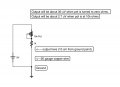
Your question is not clear. Maybe the answer is: The 9 volt battery will provide the number of milliamps that is can push through the resistors. In Gopher T's circuit (or is it #12's circuit?) the current will be about 9 milliamps.
Your question is not clear. Maybe the answer is: The 9 volt battery will provide the number of milliamps that is can push through the resistors. In Gopher T's circuit (or is it #12's circuit?) the current will be about 9 milliamps.
In my first circuit, I told you to use a 10k resistor and a 60 cm piece of bare, 20-gauge wire (every 3cm from ground is a out one microVolt when using a 9V battery to power it. 60 cm from ground will give you 20 microvolts.
If you want a potentiometer instead of moving a clip somewhere along the 60cm wire...
9V +
|
1k resistor
|
10k pot linear taper (wiper connected to 1k resistor side of pot)
|
6 cm piece of wire. - tap here for various voltages (1 to 20 uV)
|
Ground (negative terminal of 9V battery)
Turn the pot to change the voltage from the tap used off of the bare copper wire. Arrange tap position to adjust voltage range when pot is turned far to one side. Then turn far to other direction to get (~10x voltage). You may find you get 10% of initial voltage if pot was connected revers of what I imagine but you will figure it out easily).

 Facebook
 Google
 GitHub
 Linkedin