Facebook
 Google
 GitHub
 Linkedin

Suppose you place a wire loop in an external magnetic field and you run a current through the wire loop, then the external field will exert a force couple on the loop. What I think happens is that the current in the loop generates a magnetic field that wants to align with the external field. The torque is proportional to the sine of the angle a between the field directions. So T is proportional to sin(a).
When researching microstepping I see mention that the phase current waveform at one stator pole is a sine and at the next one it's a cosine. This would make sense to me if the step is exactly 90 degrees.
However, most steppers only step small angles and for small angles sin(a) ~ a. Here it would make more sense to me if the phase current wave forms were more like a linear ramp down at one pole and a linear ramp up at the next, to balance the forces at each rotor position.
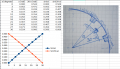
I will try to illustrate what I mean graphically for a hypothetical stepper with step angles of 30 degrees. Even for such large-ish steps the relations are almost linear.
However, I am apparently wrong. For example in the video below, at 22 minutes, someone shows non-smooth rotation for a linear PWM distribution. The stepper used is a 24BYJ48 which has 5.625 degree steps. Then he changes to sinusoidal distribution and rotation is smooth.
I assume the phase current is linearly proportional to the PWM duty cycle and is therefore not the source of my confusion.
So, what am I missing here?
When researching microstepping I see mention that the phase current waveform at one stator pole is a sine and at the next one it's a cosine. This would make sense to me if the step is exactly 90 degrees.
However, most steppers only step small angles and for small angles sin(a) ~ a. Here it would make more sense to me if the phase current wave forms were more like a linear ramp down at one pole and a linear ramp up at the next, to balance the forces at each rotor position.
I will try to illustrate what I mean graphically for a hypothetical stepper with step angles of 30 degrees. Even for such large-ish steps the relations are almost linear.
However, I am apparently wrong. For example in the video below, at 22 minutes, someone shows non-smooth rotation for a linear PWM distribution. The stepper used is a 24BYJ48 which has 5.625 degree steps. Then he changes to sinusoidal distribution and rotation is smooth.
I assume the phase current is linearly proportional to the PWM duty cycle and is therefore not the source of my confusion.
So, what am I missing here?