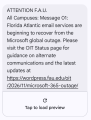
The guys at Microsoft definitely dropped the ball this time. This is going to have serious consequences, and make people start contemplating other options.
You know, back in my day, the Computer Science department hosted all of the University's own services on its own servers, managed by CS profs, grad students, and Information Systems work-study undergrads (I was one!).
How are the kids supposed to learn anything if MS is managing their IT?
You know, back in my day, the Computer Science department hosted all of the University's own services on its own servers, managed by CS profs, grad students, and Information Systems work-study undergrads (I was one!).
How are the kids supposed to learn anything if MS is managing their IT?
"Cash Register Syndrome" is not an official medical diagnosis, but it is an informal term used to describe two completely different experiences: physical repetitive strain injuries in retail workers and situational checkout anxiety in shoppers.
Depending on which side of the counter you are on, the term refers to one of the following issues.
1. Physical Strain in Cashiers (Repetitive Strain Injuries)
In occupational health, the phrase refers to the musculoskeletal disorders caused by scanning items, bagging groceries, and standing at a register for long shifts. Cashiers often scan 500 to 1,000 items per hour, placing heavy stress on the upper body. [1, 2]
Carpal Tunnel Syndrome. Repeatedly flicking the wrist to scan barcodes compresses the median nerve in the wrist. This leads to numbness, tingling, and weakness in the hands and fingers. [1, 2]
Neck, Shoulder, and Back Pain. Reaching awkwardly across wide counters or lifting heavy items like beverage packs strains the upper limbs and lower back. Studies show that roughly 70% of supermarket cashiers experience shoulder and neck pain. [1, 2, 3]
Lower Body Fatigue. Standing in a fixed spot for hours on hard floors causes swollen feet, leg pain, and lower back strain. [1, 2]
How to relieve cashier strain:
Adjust your posture. Keep your wrists in a neutral, straight position rather than bending them sharply while scanning or typing.
Use ergonomic tools. Stand on anti-fatigue floor mats, use a footrest or tall stool if permitted, and slide heavy items across the scanner rather than lifting them.
Take micro-breaks. Gently stretch your hands, wrists, and shoulders for a couple of minutes every hour to let your muscles recover. [1, 2, 3]
2. Checkout Anxiety in Shoppers
Among customers, "cash register syndrome" (or checkout anxiety) describes a sudden wave of panic, stress, or overwhelm while waiting in line or paying at the register. [1, 2]
Social and Time Pressure. People often feel rushed to pack their bags, count cash, or put their wallet away while a line of impatient shoppers waits behind them. One point of agreement among users on Reddit is that fears of card declines, insufficient funds, or being judged for the items in their cart frequently trigger this panic. [1, 2]
Self-Checkout Stress. Using self-checkout machines can heighten anxiety because shoppers worry about making accidental scanning mistakes under the watch of cameras and store attendants. [1]
Sensory Overload. Bright fluorescent lights, loud beeping scanners, and crowded checkout lanes can trigger physical symptoms like a racing heart, sweating, or dizziness. [1, 2]
How to manage checkout anxiety:
Prep your payment early. Have your debit card, mobile wallet, or exact cash ready in your hand before it is your turn to pay.
Shop during off-peak hours. Visiting stores early in the morning or late at night reduces crowd sizes and eliminates the pressure of long lines.
Take your time. Remember that you are allowed to take a few seconds to organize your receipt and wallet before stepping away from the counter. [1, 2, 3]
Are you experiencing physical wrist or back pain from working a register, or stress and anxiety while checking out as a customer? Let me know so I can share more tailored tips.
Who knows what is the Cash Register Syndrome or is this something that @WBahn made up?
I can only surmise that he is making reference to the situation where a bill adds up to $9.20 and you give the cashier a $10 note and a 25-cent coin which confuses the heck out of the cashier. The usual response is, "Sir, you gave me too much money!".
Who knows what is the Cash Register Syndrome or is this something that @WBahn made up?
I can only surmise that he is making reference to the situation where something adds up to $9.20 and you give the cashier a $10 bill and a 25-cent coin which confuses the heck out of the cashier. The usual response is, "Sir, you gave me too much money!".
Microsoft blames failed server health checks
On a status page, Microsoft said “we have no evidence of malicious activity associated with this incident” and promised to “share a full Post-Incident Report with root cause and defense-in-depth actions after mitigation is complete.”
“We’re aggressively pursuing all pathways to reduce impact,” Microsoft said on X.
But Microsoft’s public statements make clear that the tech giant was blindsided by the outage and struggled for hours to find mitigations that could reliably restore user access.
Shortly after detecting the outage, Microsoft confirmed that the main issue was “a portion of infrastructure” that “is experiencing elevated load across multiple regions.” This was not caused by increased traffic, Microsoft said, but “a problem that’s causing servers to fail automated health checks and become unavailable.”
Once it became clear that the failed health checks were to blame, Microsoft said it took steps to prevent additional server outages while validating alternate health check methods. But four hours later, the company admitted that it was still in the weeds.
This is akin to what a colleague of mine (who, in the 90s, was considered one of the nation's top 100 researchers in AI) told me about how self-driving cars would be programmed by just telling them to take the action that is, overall, in society's overall best interest.
I am very close to buying a Windows 11 machine to run stuff that demands it. But I honestly have no idea what to buy. I don't need a powerhouse, but I don't want a dog either. It's quite confusing.
I am very close to buying a Windows 11 machine to run stuff that demands it. But I honestly have no idea what to buy. I don't need a powerhouse, but I don't want a dog either. It's quite confusing.
It depends on what you are going to do with it and what level of performance is acceptable. I tend to opt for higher-end machines when I buy one because I only upgrade computers every ten to fifteen years. I've had my current machine for about five years and it's performance is still far beyond what I need. My prior laptop served me well for about 13 years, though is was definitely getting long in the tooth.
I am very close to buying a Windows 11 machine to run stuff that demands it. But I honestly have no idea what to buy. I don't need a powerhouse, but I don't want a dog either. It's quite confusing.
An Intel based/Nvidia graphics desktop PC system with reasonable processing speed that can be used for just about anything will cost $4K to $5K whether you build or buy. I recommend Intel Z890 CPU, RTX 5080 graphics for starters. This could be used for video rendering, Gaming, etc.

 Facebook
 Google
 GitHub
 Linkedin