Micro controlled shift box project

Reloadron

Joined Jan 15, 2015
7,889
just a minute... As per my diagram the arduino GND is being connected to auto GND so technically couldnt i just connect the diode from arduino GND to just before the relay control output. I mean wouldn't that have the same effect since they are connected anyway just from a much longer distance? Please correct me if I'm wrong. I again have no idea how shared grounds work.
That's the idea. :) That will work just fine. Q1 and Q3 can be any common switching transistor like a 2N3904 or a 2N2222 and the diodes anything like a 1N4002 as it's not critical. Tes. the diodes will just go outside the case at the solenoid inputs with the cathode (band side) at the solenoid inputs and the anodes to chassis ground.

The way we refer to ground is a "common" ground which just means the 12 volt and 5 volt grounds are a common ground. There is no need or reason to isolate the grounds from each other. Not for what you want.

Also, before I forget when you write your Arduino code for the buttons consider switch bounce on your buttons.

Ron
 

Thread Starter

Blinkyblinx9

Joined Dec 6, 2018
16
Got it. I know this is probably elementary stuff but for you to take your time to explain all of this as you probably have a dozen times before is just amazing. I am taking this project on because I had to pull out of my class early last season as a result of the learning curve of my current shifting solution and a track car requires the type of accelerator response you can only get from being at high RPM the entire time. Shift boxes with up down shifting, down shift protection, gear indicator, Paddle and lever shifting cost entirely too much and class entry is pretty steep for me by itself. At least I was refunded half of last season. I honestly cant thank you all enough.
 
Last edited:

Reloadron

Joined Jan 15, 2015
7,889
Got it. I know this is probably elementary stuff but for you to take your time to explain all of this as you probably have a dozen times before is just amazing. I am taking this project on because I had to pull out of my class early last season as a result of the learning curve of my current shifting solution and a track car requires the type of accelerator response you can only get from being at high RPM the entire time. Shift boxes with up down shifting, down shift protection, gear indicator, Paddle and lever shifting cost entirely too much and class entry is pretty steep for me by itself. At least I was refunded half of last season I honestly cant thank you all enough.
My pleasure for my contribution. This is a really good forum to pick things up. Me? Well some perspective the cars I built and engines I built were like 50s to mid 60s vintage. Been retired almost 6 years so the forums keep me thinking and being in NE Ohio it's getting cold out there so my shooting range (outdoors) is snow and ice covered. :) I try to keep things simple When you have questions just ask and if you don't understand an explanation then ask again.

Ron
 

Thread Starter

Blinkyblinx9

Joined Dec 6, 2018
16
I forgot you mentioned switch bounce. Typically I would just code in to ignore inputs for 5ms or so for push button switches if I had ever encountered that issue. I may have a bit of double click with these as they will likely be operated by a spring that ill push on so I'm not squeezing a paddle or slamming a lever into the switch itself. Is that what your referring to? Is their an easier way to cope with that sort of thing? Maybe use some sort of capacitance to smooth out button presses so I wont have to code around it?
 
Last edited:

Thread Starter

Blinkyblinx9

Joined Dec 6, 2018
16
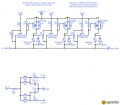
Hope posting in the same thread after so long isn't against the rules here. I just didn't see a point in making a new thread for a last opinion before I start ordering everything. I think the solenoid controller is good after looking over the datasheets of the parts you suggested. I have never tried negating switch bounce through capacitance and thought I would try my hand at if. I have gone over several examples and explanations on how to deal with it and this is what I have come up with.Blinkyblinx9.png
 

Reloadron

Joined Jan 15, 2015
7,889
I would just add a 10K resistor from each MOSFET gate to 12V. This will make sure when the MOSFET is off it is off. Beyond that it looks fine.

Ron
 

Reloadron

Joined Jan 15, 2015
7,889
My bad as I never caught R2, 5, and 8 but yes, I would make them 10 K . They will work as is but typically a 5 or 10 K resistor is used.

Ron
 

Thread Starter

Blinkyblinx9

Joined Dec 6, 2018
16
Thank you. I thought about how much current was needed to trigger them when I placed it there and I originally had 2.5k but felt it was a bit high. I guess my math was off a digit. The switches where a stab at best. It actually took a couple hours. The only info I could find anywhere was for pull down circuits I think its called.
 
Top