Measuring Low Input Bias Currents

Thread Starter

Doros

Joined Dec 17, 2013
144
Dear all hello,

I was trying to make a simple charge amplifier circuit, to measure electrostatic fields, but the output didn't remain stable due to capacitor charging from input bias currents.
The op amp used was a LMC 6041, with really low input current.

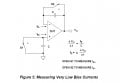
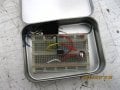
So I decided to measure it (the input bias current) with the circuit attached, on a breadbord. I used as a capacitor a polyester metalized film capacitor 100nF.
I do something wrong because in the beginning of the measurement, when I open the switch, the capacitor charges very fast for i.e. 4min. and then it charges slowly. That means that the ΔV/Δt, is not constant, and I cannot measure the input current of the op amp which must be very low

Any idea what I am doing wrong? Any idea how I can make a charge amplifier circuit with an output remaining stable?

Thank a lot for your help
 

Attachments

Hymie

Joined Mar 30, 2018
1,347
Looking at the data sheet for the LMC6041, on page 11 is noted the importance of the layout of the PCB (given the low bias currents of the device); I doubt these requirements are met on your bread-boarded circuit.

Perhaps a better method of measuring the input bias current would be to use the circuit shown at the foot of page 1 (of the data sheet), which is a variation of your figure 5 – and measure the op-amp output voltage change over time to determine the capacitor current.

You might need to use a capacitor value much less than 100nF, otherwise you will have a long wait to record a voltage change and your result may be affected by the capacitor parasitic parallel resistance causing the voltage drop (and not the op-amp bias drain current).
 

Attachments

Thread Starter

Doros

Joined Dec 17, 2013
144
Thank you both,

I will try to make connections not on a breadboard, but soldering the pins of the op amp in the air, and as a switch, for shorting/discharging the capacitor a wire.

It is not that I do not trust TI's data sheet. It is that I can not have stable outputs, (it is rising continuously), on a simple charge amplifier circuit, used for the measurement of static fields.

thanks a lot

doros
 

Attachments

Thread Starter

Doros

Joined Dec 17, 2013
144
Thank you danadak, I will go through them.

@Hymie , when you say capacitor parasitic parallel resistance, you do not mean esr, but what you mean? I ggogled it but I was confused

thanks for your input

doros
 

Hymie

Joined Mar 30, 2018
1,347
But resistor Rp is causing the capacitor to discharge with no external load; so the effect of this resistance may impact your calculation of the input bias current, if it is not at least an order of magnitude less that the bias current.
 
Two problems I see.

1. A real switch will generate a lot of charge initially.
2. You have to time it. I = coulombs/time; pico, nano or whatever.

I did use this technique with a Keithley Electrometer.

You have both a zero check and a zero correct button.
 

Thread Starter

Doros

Joined Dec 17, 2013
144
Hello KeepitSimple,

You are referring to the input bias current measurement?

You use the Keithley electrometer to measure input bias currents of op amps?

You mean the switch is mainly the problem?

I trust the datasheet of the LMC 6041, I know the input current is very very low, but the output voltage (mV) of my simple charge amplifier is not stable and it keeps rising, with or without any static field present.


thanks KeepItSimple
 
I set up a system that could do I-V-T measurements from -80 to 100C for semiconductors to basically determine carirer concentration and activation energy. Range was from a few pA to 10 mA and +-100 V. Dry Nitrogen purge was also available.

I did at one time had to assure that all of the resist was removed from a 100 um gap and used the coulombs mode for 30s to measure the currents.

I think when you took the electrometer out of zero check, there was a FLOOD of current. I can;t remember exactly what I did, but I needed to take the difference in charge for usually 30s.

I could measure the resistance of a piece of paper.
 
Top