Measuring high current (180A) indirectly with shunt resistor method

Thread Starter

jim0000

Joined Oct 28, 2020
130
A few more observations.
1) If you use the 10A current range on the meter, then the resistance is not 10MΩ - that would be silly because the voltage drop across the meter would be 100,000,000 Volts. Use the meter on the 200mV Voltage range, and measure the voltage across the shunt resistor. Multiply the mV by 10 to get the current in Amps.
2) The tolerance on a shunt will be no better than 1%, possibly 0.1% if you buy a really expensive one.
The current through the meter is 10^10 less than the current through the shunt. To all intents and purposes the meter resistance is infinite.
Okay thank you! I am not 100% sure how the fluke 117 works I guess. I was thinking since I won't be using the amp measurement setting then I wouldn't need to consider the 10A fused max of the meter? I just got the internal resistance from the spec sheet and I was thinking it has that internal resistance whenever the voltage setting is on. I could be completely wrong in my thinking, as i am not positive just how the fluke works.
 

Ian0

Joined Aug 7, 2020
13,158
Nice, this brings up something i have been curious about. Why are amplifiers used in current sensing?
because you only have a small voltage across the shunt, so you have to amplify it to get it to 3.3V for you MCU to measure it.
If you had a larger voltage across the shunt, the shunt would be very warm!
 

Thread Starter

jim0000

Joined Oct 28, 2020
130
because you only have a small voltage across the shunt, so you have to amplify it to get it to 3.3V for you MCU to measure it.
If you had a larger voltage across the shunt, the shunt would be very warm!
Oh nice I was actually wondering if my meter could measure that low.
 

Thread Starter

jim0000

Joined Oct 28, 2020
130
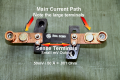
If you want to keep with the sense resistor, in order to have any accuracy be sure to use a '4 wire current sense resistor'. These devices contain two terminals that are designed to handle the main current and two smaller terminals that are used for the sensing. The manufacturer of such devices can keep the accuracy across the sensor element at much greater values.
Is this what you mean by four wire? View attachment 249820
 

Ian0

Joined Aug 7, 2020
13,158
Okay thank you! I am not 100% sure how the fluke 117 works I guess. I was thinking since I won't be using the amp measurement setting then I wouldn't need to consider the 10A fused max of the meter? I just got the internal resistance from the spec sheet and I was thinking it has that internal resistance whenever the voltage setting is on. I could be completely wrong in my thinking, as i am not positive just how the fluke works.
I have a Fluke 177, and I often use it to measure the voltage across a shunt on the mV range - it is more acccurate the my current clamp meter. The input impedance on all Voltage ranges is 10MΩ.
At a guess the impedance on the 10A range is about 10mΩ. I make a rule never to use it on the current ranges, and only ever have the leads in the Voltage inputs. That is so that I never accidentally try to measure the voltage of a 48V 1000AH battery with it on the current range.

if I want to measure a current, I use the clamp meter. If I want to measure it accurately, I use a shunt.
 

Ian0

Joined Aug 7, 2020
13,158
Yes, except it's a low voltage connection to the meter, not low current.
As noted, you measure the voltage across the shunt and use that, along with the shunt resistance, to calculate the current.
The current to the meter is assumed to be negligible. And 50mV/10MΩ is 5nA, which, compared to 180A, I think you’d agree is negligible.
 

dcbingaman

Joined Jun 30, 2021
1,065
Does anyone know what this accuracy statement means?

1633701684476.png

It looks like +/- 2.09%? I have a feeling that is wrong or they would have simply stated it that way?
 

dcbingaman

Joined Jun 30, 2021
1,065
I like the way the shunts are “calibrated” by a little saw-cut in one of the plates to increase its resistance slightly.
That reminds me of when I was serving in the Air Force. We needed to fine tune a resistance for calibration within a piece of equipment. We did not have the exact value. I was able to take a carbon film resistor of slightly lower resistance and with it connected to a high accuracy ohm meter I slowly cut a slit into it with an exacto knife, until the resistance needed was reached. I then covered the slit with epoxy to keep out corrosion.
 

crutschow

Joined Mar 14, 2008
38,538
The current to the meter is assumed to be negligible. And 50mV/10MΩ is 5nA, which, compared to 180A, I think you’d agree is negligible.
Of course.
Did I say something to imply otherwise?
My point was, that the current label implies you are measuring a low current from those terminals, but it is actually a low voltage.
 
Last edited:

Reloadron

Joined Jan 15, 2015
7,892
Does anyone know what this accuracy statement means?

View attachment 249826

It looks like +/- 2.09%? I have a feeling that is wrong or they would have simply stated it that way?
Here is what they are getting at. Digital multimeters or digital meters in general specify accuracy using for example : Accuracy Specifications ± (% of reading + % of range), That is what the above is getting at.

Example: Assume you want to measure a 10 Vdc signal with the 34401A on the 10 V range using the 1 year limits. The accuracy is:
0.0035 + 0.0005 = 10 x (0.0035 / 100) + 10 x (0.0005 / 100) = +/-0.00040
Thus:
The measured value: 10.00000
The accuracy: * +/-0.00040
The resolution: 0.00001
which can give an actual reading between: 9.9996 and 10.0004

The last two digits of the measured value include the error.

This assumes of course we apply an exact 10 volts. This is taken from here but in any DMM is how it plays out.

As to shunts here is another illustration.
50 Amp Shunt.png

Happens to be a 50 Amp 50 mV shunt. The precision resistance is between the sense path terminals resulting in a Voltage Out proportional to the current through the shunt. In this case 1.0 mV/Amp. While not a real big deal is the I*R drop across the shunt gets subtracted from the voltage across the load. Meaning if we have a 12 volt source voltage supplying 50 Amps the actual load voltage will be 12.000 - 0.050 = 11.950 Volts which while likely insignificant is how it plays out.

Ron
 

dcbingaman

Joined Jun 30, 2021
1,065
Here is what they are getting at. Digital multimeters or digital meters in general specify accuracy using for example : Accuracy Specifications ± (% of reading + % of range), That is what the above is getting at.

Example: Assume you want to measure a 10 Vdc signal with the 34401A on the 10 V range using the 1 year limits. The accuracy is:
0.0035 + 0.0005 = 10 x (0.0035 / 100) + 10 x (0.0005 / 100) = +/-0.00040
Thus:
The measured value: 10.00000
The accuracy: * +/-0.00040
The resolution: 0.00001
which can give an actual reading between: 9.9996 and 10.0004

The last two digits of the measured value include the error.

This assumes of course we apply an exact 10 volts. This is taken from here but in any DMM is how it plays out.

As to shunts here is another illustration.
View attachment 249836

Happens to be a 50 Amp 50 mV shunt. The precision resistance is between the sense path terminals resulting in a Voltage Out proportional to the current through the shunt. In this case 1.0 mV/Amp. While not a real big deal is the I*R drop across the shunt gets subtracted from the voltage across the load. Meaning if we have a 12 volt source voltage supplying 50 Amps the actual load voltage will be 12.000 - 0.050 = 11.950 Volts which while likely insignificant is how it plays out.

Ron
In the case of the Fluke 77
Here is what they are getting at. Digital multimeters or digital meters in general specify accuracy using for example : Accuracy Specifications ± (% of reading + % of range), That is what the above is getting at.

Example: Assume you want to measure a 10 Vdc signal with the 34401A on the 10 V range using the 1 year limits. The accuracy is:
0.0035 + 0.0005 = 10 x (0.0035 / 100) + 10 x (0.0005 / 100) = +/-0.00040
Thus:
The measured value: 10.00000
The accuracy: * +/-0.00040
The resolution: 0.00001
which can give an actual reading between: 9.9996 and 10.0004

The last two digits of the measured value include the error.

This assumes of course we apply an exact 10 volts. This is taken from here but in any DMM is how it plays out.

As to shunts here is another illustration.
View attachment 249836

Happens to be a 50 Amp 50 mV shunt. The precision resistance is between the sense path terminals resulting in a Voltage Out proportional to the current through the shunt. In this case 1.0 mV/Amp. While not a real big deal is the I*R drop across the shunt gets subtracted from the voltage across the load. Meaning if we have a 12 volt source voltage supplying 50 Amps the actual load voltage will be 12.000 - 0.050 = 11.950 Volts which while likely insignificant is how it plays out.

Ron
In the case of the Fluke 177 it appears to be percent of existing range plus x number of 'counts':

https://edadocs.software.keysight.c...o-i-use-it-to-compute-accuracy-588264098.html

According to the manual the 177 has 6000 count range and would with 0.1mV resolution have lowest range of 0 to 0.5999V. So this would be on the 0.6V range, the accuracy then would be:
0.6*0.09/100+0.1mV*2 counts = +/-0.74mV for the Fluke 177 on lowest voltage range.

That leads to a current error of +/-0.74mV/0.1mOhm or +/-7.4 Amps!

Assuming I understood the reference properly, that means using a 0.1mOhm shunt for measure 0-180 Amps would lead to an uncertainty in the measurement of +/-7.4 Amps. That being the case, I can see why it is reasonable to use a shunt that has a pre-amplifier built in.

Please correct me if I got the math wrong.
 

Reloadron

Joined Jan 15, 2015
7,892
The Fluke 177 specs things a little different. Rather than ± (% of reading + % of range) as in the example I used for an Agilent meter Fluke uses for the Model 177 ± ( [ % of Reading ] + [ Counts ] ) so a Fluke 177 is as you mentioned a 6,000 count meter and yes, it's % Rdg plus counts. The DC Voltage ranges are 600 mV, 6 V, 60 V, 600 V and 1,000 volts. The shunt mentioned back in post #1 is a 500 Amp / 50 mV shunt. So the Vout of the shunt, discounting any shunt allowable error is 0.1 mV/Amp and a 180 Amp load will only yield 18 mV out from the shunt. The lowest DC range on the Fluke 177 is only 600 mV with a resolution of 0.1 mV. So yes, using your numbers since the lowest range is really 599.9 mV or 0.5999 Volt I see what you see. We have an allowable error of +/- 7.4 Amps. This does not even take into account any allowable error of the shunt. A really good DC current shunt, using a Simpson Current Shunt as an example A 500 Amp 50 mV shunt is a 1% uncertainty with 5 foot leads provided. So now we need to algebraically add all the errors in the measuring plane. Most shunts are made from manganin, an alloy that is 84% copper, 12% magnesium and 4% nickel. This material has an extremely low temperature coefficient of resistance, only 0.0015%/degC (15ppm/°C). For comparison, the TC of copper is 0.4%/°C. Shunts are specified for a 50mV, 75mV or 100mV drop at full-scale current. Years ago I worked with some Precision L&N (Leeds & Northrup) 4360 Series shunts. Those were 0.04% and high end lab shunts.

With shunts you frequently want a high gain DC amplifier (Low Noise) and a very good low range DC voltmeter to get accurate measurements.

Ron
 

dcbingaman

Joined Jun 30, 2021
1,065
The Fluke 177 specs things a little different. Rather than ± (% of reading + % of range) as in the example I used for an Agilent meter Fluke uses for the Model 177 ± ( [ % of Reading ] + [ Counts ] ) so a Fluke 177 is as you mentioned a 6,000 count meter and yes, it's % Rdg plus counts. The DC Voltage ranges are 600 mV, 6 V, 60 V, 600 V and 1,000 volts. The shunt mentioned back in post #1 is a 500 Amp / 50 mV shunt. So the Vout of the shunt, discounting any shunt allowable error is 0.1 mV/Amp and a 180 Amp load will only yield 18 mV out from the shunt. The lowest DC range on the Fluke 177 is only 600 mV with a resolution of 0.1 mV. So yes, using your numbers since the lowest range is really 599.9 mV or 0.5999 Volt I see what you see. We have an allowable error of +/- 7.4 Amps. This does not even take into account any allowable error of the shunt. A really good DC current shunt, using a Simpson Current Shunt as an example A 500 Amp 50 mV shunt is a 1% uncertainty with 5 foot leads provided. So now we need to algebraically add all the errors in the measuring plane. Most shunts are made from manganin, an alloy that is 84% copper, 12% magnesium and 4% nickel. This material has an extremely low temperature coefficient of resistance, only 0.0015%/degC (15ppm/°C). For comparison, the TC of copper is 0.4%/°C. Shunts are specified for a 50mV, 75mV or 100mV drop at full-scale current. Years ago I worked with some Precision L&N (Leeds & Northrup) 4360 Series shunts. Those were 0.04% and high end lab shunts.

With shunts you frequently want a high gain DC amplifier (Low Noise) and a very good low range DC voltmeter to get accurate measurements.

Ron
Thanks for the info on manganin, very informative. It is amazing how an alloy that is only 12% magnesium and 4% nickel and 84% copper can create a T coefficient that is .04/.0015 or 26 times better than simply copper. Alloys continue to amaze me.
 

Reloadron

Joined Jan 15, 2015
7,892
Yes, pretty cool (literally) what goes into a quality shunt. Years ago we used them extensively at my work but as newer and better current measuring devices came out the shunts slowly went by the wayside. When using them in designs I just about always used signal conditioning to get from what I had to what I wanted. Hopefully things will work out for the thread starter. :) Heck I still have a pile of shunts. :)

Ron
 
Top