Mcdonald’s ecoli infections

Thread Starter

killivolt

Joined Jan 10, 2010
836
https://www.nbcnews.com/health/heal...-cause-mcdonalds-e-coli-infections-rcna177777

Other restaurant chains in Colorado, including Taco Bell, Burger King, KFC, Pizza Hut and Illegal Pete’s, removed onions from their menus out of an abundance of caution. There are no signs of people getting E. coli after eating at those restaurants.
The restaurant chain said it stopped sourcing onions from the company indefinitely on Friday. It’ll start selling the Quarter Pounder without onions in affected stores this week
kv
 

Reloadron

Joined Jan 15, 2015
7,886
Yeah, and when it broke I had just eaten two quarter pounders w/ cheese. Driving from Cleveland, Ohio to Winston Salem North Carolina. I think I may have eaten them in W. VA. or maybe VA. Nothing bad happened and it was over a week ago. :)

Ron
 

MrChips

Joined Oct 2, 2009
34,807
Yeah, and when it broke I had just eaten two quarter pounders w/ cheese. Driving from Cleveland, Ohio to Winston Salem North Carolina. I think I may have eaten them in W. VA. or maybe VA. Nothing bad happened and it was over a week ago. :)

Ron
Looks like you dodged the bullet.
 

WBahn

Joined Mar 31, 2012
32,823
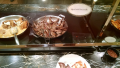
I miss the places like Roy Rodgers, where you could make your own burger.
View attachment 334819View attachment 334820
More and more places are getting rid of customer self-serve things like this and I wouldn't be surprised if, at some point in the relatively near future, they are outlawed.

Think of the potential here for both accidental and intentional contamination. Accidental contamination is a well-known risk (there's a reason they always have sneeze guards) and a common source of food poisoning, but accidental events tend to be extremely localized and difficult to track down because the number of people affected is tiny, most of whom just get sick and recover without ever reporting anything. I've seen estimates that about 3000 to 5000 people in the U.S. die from food-borne illnesses each year and that a significant fraction of these are from restaurants and hotels (continental breakfast, anyone), as opposed to meals prepared at home. That works out to about, on a very crude average, about one a week in any given state. It's completely lost in the noise and doesn't register except when it happens on a noticeable scale. Heck, as far as I'm aware, the McDonald's incident resulted in one death over about a week time frame. During that same time, there were probably more than fifty other people that died from food poisoning at other restaurants, but we never heard about them because they happened in ones and twos, here and there.

But imagine what just a small number of people could do if each one took a small, easily concealed spray bottle loaded with a contagion and took a cross country trip from coast to coast and all they did was go into places that had some kind of food bar and bought a one-trip salad at a time of day when there are few people there and then they walk up and deliver a couple of squirts onto the food and leave (taking their purchase to go, if needed, to avoid raising suspicion). How many places could a single person visit over the course of a day if that was their sole mission? How many people would it take to cause infections in all 48 states over a period of a week or two? How hard would it be to put enough contagion into that bottle such that there would likely be multiple deaths from each application? If one death and a few dozen illnesses from one chain gets huge media attention, how much more attention and panic would result from hundreds or even thousands of deaths all over the country. Worse, imagine a slow-roll approach, where you go only into a particular chain and spray one thing (say the onions). Now you have an incident that looks just like the McDonald's event and the response will, quite naturally and reasonably, focus on the supplies of onions to that chain. A week later, you attack a single food at another chain, maybe onions again, or maybe tomatoes. How long could you keep the media and the food safety folks chasing their tails and whipping up the hysteria before people start realizing that this has to be a methodical attack on the nation's food supply?

The next question I always come with at this point is... why hasn't it already happened?
 

joeyd999

Joined Jun 6, 2011
6,279
More and more places are getting rid of customer self-serve things like this and I wouldn't be surprised if, at some point in the relatively near future, they are outlawed.

Think of the potential here for both accidental and intentional contamination. Accidental contamination is a well-known risk (there's a reason they always have sneeze guards) and a common source of food poisoning, but accidental events tend to be extremely localized and difficult to track down because the number of people affected is tiny, most of whom just get sick and recover without ever reporting anything. I've seen estimates that about 3000 to 5000 people in the U.S. die from food-borne illnesses each year and that a significant fraction of these are from restaurants and hotels (continental breakfast, anyone), as opposed to meals prepared at home. That works out to about, on a very crude average, about one a week in any given state. It's completely lost in the noise and doesn't register except when it happens on a noticeable scale. Heck, as far as I'm aware, the McDonald's incident resulted in one death over about a week time frame. During that same time, there were probably more than fifty other people that died from food poisoning at other restaurants, but we never heard about them because they happened in ones and twos, here and there.

But imagine what just a small number of people could do if each one took a small, easily concealed spray bottle loaded with a contagion and took a cross country trip from coast to coast and all they did was go into places that had some kind of food bar and bought a one-trip salad at a time of day when there are few people there and then they walk up and deliver a couple of squirts onto the food and leave (taking their purchase to go, if needed, to avoid raising suspicion). How many places could a single person visit over the course of a day if that was their sole mission? How many people would it take to cause infections in all 48 states over a period of a week or two? How hard would it be to put enough contagion into that bottle such that there would likely be multiple deaths from each application? If one death and a few dozen illnesses from one chain gets huge media attention, how much more attention and panic would result from hundreds or even thousands of deaths all over the country. Worse, imagine a slow-roll approach, where you go only into a particular chain and spray one thing (say the onions). Now you have an incident that looks just like the McDonald's event and the response will, quite naturally and reasonably, focus on the supplies of onions to that chain. A week later, you attack a single food at another chain, maybe onions again, or maybe tomatoes. How long could you keep the media and the food safety folks chasing their tails and whipping up the hysteria before people start realizing that this has to be a methodical attack on the nation's food supply?

The next question I always come with at this point is... why hasn't it already happened?
I don't think I've ever eaten at a Golden Corral without getting sick afterward.

But I blame it on the food.
 

WBahn

Joined Mar 31, 2012
32,823
I don't think I've ever eaten at a Golden Corral without getting sick afterward.

But I blame it on the food.
I haven't eaten there for over twenty years. We had at least three here in the Springs. Two were so-so, but one was really, really good. Unfortunately, the good one was one of the ones that closed, leaving just one that I know of (and to which I've never been). My first job was in a buffet restaurant and so I got to see firsthand what it took to do it right, including getting quality ingredients, storing them properly, good food prep and cooking, and an emphasis on proper cleaning of just about everything in the building. I also saw the results when it wasn't done right at another restaurant I worked some time later and how that had a direct impact on the quality of the food that was served.
 

Reloadron

Joined Jan 15, 2015
7,886
To add a little to my previous post. I stopped at the McDonalds at about 11:05 AM on a Tuesday. I wrongly assumed breakfast items till 11:30 AM. Yes, 11:30 AM on weekends so here I am at the drive through when a nice girl informs me of those hours. I wanted two bacon, egg and cheese bagels which wasn't going to happen so pressured I blurted out two quarter pounders with cheese. Then, that evening came the breaking news story. Fortunately nothing happened. :)

Ron
 

nsaspook

Joined Aug 27, 2009
16,320
https://www.ewg.org/news-insights/n...contaminate-onions-dangerous-pathogens-e-coli
The Centers for Disease Control and Prevention and the Food and Drug Administration report that onions are the likely source of the McDonald’s E. coli outbreak that killed one person and sickened dozens more.
...
Factory farms can increase the likelihood of E. coli and other pathogens contaminating onions, and many other vegetables and fruits. That’s because dangerous bacteria, like E. coli, salmonella and giardia, commonly found in animal manure, can wash or drift with dust into irrigation waterways whose water is then sprayed on food crops such as onions.

Following the E. coli incident, EWG identified California onion fields near livestock facilities. In 2022, over 68,000 acres in California were planted with onions. Of those, 4,000 acres are within one mile of a factory farm, known as a concentrated animal feeding operation, or CAFO. The map below shows the proximity of some of these fields in the Imperial Valley.
Humans can become immune to E. coli and I suspect I have a high resistance due to shoveling cow pies for fertilizer on the farm.
1730421562534.png
 
Last edited:
Top