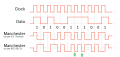
Manchester encoding is also known as phase-encoded.
The direction of the transition tells you if the data is 0 or 1.
Take a look at the bottom trace.
A rising edge identifies a 1.
A falling edge identifies a 0.
After that, you have to ignore any transitions that occur before a half bit width has expired, i.e. ignore the transitions you have indicated with the green arrows.
So referring to the image below, if I am at the receiving end, how can I tell the data is 1 1 1, but not 10101?? How can I tell how much time is one bit?
PS: Assuming the receiver don't know how many bit the transceiver are sending.
Yes, you need to send a synchronizing byte. Any byte that begins with 10xxxxxx will do.
If you send 10101010, the receiver can figure out the bit width.
Yes, you need to send a synchronizing byte. Any byte that begins with 10xxxxxx will do.
If you send 10101010, the receiver can figure out the bit width.

 Facebook
 Google
 GitHub
 Linkedin