LTC2912-1

Thread Starter

absdoso

Joined Mar 26, 2025
13
Hello everyone,
I am currently studying how to use the LTC2912-1 (specifically the LTC2912ITS8) to monitor a voltage (Vmon) that fluctuates between 0–3.3V.
My goal is to detect when the voltage exceeds 3V, at which point the OV (Overvoltage) output should go active, and when the voltage drops below 2.92V, the OV output should return to its normal state.
I’ve read the datasheet but I don’t quite understand how to wire it properly — or maybe this voltage monitor isn’t the right choice for my needs..
Has anyone here worked with the LTC2912-1 and could help me?
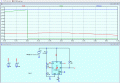
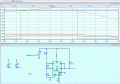
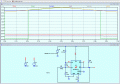
Below is my LTspice simulation file where I tried to simulate, but the circuit doesn't behave the way I expected.
 

Attachments

Thread Starter

absdoso

Joined Mar 26, 2025
13
Hello Eric,
That 51kΩ resistor is actually connected to the monitored input voltage (Vmon). The 51kΩ and 10kΩ form a voltage divider, which I'm using to scale Vmon down to a level suitable for the internal threshold of the LTC2912 (specifically the VH pin).
As I understand it, the OV (overvoltage) output is triggered when the internal VH threshold is exceeded. This threshold is approximately 0.492 × Vcc ≈ 1.62V (for Vcc = 3.3V).
Using the voltage divider:
1.62V = Vcc*Vhexternal=Vcc*Vmon*10/61=3V*10/61*3.3V=1.623V
So the divider is sized to ensure the trigger point aligns with a 3.0V threshold at the monitored input..
 

ericgibbs

Joined Jan 29, 2010
21,439
hi abs,
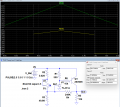
This simplified version shows the >3.0V requirement action.
I would use the PWL voltage source to check the operation
.
E

Note: the Vmax and Vmin voltage sources are only to make the plot easier to read....:)
EG57_ 2802.gif
 

Attachments

Thread Starter

absdoso

Joined Mar 26, 2025
13
Hi Eric,
Thank you for the suggestion!
However, I’m a bit unclear about the role of R2 connected to VL. Could you please explain its purpose?
Also, I noticed that UV is connected to OV instead of to GND—could you help me understand why that is?
Thanks again!
 

ericgibbs

Joined Jan 29, 2010
21,439
hi abs,
R2 is feedback that adjusts the VL senses voltage, for 2.9V, when UV =Hi
In your first post you said that 2.9V was the low voltage detect level, so UV is set to suit that 2.9V.

So VH +> 3.0V and VL= <= 2.9V a 0.1V difference.
E
 

crutschow

Joined Mar 14, 2008
38,503
For your amusement/interest, below is the LTspice sim of a simple voltage detect circuit that uses common, inexpensive parts (a TL431 programmable voltage reference and a PNP BJT) in place of the more expensive LTC2912.

Its output goes high when the voltage exceeds 2.5V at the TL431 Ref pin.
That gives >3V to go high and <2.92v to go low for the given resistor values.

Pot U2 adjusts the trip point and the value of R4 determines the difference (hysteresis) between the two voltages (here 88mV).

1744080117089.png
 
Last edited:

Thread Starter

absdoso

Joined Mar 26, 2025
13
hi abs,
R2 is feedback that adjusts the VL senses voltage, for 2.9V, when UV =Hi
In your first post you said that 2.9V was the low voltage detect level, so UV is set to suit that 2.9V.

So VH +> 3.0V and VL= <= 2.9V a 0.1V difference.
E
thank you for the explanation!
 

Thread Starter

absdoso

Joined Mar 26, 2025
13
For your amusement/interest, below is the LTspice sim of a simple voltage detect circuit that uses common, inexpensive parts (a TL431 programmable voltage reference and a PNP BJT) in place of the more expensive LTC2912.

Its output goes high when the voltage exceeds 2.5V at the TL431 Ref pin.
That gives >3V to go high and <2.92v to go low for the given resistor values.

Pot U2 adjusts the trip point and the value of R4 determines the difference (hysteresis) between the two voltages (here 88mV).

View attachment 346398
Thanks for the suggestion! I wish I had looked into this method before buying the LTC
 
Top