Low performance of my stepper motor

Thread Starter

crazybuoy

Joined Sep 19, 2010
77
I have taken a unipolar stepper motor (5-4 ohm winding resistance) from photocopier. I have L297 + 4 Mosfets (IRFZ44N) + 8 diodes to drive this motor. I use ATX as power supply and Mach3 as software. The performance is as follows:

At 3.3v, motor turns, motor and mosfets don't turn hot, but but there is very low speed (3 inch/minute according to pitch of lead screw).
At 5v, motor turns, motor and mosfets turn hot slowly, but but there is still very low speed (5 inch/minute).
At 12v, motor turns, motor and mosfets turn hot very fast, but but speed is still not better (8 inch/minute).

I THINK, 3.3V is BETTER TO USE FOR THIS MOTOR because any part don't turn hot too much.

I want to increase the speed (1 foot/6 sec). Do I need to increase the Amp using another power supply. Or do I need to make any change in driver?
 
Last edited:

Externet

Joined Nov 29, 2005
2,630
Perhaps you should also have taken with a hack saw the photocopier PCB section containing the entire stepper driver circuitry and provide the same power supply as the photocopier has.

I usually do that instead of removing a component, or an IC/motor/whatever to re-purpose. Take the whole thing section and re-purpose its wholeness; gives you already engineered, built! matching parts and tested/proven to work to its capabilities.
 

MaxHeadRoom

Joined Jul 18, 2013
30,654
The important part of feeding a stepper motor is the plate current should never be exceeded, in order to maintain this current when the inductive reactance increases with speed is to increase the P.S. voltage and the drive should ensure the mean current does not exceed the rated current, otherwise the stepper can burn out.
Max.
 

shortbus

Joined Sep 30, 2009
10,050
Your still struggling with this? You need to go back and learn more about how stepper motors work. As I've told you many times your trying to do this with chips that are so outdated and have been improved so many times. If you would just listen to the many people who have given you the same advice on your project you would have it working, not asking the same questions again. Myself I'd rather get my project working instead of trying to make obsolete ideas work.
https://www.aliexpress.com/cheap/cheap-stepper-motor-driver.html
 

Reloadron

Joined Jan 15, 2015
7,887
I want to increase the speed (1 foot/6 sec). Do I need to increase the Amp using another power supply. Or do I need to make any change in driver?
What you need to do is understand how a stepper motor works and then you would maybe understand why the answer to your question is no. There is a reason it is known as a "stepper motor". One foot six seconds says absolutely nothing. Stepper motor? Steps? Really you need to start with the basics of a stepper motor.

Ron
 

MrAl

Joined Jun 17, 2014
13,702
I have taken a unipolar stepper motor (5-4 ohm winding resistance) from photocopier. I have L297 + 4 Mosfets (IRFZ44N) + 8 diodes to drive this motor. I use ATX as power supply and Mach3 as software. The performance is as follows:

At 3.3v, motor turns, motor and mosfets don't turn hot, but but there is very low speed (3 inch/minute according to pitch of lead screw).
At 5v, motor turns, motor and mosfets turn hot slowly, but but there is still very low speed (5 inch/minute).
At 12v, motor turns, motor and mosfets turn hot very fast, but but speed is still not better (8 inch/minute).

I THINK, 3.3V is BETTER TO USE FOR THIS MOTOR because any part don't turn hot too much.

I want to increase the speed (1 foot/6 sec). Do I need to increase the Amp using another power supply. Or do I need to make any change in driver?
Hi,

Show your circuit so we can see exactly what you have. Some of this stuff has to be connected properly and there is no general purpose hook up for every single stepper. Yours is unipolar too which means you may not have it connected properly to begin with.

Another issue i see is that you state that you have the L297, but then four mosfets. Again, a schematic would show us what is really wrong, every detail, but in the mean time it sounds like you need a little more circuitry in order to get optimum response out of your motor regardless what kind it is. To get optimum performance with a stepper you dont just drive it with a voltage pulse of some kind, in fact, you use more of a current control scheme. That's so you can get the optimum 'step' without wasting time in between steps. I'll wait for your schematic though and check that out and see if you have the required circuitry or not.
 

shortbus

Joined Sep 30, 2009
10,050
He's been trying to do this for ~1year. On both AAC and ETO. He's using a fine thread lead screw and wants to do it with full slow steps. Lead screw made of all thread. Every one has told him different real step drivers to use but insists on his way. For some type of CNC machine. At one time he was going to write his own software to run it too.
 

Thread Starter

crazybuoy

Joined Sep 19, 2010
77
I'll wait for your schematic though and check that out and see if you have the required circuitry or not.
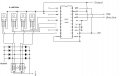
I wired all parts 100% same as shown in attached schematic. I have tried to apply 3.3, 5 & 12v as described in my first post.

He's been trying to do this for ~1year.
Your memory is really awesome and I did it like start-stop, then again start-stop with hope and different approach. Actually, Im not much good in electronics. I will try to read SECTION 2: SPEED-TORQUE CURVE BASICS better. I hope I will get the point.

Last time, you and other members have said me to order ready-made drivers from web. Yes, of course, it is easy to order and I will if I could not do DIY, but I want to understand and do DIY.

I am really thankful to your and other members here and please don't laugh at my poor electronics knowledge.
 

Attachments

Last edited:

bertus

Joined Apr 5, 2008
22,921
Hello,

It looks like the gate threshold of your fets is to high.
Then the fets are still in linear mode and will dissipate much more as expected.
Better look for some logic gate mosfets like the IRL510, IRL520.

Bertus
 

MaxHeadRoom

Joined Jul 18, 2013
30,654
As a point of historical interest, the way the constant current issue was handled a few decades ago was to simply use a series resistor, the value of which restricted the current with the stepper at rest to the plate current based on the higher applied voltage.
As the motor rpm increased and the inductive reactance increased the voltage across the motor increased and attempted to keep the current constant.
Max.
 

MrAl

Joined Jun 17, 2014
13,702
I wired all parts 100% same as shown in attached schematic. I have tried to apply 3.3, 5 & 12v as described in my first post.


Your memory is really awesome and I did it like start-stop, then again start-stop with hope and different approach. Actually, Im not much good in electronics. I will try to read SECTION 2: SPEED-TORQUE CURVE BASICS better. I hope I will get the point.

Last time, you and other members have said me to order ready-made drivers from web. Yes, of course, it is easy to order and I will if I could not do DIY, but I want to understand and do DIY.

I am really thankful to your and other members here and please don't laugh at my poor electronics knowledge.

Hi,

Unfortunately both issues i pointed out in post #7 appear to be true based on your schematic. This why a schematic is so important. This kind of thing is typical though and you'll find the same errors in circuits on the web.

The main problem is the placement of the 8 diodes, in particular the top 4 diodes. With a bipolar motor the 8 diodes are required and are sometimes even built right into the driver chip, but with a unipolar motor you can not connect the upper 4 diodes. This is because the windings act like center tapped transformers, where with the center tap connected to +Vcc and you drive one winding low, the other winding end must be allowed to go as high as 2*Vcc, which in the case of a 12v power supply for Vcc, means the collectors of the transistors MUST be allowed to go all the way up to +24v without any clamping action like you see from a diode to +Vcc. the diode tries to clamp +24v to +12v and that means a ton of current flow. If you are lucky, the leakage inductance limits this current, but it's not going work very well because the current level most likely goes too high.

So the first solution is to remove the upper 4 diodes, the ones that connect to +12v, but do not remove the lower 4 diodes as they help to keep the OTHER winding clamped at +24v through the mutual inductance of the two windings. You should then also check the windings for a voltage that does shoot up too high which would be due to leakage inductance, and then apply a zener if needed or a snubber of some kind.

The other issue is you need to find a way to use the sense inputs of the L297 chip. They are there to help get optimum step performance from the motor. We can talk about that more later.

Removing those four upper diodes may do the trick though, depending on your real needs here.

Max: Yes the sense inputs are used for that but he has them grounded. That has to be changed too, but because of the more severe problem with the diodes he may get good enough performance without any current sense...it all depends how good he needs it to be.
 

shortbus

Joined Sep 30, 2009
10,050
Last time, you and other members have said me to order ready-made drivers from web. Yes, of course, it is easy to order and I will if I could not do DIY, but I want to understand and do DIY.

I am really thankful to your and other members here and please don't laugh at my poor electronics knowledge.
I'm not trying to discourage you in this, I'm trying to give you the benefit of my problems during my time in trying to do exactly what your doing. I thought "this should be easy, I can save a little money and use the same chip your using". But after many failed attempts, like you, I saw the light. When I first started out the stepper driver modules were in the $100 or more range, and for just a hobby I couldn't justify that much money. But now the same type of module that was so expensive then is under $20 and many time even less. They work so much better than the chip your trying to use, and you just hook up a few wires and get on with the rest of your machine.

Another thing is when it comes to programing the actual part you want to make, the chip and homemade driver will have a much harder time doing the actual cutting. We all have to start somewhere on this journey into electronics, so it makes sense to me at least, to take advice from those that went before us. Your end goal seems to be a CNC machine, so take advantage of the established electronics and get on to the goal.
 
Top