Was it bowed (i.e., long edges were curved) , or was the center 2/3 or so straight? Were the ends narrower or the correct width compared to the center?
Finally, was the corrected one the same size as the bowed one? ( I am wondering about the evenness of illumination.)
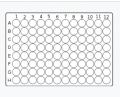
They are widely used for lots of high volume chemistry and microbiological testing. With anaerobic bacteria, antimicrobial susceptibility testing in the edge wells was always suspect. After awhile, we just accepted it and didn't use those wells. Or, planted the same organism in duplicate somewhere else.
I hope we learn what the cause of the problem was, but at least you have a solution. Thanks for sharing.
What I normally do when a part's been printed is I immediately detach it from the platform, and dip it in a container filled with isopropyl alcohol. I shake it for a few seconds and then I fish it out and thoroughly rinse it under running water.
I've been doing this because I read online that's what most people do with their freshly printed parts. But the thing is that all of those parts come out with a dull and opaque surface finish.
So this morning, for a change, I dipped the part in IA as I usually do, but after fishing it out I did not rinse it under running water. I figured, why rinse it since IA evaporates real quickly? And it's been quite sunny outside this last few days. So I just shook the part a bit to get rid of the excess IA, and took the part outside where I left it sunbathing for a few hours. I have a couple of UV lights that I could've used to "post-bake" the part for a time, as I usually do. But I feel that direct sunlight is even better... please correct me if I'm wrong, John.
Anyway.... lo and behold! ... the part had a nice-looking shiny and polished surface finish after it completely dried! ... what's with the water and turning it opaque? ... also, I've noticed that IA with a little resin in it has a nice, transparent blue hue, but when a few drops of water are added it turns milky and opaque.... what's with that?
You IPA is only diluting residual resin, not completely removing it. So, when you dipped in water, residual resin precipitated in the water to leave a cloudy residue.
If you have ever painted with lacquer or any automotive paint with a fast evaporating reducer (e.r., acrylic enamals), you get the same effect when it is hot and humid. The humidity condenses in the liquid paint and causes it to turn cloudy. It's called blushing. It never goes away. Auto finishers use a slower evaporating reducer. But their problem is condensation of water, not a water rinse.
Possible solutions:
1) You found a good one. Avoid the water rinse unless the item is absolutely free of resin..
2) Multiple rinses with IPA.
3) Add a co-solvent, such as a cellosolve (ether alcohols like ethoxyethanol or butoxyethanol, See: https://en.wikipedia.org/wiki/Glycol_ethers ) to your final rinse. That will help prevent water from precipitating the resin.
4) Consider switching to aqueous resins. (I have only read about them. No experience.)
I don't see the value of the final water rinse. I would try #3 only if a water rinse was necessary or you had problems with condensation of humidity.
The parts that I never rinsed in water took ages to cure... I'm talking in the order of days!... and when they did, they remained soft and flexible. As soon as I rinsed them thorough under running water, in less than an hour they became far more rigid and strong... what's with that?
My favorite resin, which is hard and tough and abs-like, turned out to be extremely hydrophilic. That is, when submerged in water for more than a few hours, it not only absorbs a very noticeable amount of water, but it also swells a bit and its texture and hardness turns rubber-like. As soon as the part is taken out of the water and is allowed to dry, it goes back to its usual hard and rigid state.
I made that test using newly printed parts, and also parts that were almost a year old. And the result was exactly the same.
I now have renewed appreciation for my old filament printer, which can print parts using real ABS. From what I found online, ABS has only a 1% water absorption index. Which I'm sure is far less than the resin I've been using.
If not already mentioned, Make magazine has an issue every year (I think) that compares 3D printers. Subscribe, or your local library may carry it...mine does.
I believe that the best engineering plastic for printing is ABS. Especially for my personal purposes. But it's a plastic that is not easy to tame, and lots of things must be considered when working with it.
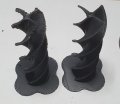
I've just discovered that a small variation in temperature can make the difference between a useful part and a piece of junk. Case in point: the part on the left was printed at 230°C, whilst the part on the right at 260°C.
Another thing that proved to be a headache was finding the proper plate temperature. The sweet spot that provides good adhesion but not too strong, and that also works best for a good first raft layer, turned out to be 80°C
I printed with ABS for the first time this past summer. It took me a few trials and errors to get it right.
The biggest problem is adhesion and warping.
Here are things I did to get it right:
1) Use Kapton film on the bed
2) Turn off the fan at the print head
3) Squish the first layer
4) Reduce the print speed on the first layer
5) Check your settings:
Print head: 230°C
Bed: 80°C
Speed: 100
Fan: 0 (off)
6) Print with brim
7) Allow part to cool down on the bed
I have never 3D printed. But I have machined a variety of plastics. For me, the easiest is Delrin. It is not chemically welded as ABS is, but it machines beautifully, is stable, and can be heat or ultrasonically welded. Apparently it is available as a filament for printing (https://all3dp.com/2/delrin-3d-printing-filament/). That was just my first hit. There surely are others.
Not in the lathe. Unless you grind the tool different than what is used for most other materials. It makes a chip that wraps around the part and you have to stop and cut it off.
Not in the lathe. Unless you grind the tool different than what is used for most other materials. It makes a chip that wraps around the part and you have to stop and cut it off.
I have had no problem with using a lathe to work it. My cutters are carbide, and for external turning, they have a chip breaker groove around the perimeter. Yes, it does produce a long chip, but compared to nylon, for example, I found it easier to work. There was no problem with hogging in, and it doesn't crack. I do not consider having to remove the chip a big negative. All of my experience with Delrin (POM) was on my small lathe where I take relatively light cuts (=< 0.050).
My machining of plastics has been mostly Teflon where the tool grabbing the work and pulling it out of the chuck was not fun.
For Acrylic and Polycarbonate it's been drilling holes (mostly 5/8 with a bit I custom made) with soap and water as a lubricant. There was some machining in the mill. There was also fire polishing. I also had to make some precision small holes for ASR-3 Pogo pins.
The shop made a jig for bending and they also solvent glued edges. I never did that,
We had to drill about 100 holes (1/4" diameter) in piece of Molybdenum. I set up a mechanical engineer to use the x-y positioning system and set the mill to feed and release. I used a 1/4" ball end mill and he had no issues.

 Facebook
 Google
 GitHub
 Linkedin