The amount of money you're willing to spend on the machine (don't forget, the accessories and filament cost another +$500), is adequate to purchase just about any machine.
I own one, it's not set up yet, it's a reach3d printer. I bought it because it uses metal parts which, unlike the acrylic or 3d printed parts, are less likely to break. That might be a great consideration for your printer.
OTOH: If you want pure speed, then you might try contacting the creator of the eoma68 project. He's been designing/building a very fast one for over 1 year for his own uses. He's very friendly and believes in open-source so you're very likely to get a positive response from him.
Um, if you read the webpage the eoma68 is a computer module with optional laptop/desktop chassis -- not a 3D printer. Luke needs a FAST 3D printer to print parts for the eoma68's chassis. That's why I said to contact him directly if you wanted that.
As for why they haven't shipped it's a sad story, some of the parts he wanted to order for the module went out of stock while the funding campaign was ongoing. After that the head gentlemen that did the layout/setup (I forget his exact role), at the PCB fab where he was ordering from quit suddenly without leaving any notes.
If he had budgeted these things in it would have been easy to hire another professional and ask the company that quit making the part to continue manufacturing it. There's still hope, he's very very motivated and is expecting to get the modules out this year from the looks of it and unlike previous years (2018 excluded because of the gentlemen quiting), I think he's really close.
I should ask him about the 3D printer though.
@cmartinez
I did it. I finally pulled the trigger on a resin 3D printer. I will keep the brand private for the time being, but you can depend on updates. One experiment I want to do is flush the cabinet with argon/nitrogen/CO2 during printing and see whether that helps with the stickiness.
I have almost eliminated all the bugs with my roast thermometer code and need to think ahead to a decent case for that project. Experiments with PCB to follow too. Just think, 10 um minimum layer thickness. Kinda makes one wonder about using it as a resist.
@cmartinez
I did it. I finally pulled the trigger on a resin 3D printer. I will keep the brand private for the time being, but you can depend on updates. One experiment I want to do is flush the cabinet with argon/nitrogen/CO2 during printing and see whether that helps with the stickiness.
I have almost eliminated all the bugs with my roast thermometer code and need to think ahead to a decent case for that project. Experiments with PCB to follow too. Just think, 10 um minimum layer thickness. Kinda makes one wonder about using it as a resist.
Thank you for the kind offer. My package is supposed to arrive Sunday. It will be my very first experience with anything CNC and will surely have quite a learning curve.
Update. It's been a couple of months since I printed two halves of a small water valve I'm building. And for that purpose I needed a level of accuracy that could only be attained through machining the parts after they were printed. So what I did was take them to my workshop supplier, and had them mill the faces of the two halves so that they would be perfectly flat for assembly. It's important to note that the parts had been printed three weeks prior to their being milled.
And flat they were right after they were milled. In fact, I checked them with a set of gauges and concluded that they were flat to within 0.002", which would be perfectly manageable when the time came to put them together using a few screws and a little bit of sealant.
But, lo and behold! Five weeks after the parts were milled I was finally able to put the valve's innards together, and when I tried to assemble both halves, they were so severely warped that the part was completely useless for testing purposes.
My theory is that the resin had not yet completely cured, even after three weeks, and that the extremely slow curing process was responsible for the parts being distorted even after such a long time.
What am I going to do now? ... I really need to finish and deliver this project ASAP!
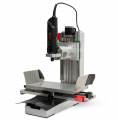
Yes, it can be made using a conventional CNC. And as a matter of fact, I'm currently looking at machines in the range of 5 to 10 grand to see if they meet my requirements. So far, this is the machine I've liked best:
As for casting, are you referring to metal or plastic or both? Because, as an alternative, I've also been doing some research on the lost wax casting technique, after which I'd finish the part with a CNC.
Do you have to make everything? Sometimes it's more cost effective to contract out... especially in the beginning. The machine you show on top doesn't look very rigid or able to be very productive.
Do you have to make everything? Sometimes it's more cost effective to contract out... especially in the beginning. The machine you show on top doesn't look very rigid or able to be very productive.
That machine is far more rigid than it looks. Especially when compared to its chinese equivalents. Take a look at this video, I've set it to start at 7:10 so you can appreciate how well it finishes the sides of the part being milled:
I agree, that does not look like a very rigid mill. A spring cut for finish doesn't put much stress on the machine.
About 15 years ago, I visited a gentleman who had a low end Tormach CNC mill. Prices have really gone up. It simply used stepper control with no position feedback but still did nice work. I would look for something rigid with a spindle designed for milling.
As for casting, yes, I was thinking of the lost wax method.
Thing here is.... that after those 5 to 6 grand machines things jump up into a range of $21K to $27K
I've even been thinking about buying a sturdy manually operated one, and then retrofitting it using steppers and some commercially available controller. But I've run out of time and need to get things done quickly.
retrofittng manual machines get expensive very fast... I have access to two very hefty Grizzley mills and lathes... even these will only barely cut aluminium only... (due to the steppers they used). The guy spent thousands to get them there... and its painful how much each step needs hands on time. Can you look for used industrial ones?
retrofittng manual machines get expensive very fast... I have access to two very hefty Grizzley mills and lathes... even these will only barely cut aluminium only... (due to the steppers they used). The guy spent thousands to get them there... and its painful how much each step needs hands on time. Can you look for used industrial ones?
Right now I'm not only looking for industrial machines, but for services providers also. Most of my projects are time-critical, and I need as much autonomy as I can afford so I can respond as quickly as possible to changes in design and specs. That's why I always try to have my own equipment at hand, if I can.
It's been a while since I've posted here, but here's a little thing I discovered.
My resin printer tends to distort the material as it prints it by solidifying a photo-sensitive resin through its image projection process.
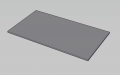
I tried printing a rectangular lid, with a 1mm thickness like this one:
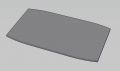
But after printing its edges came out warped, like this:
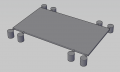
The solution was to add a few lateral supports around the part, so as to keep it tight within its intended shape, like this:
My point is that, even though the software automatically adds supports to the part to keep it in shape vertically-wise, sometimes one needs to manually add supports on the sides to prevent it from warping as the resin solidifies.
What I still don't understand is, why is the distortion manifesting itself on the long axis, but not on the short one?

 Facebook
 Google
 GitHub
 Linkedin