Looking for a decent 3d printer

Thread Starter

cmartinez

Joined Jan 17, 2007
8,759
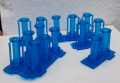
Just did a third test, and the results have been consistently beautiful. From the very first run I used the resin manufacturer's parameters and haven't had a single problem, nor have I had to adjust the slightest thing. The one thing I discovered is that it's best to immerse the parts in isopropilic alcohol for at least 20 minutes right after they're finished so as to thoroughly clean the uncured resin film, which is an unavoidable remnant resulting from the process. The next step is to rinse them thoroughly under running water from the tap, and then waiting for them to dry before bathing them under a UV light. Which is something I haven't tried because my UV lamps are at least several days away from being delivered.

Anyway, the parts I printed yesterday have shown considerable increase in their hardness and stiffness, and it's no longer easy to dent them with my thumbnail. The resin type I'm using (a rather expensive one) is beginning to perform exactly as its label describes it.
465cc6e8-e1fc-4dcc-b6ee-cc92cfef5865.jpg
 

Thread Starter

cmartinez

Joined Jan 17, 2007
8,759
1573406654723.png An evil idea has just popped into my head...


What if... and it's a big if, with big implications ... what if I could use this resin printer to make SMT soldering paste stencils for my PCB's? ... of course, the stencil itself couldn't be very large... only as large as the printer's capacity itself, which is 120 x 68 mm ... but that's large enough for most of my circuits. And maybe I could just make several stencils for different sections of larger PCB's

@Wolframore , what's the standard thickness for an SMT soldering paste stainless steel stencil?
 

Thread Starter

cmartinez

Joined Jan 17, 2007
8,759
Are the "straight" edges really wobbly, or is that an artifact of the photograph?
They're a little wobbly (plus a little of the pic's artifact, as you've said) ... but I discovered that the software-generated supports contribute to the part's distortion. Which is not really much, btw. But it might be significant for more precise work. Look at the part in the back, right in the middle. That one's got no supports (I removed them as a way of testing) and it's much less distorted than the rest that do have supports.
 

SamR

Joined Mar 19, 2019
5,487
Impressive. I can see an evolution from small metal machine shop operations to custom "Plastc" fabricators. The startup costs would be far far less generating a much better revenue profit stream.
 

Thread Starter

cmartinez

Joined Jan 17, 2007
8,759
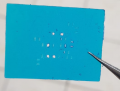
Jesus H Christ on a Bike.... it worked!

After a couple of failures, I finally made things work and had my machine deliver this 0.012" thick stencil. The cleared holes at the low center belong to a 0805 sized resistor... it looks a little crappy but now I'm 90% certain that with the right resin and a few tweaks this thing can make usable stencils for my future SMT projects... and the best part is that the processing time was under one minute!


1573416856445.png
 
Last edited:

Thread Starter

cmartinez

Joined Jan 17, 2007
8,759
A couple of questions.

@jpanhalt, my UV lamp should be arriving sometime this week. I read somewhere that it's recommended to cure the parts for about 20 minutes under said light as soon as they're properly washed in isopropyl alcohol, and then rinsed under running water and dried. Is there such thing as over-curing? Say the parts were exposed to UV light for three hours. Would they harden so much that they'd become fragile?

Which begs the next question. What would happen to said resin if the part were to be used outdoors? Would sunlight affect it significantly on the short run?
 

dendad

Joined Feb 20, 2016
4,637
Good questions. I do not know. But, just an aside, it may be worth while making a screen to put around the UV light when in use as some wavelengths are quite dangerous.
 

jpanhalt

Joined Jan 18, 2008
11,087
Actually, I tried to download the MSDS for that resin yesterday, but that function on eSun's site wasn't working. I sent it an email (bright@brightcn.net) at noon. I'll anxiously await it. As for general principles, I suspect the resins themselves are not involved in the photoinitiation. A photosensitizer is usually used that absorbs the UV, then creates an active chemical species that initiates polymerization. I think ABS is normally initiated by a radical. One might also use MEKP (MEK peroxide) as is used with polyester resins.

The intensity of your UV light might affect polymer chain length, but I suspect the manufacturer has considered that in its formulation. I don't suspect additional irradiation will affect that much, but it may depend on whether the photoinitiator is consumed in the reaction or acts as a true catalyst.

UV light of 405 nm is produced by ordinary fluorescent lights. At the intensities you are using, I don't think over exposure to that will cause degradation of the polymer per se. Sunlight is a different story. ABS is sensitive to degradation in sunlight.

I will update when/if I get the MSDS.
 

Thread Starter

cmartinez

Joined Jan 17, 2007
8,759
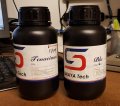
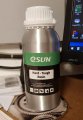
Forgot to mention... I could only acquire two half Kg bottles of eSun's Hard-Tough resin. It seems to be on high demand, since the machine's supplier had only one bottle available when I bought it, and the other one I found on Amazon, which didn't have more either.

37464d46-c46c-425f-be7e-e365559ea2ac.jpg

So after doing some browsing around, I found a post in you tube by a user claiming that when one mixed 70% Siraya Blu with 30% Siraya Tenacious, the result would be as good (or even superior) as eSun's resin... So I got two bottles of each to play with too.

I've attached their safety datasheets for reference purposes.
 

Attachments

Thread Starter

cmartinez

Joined Jan 17, 2007
8,759
From the previous resin's user guide:

Curing by submerging object in water will significantly increase curing efficiency
What is that supposed to mean? That by only submerging the parts in water is enough? Or that by applying UV light whilst the parts are submerged in water would be best?
 

jpanhalt

Joined Jan 18, 2008
11,087
Interesting and thanks for attaching the MSDS's. Both resins contain the same chemicals, urethane acrylate, acrylic monomer, and dipenylketone (photoinitiator, aka benzophenone).

It appears the two formulations differ only in the ratio of urethane acrylate and acrylic monomer. I am not surprised that varying those ratios affects physical properties of the end product.

Photoinitiation by benzophenone goes back a very long time. When it absorbs a photon in the near UV (due to the ketone) it very efficiently (almost 100%) forms a triplet radical (2 unpaired electrons) and abstracts a hydrogen atom ( H^dot) from one of the resin components. It remains a radical, and the radical it forms from the resin initiates polymerization. The (benzophenone+H) radical can further react by adding another hydrogen atom to become diphenylcarbinol, react further in the polymerization, or even add as a terminator to the resin polymer chains.

In the end, however, the reduced benzophenone -- diphenylcarbinol (aka diphenylmethanol) -- is a poor absorber of UV. I would not expect it to react further upon near UV irradiation, but it may leach out of the product over time (as will unreacted monomers).

As you might expect, there is a lot of literature on the subject because of its commercial application. Here are just three:

Review (Scheme 41) for what I just described:
https://pubs.acs.org/doi/full/10.1021/acs.chemrev.5b00671
Review of other photopolymerization initiators:
https://pdfs.semanticscholar.org/a5f3/85611d8d4efb2ea8b43226c8ca3542afb424.pdfhttps://polymerdatabase.com/polymer chemistry/Photoinitiators1.html
 

Thread Starter

cmartinez

Joined Jan 17, 2007
8,759
Are the "straight" edges really wobbly, or is that an artifact of the photograph?
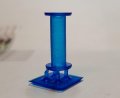
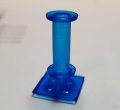
Just cured those solenoid cores under the sun for a few hours... and they're quite precise, practically no wobbles. Only thing is that the top and bottom flanges show a little bevel on the edges, and are not perfectly squared. My guess is that the resin was not warm enough (recommended temp is about 28° to 30° C, but I worked it at 21°C) to more freely flow while it was being formed. But that's something that I intend to address on my next run.


6b9758f3-44ff-4ee4-bbcc-df29f37b26ad.jpg

9a49ae78-7e54-440c-a84f-b933238d7a35.jpg


Thread Starter

cmartinez

Joined Jan 17, 2007
8,759
Does that resin shrink (or expand) as it cures?

Those look very nice, particularly the clarity.
Good question... I've just measured one of them to find out...

Designed external dimensions are 0.700" long x 0.335" diam.... physical measurments resulted in 0.710" long x 0.341" diam ... so yes, they do expand about 1.5% at that scale.

OTH, a piece of tube that I've just printed was designed to measure 111mm long, and it came out as 112. So it's about a 1% at that scale.

This is using eSun's resin, my guess is that other brands might behave differently.

I'll keep that in mind on my next run.
 

jpanhalt

Joined Jan 18, 2008
11,087
If there is "squish" (i.e., the resin is laid down properly but flows a little before it hardens) that could explain the slightly larger OD, and the ID should might be smaller. If the resin expands, the ID should be larger. A combination of the two factors might be hard to predict.

I am sure you know that measuring small ID's can be challenging. Anyway, that error is not too bad -- at least it is bigger.
 

Thread Starter

cmartinez

Joined Jan 17, 2007
8,759
If there is "squish" (i.e., the resin is laid down properly but flows a little before it hardens) that could explain the slightly larger OD, and the ID should might be smaller. If the resin expands, the ID should be larger. A combination of the two factors might be hard to predict.

I am sure you know that measuring small ID's can be challenging. Anyway, that error is not too bad -- at least it is bigger.
The ID was also bigger, meaning that the entire piece expanded.
 
Top