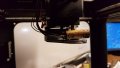
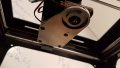
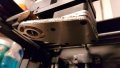
I think I may have found the key to all the crappy results I've been getting lately. And that key is the cooling fan.
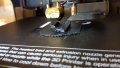
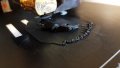
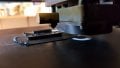
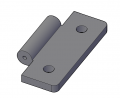
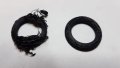
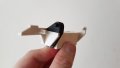
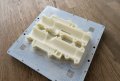
My latest intended build was this hinge that I plan to use to fix an acrylic door on to the printer itself. Notice how, in the pictures, only one edge of the part itself has an acceptable finish. The other three sides are distorted in a very bad way, and it can easily be seen that the material crept to the outside, except on the side on which the cooling fan was blowing directly at.
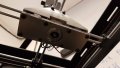
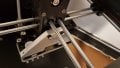
My next step is to fabricate a special "air ring" around the nozzle that will substitute the present cooling fan output duct. This way air will be blown from all sides around the nozzle, and not just from the right, as the pictures show.
I'll be back later with specific drawings and plans for this little modification that has very promising results.
Will this one fit your printer?
Center Nozzle Fan: http://www.thingiverse.com/thing:1620630
It is from this video.
How to Use Your 3D Printer - Anet A8 (Tips, Tricks, and Upgrades)
I got one of these Anet A8 Prusa i3 3D Printers. So far I have only used it once to print out one of their sample files of a little business card size box. It did a very nice job, first time.
Here are a few other videos that I though worth while.
Yes, I was working with ABS at 245°C, and things improved a bit when I lowered the temp a bit to 235°C. I'm going to try 230°C now, see how much difference it makes.
After making NUMEROUS mechanical adjustments, add-ons and tests, and adjusting an almost endless amount of parameters in the slicer and printer control software (Cura), I've finally made ABS work more or less decently in my Monoprice Ultimate IIP printer.
The keys for things to work were, of course, proper temp settings of the extrusion and the plate, but also of the raft and a proper temp change from the initial layer to the rest of the piece.
But the definite and most critical aspect was the change I made in the cooling method. In the pics shown in post #62, one can see how air being blown from the cooling fan affects material adhesion and surface finish. So what I did was design and build a flat air duct (made using several layers of aluminum sheet of different thickness that were cut using a CNC router) that surrounds the nozzle, forcing the air being blown by the fan through a circular opening; ensuring that air is able to reach the deposited material from all directions.
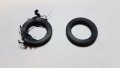
The difference this made was nothing short of astounding. The following two pictures show a couple of hollow toroids (shown top and bottom, respectively, and with general dimensions of 19mm id, 29mm od, 5mm tube diam, wall thickness of 0.5mm). The toroid on the right was made using the new annular air duct, and the one on the left was made using the original duct blowing from only one side. It's unbelievable how this relatively small change made the difference between a usable part and a total piece of crap ... the result thus obtained is still not perfect, but it's very close to it.
Of course, I also adjusted several speed parameters. Especially the ones concerning the first layer and free travel from point to point. This resulted in a more perfect part, with very little sacrifice in extra build time (about 5%).
I've come to the conclusion that the Monoprice Ultimate is not a bad machine (if one is willing to ignore the lose screws situation that I had to fix, and that I'm sure other people have had to face too), but it's far from being of professional quality. I'd qualify it as an "Advanced Level Toy" ... and with the adjustments and new additions I've made, I'd say it now qualifies as an "Austere Basic Prototyper"
Next step: Add a couple of acrylic side windows and a front door. I'll now try to make a couple of hinges for the latter, see how it goes. Wish me luck.
Good mod
I think it is well worth while to get a base model 3D printer and modify it for improved prints. You learn so much more that just buying an appliance. That being said, the stress levels can be a lot higher.
My Deltaprintr is quite heavily modified and now prints really well. The cooling fan for the parts is a must and makes a big difference. Originally, my printer had no fans at all.
A fan I used for ages, until a fault filled it with plastic, had 2 fans.. https://www.thingiverse.com/thing:1219819
I hope you get as much enjoyment from your 3D printer as have I. It is so much fun, and sometimes, even useful parts can be made
My biggest builds... https://www.thingiverse.com/thing:1243462
Here are my latest results. I added a double-fan air blower coaxial assembly to the nozzle, and the results have been stunning, to say the least. Now the pieces come out perfectly homogeneus on all sides. Something interesting that I noticed was that I had to power down both fans to 20% pwm, otherwise the nozzle's temp would start going down until the machine detected an error and stopped.
My very first real-world, practical-application part. I had to repair my microwave oven's hinge after one of its sides broke due to normal fatigue, after almost 20 years of use... drawing the part in AutoCAD and having my baby produce it after a couple of hours was a piece of cake.
I have a Creality CR10S Pro... I like it. I use solidworks for creating (as needed) lot's of great stuff on the internet including thingiverse. I use Cura for slicer and it's pretty good but had to do a lot of adjustments for it to work correctly with my printer (like acceleration and retraction settings). The worst part of this machine is the capacitive Z sensor which is affected by temperature... I've replaced with an inductive sensor and it's giving me a nice first layer. Some prefer the BLtouch sensor.
Your prints look ok, the slicer can make a huge impact on final print quality.
Back to the machine - you can add opensource firmware to this one... and the best part it was about $500 for build volume of 300x300x400mm. I haven't needed to build an enclosure... it's very quiet and no issues yet.
Guess I should start knocking on wood. Our microwave oven, and most of the kitchen appliances, are going on 25 years and there are 3 door slammers in the family...
I have just bought a liquid resin epax 3d printer, since the results I obtained using the filament type were neither precise nor strong enough. I'll be more than happy to post my results here in a few weeks, after I've thoroughly learned and tested it.
So your stepping up to a form of "stereo lithography"? At work they used that to make prototype parts for electrical connectors and other small car electrical parts. Don't know if it was just the level of scan they used, but we still needed to do hand finishing work on the parts.
Some guys get knighthood and others get the good toys.
So your stepping up to a form of "stereo lithography"? At work they used that to make prototype parts for electrical connectors and other small car electrical parts. Don't know if it was just the level of scan they used, but we still needed to do hand finishing work on the parts.
Some guys get knighthood and others get the good toys.
Yeah, stereolithography is the first thing I thought of when I looked at this new printer type. But the difference is that the resin is not being solidified by a laser one spot at a time at the top of the bucket, but rather by UV light being projected at the bottom of the bucket using an LCD screen as a mask. So an entire 2D layer is being solidified every 7 seconds or so.
Also, prints seem to be far more consistent, precise and have no directional weakness. Look it up, it's really cool.
I did some reading about UV curing resins (near UV) for 3D. Quite an assortment are available and some are quite strong. This link: https://polymerdatabase.com/polymer classes/UV Curing Resins.html shows various manufacturers and products. Unfortunately, not all the manufacturers' links have useful information. Still, properties from hard acrylic to silicone are available.
I am quite interested in your results. You may be able to apply a photoresist for PCB's with it.

 Facebook
 Google
 GitHub
 Linkedin