LM339 set-points

Thread Starter

Dritech

Joined Sep 21, 2011
907
Hi,

How can I calculate the values for the resistors which will be used in a voltage division configuration to set 6 different voltage set-points?

So basically I know Vcc, the set-points voltages and need to determine the resistors' values.

Thanks in advance.
 

tubeguy

Joined Nov 3, 2012
1,157
What voltages do you need ?
You can calculate a quick divider string by thinking of it as 1000 ohms per volt (for example).
 
Last edited:

Thread Starter

Dritech

Joined Sep 21, 2011
907
Thanks for the replies.

You can set one of the resistors and calculate what the other should be. Then choose a value you can buy and calculate the real threshold.
But that can only be done when having 1 voltage output right? In this case I need 6 outputs

What voltages do you need ?
The voltages needed are 50mV, 200mV, 250mV, 300mV, 450mV, 500mV.
 

tubeguy

Joined Nov 3, 2012
1,157
What is your supply voltage and available current?
And is the supply voltage well regulated ?
 
Last edited:

Thread Starter

Dritech

Joined Sep 21, 2011
907
The supply voltage will be 12V which will be regulated to 10V using a zener diode. Is the available current of the supply? If so, I will be using a bench top power supply so the current can go up to 5A.
 

Jony130

Joined Feb 17, 2009
5,598
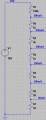
You can use this voltage divider.
And for R7 you can use 180K + 10K or 180K + 51K (precision trim potentiometer). For 3K you can use 3x1K resistor or two 1.5K resistors.
 

Attachments

Last edited:

Jony130

Joined Feb 17, 2009
5,598
Yes you can assume R1 value and then use Ohm's law to find the current
I = 50mV/1K = 50uA And next use Ohms low and find the remaining resistors.
R2 = (200mV - 50mV)/50uA = 150mV/50uA = 3K and so on.
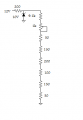
Or you can assume current as #12 did. But he made a small error.
He assume 1mA.
So from then R1 = 50mV/1mA = 50R;
R2 = 150; R3 = 50; R4 = 50; R5 = 150; R6 = 50; R7 = (10V - 0.5V)/1mA = 9.5K = 9.1K + potentiometer
 

tubeguy

Joined Nov 3, 2012
1,157
That's where thinking of the divider as 1000 ohms per volt is very useful.
Ohms law states that 1volt/1000ohms = 1ma. 1ma is a convenient low current which works well in circuits like this.
The 1ma current flows through the whole resistor string and each resistor has a voltage across it based on it's resistance.
So, 1000 ohms = 1 volt(1000mv) drop, 50 ohms = 50mv drop etc,,,

One thing that can easily trip you up is that you need to calculate the drop individually across each resistor in the stack.
 
Last edited:
Top