live wire and neutral wire short, the result can not be explained

Thread Starter

zhang peng

Joined Dec 3, 2017
6
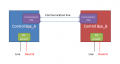
pic.png hello,guys,think you for looking this topic! You can see the graph above.

We have two control box, use the live wire and neutral wire to supply the power. Inside the control box, there is 24V DC power. The question is...

When the live wire and neutral wire short to each other, the air switch jumped. All the system is good, except the communication chip damaged(purple color in the graph).

It happened twice, the results were the same(the commutation chip damaged).I don't know why, and can't analysis. Can anybody show me some way to figure it out?


Note: the commutation used is the CAN bus...
 

Alec_t

Joined Sep 17, 2013
15,112
Because of the wire inductance, shorting then disconnecting live and neutral could have caused a voltage spike sufficiently high to break down the insulation/semiconductor junction of some component in the DC supply and hence damage the comms chip.
 

Thread Starter

zhang peng

Joined Dec 3, 2017
6
Because of the wire inductance, shorting then disconnecting live and neutral could have caused a voltage spike sufficiently high to break down the insulation/semiconductor junction of some component in the DC supply and hence damage the comms chip.
Thank you for the answer, I doubt why the 24V DC power is OK, the DC current should pass it or not? Only the communication chip is down.
 

MaxHeadRoom

Joined Jul 18, 2013
30,590
How come the live and nuetral is shorting together?
What is the AC voltage of the live and neutral?
Is the power supply a SMPS or Linear?
Are the control boxes metallic, if so are they earth grounded and bonded together?
Max.
 

crutschow

Joined Mar 14, 2008
38,392
If someone is going around regularly shorting the mains voltage :rolleyes:, then you may have to add an opto isolator in the communication line to prevent damage from the voltage surge.
 

Papabravo

Joined Feb 24, 2006
22,065
Thank you for the answer, I doubt why the 24V DC power is OK, the DC current should pass it or not? Only the communication chip is down.
Because CAN transceivers will use either CAN_H or CAN_L for a return path when the ground potential to the transceiver chip is disturbed. Newer transceivers are supposed to be more immune to this fault. What CAN transceivers are you using?
 

Thread Starter

zhang peng

Joined Dec 3, 2017
6
Because CAN transceivers will use either CAN_H or CAN_L for a return path when the ground potential to the transceiver chip is disturbed. Newer transceivers are supposed to be more immune to this fault. What CAN transceivers are you using?
Thank you for the answer. The CAN transceivers we use is the TLE6250, made by infineon. Do you have some suggestion about the CAN transceivers?
 

Papabravo

Joined Feb 24, 2006
22,065
Thank you for the answer. The CAN transceivers we use is the TLE6250, made by infineon. Do you have some suggestion about the CAN transceivers?
I'm not familiar with that chip. I know that Philips made the 82C251, as an upgrade to the 82C250 to address some of the issues with common mode differences in ground potential. If I am not mistaken the company that was Philips is now part of NXP, and I forget how Infineon fits into the new mix. Read the datasheet(s) carefully and look for a parameter that describes the maximum potential difference between the grounds on transceivers at opposite ends of a long (500 m.) network cable. Compare that parameter to the one for the 82C251.
 

Thread Starter

zhang peng

Joined Dec 3, 2017
6
I'm not familiar with that chip. I know that Philips made the 82C251, as an upgrade to the 82C250 to address some of the issues with common mode differences in ground potential. If I am not mistaken the company that was Philips is now part of NXP, and I forget how Infineon fits into the new mix. Read the datasheet(s) carefully and look for a parameter that describes the maximum potential difference between the grounds on transceivers at opposite ends of a long (500 m.) network cable. Compare that parameter to the one for the 82C251.
Thank you! We will test the new way this week!
 

Papabravo

Joined Feb 24, 2006
22,065
To clarify what is going on in more detail; when there is a sufficiently large difference in ground potential between the grounds of two CAN transceivers, one of the CAN data lines becomes an "alternate" ground return, and the transceiver circuits can have trouble with this.
 
Top