Lithium polymer cells ...

Thread Starter

Externet

Joined Nov 29, 2005
2,624
Hi.
Seen misleading sites telling the polymer is the cell wrapper, seen polymer as the electrolyte chemistry, seen polymer as a branch of ion chemistry, seen too many convoluted and misused misleading terms in a growing variety of lithium-based cells.

Do 18650 lithium polymer cells exist ? How do you recognize from a 18650 Li-ion ? Wrapper ? Color ? Printed codes ?
-No, I do not want any batt university link-
 

Papabravo

Joined Feb 24, 2006
22,058
Hi.
Seen misleading sites telling the polymer is the cell wrapper, seen polymer as the electrolyte chemistry, seen polymer as a branch of ion chemistry, seen too many convoluted and misused misleading terms in a growing variety of lithium-based cells.

Do 18650 lithium polymer cells exist ? How do you recognize from a 18650 Li-ion ? Wrapper ? Color ? Printed codes ?
-No, I do not want any batt university link-
Sounds like you wouldn't understand it even if we laid it out in more than ordinarily detailed rhyme.
 

Ya’akov

Joined Jan 27, 2019
10,226
Hi.
Seen misleading sites telling the polymer is the cell wrapper, seen polymer as the electrolyte¹ chemistry, seen polymer as a branch of ion chemistry, seen too many convoluted and misused misleading terms in a growing variety of lithium-based cells.

Do 18650 lithium polymer cells exist?² How do you recognize from a 18650 Li-ion?³ Wrapper ? Color ? Printed codes ?
-No, I do not want any batt university link-
1. The “Polymer” in “Lithium Polymer“ refers to the Soild Polymer Electrolyte (SPE) which replaces the liquid electrolyte in a cell based on such chemistry. The liquid electrolyte is a Li compound dissolved in a (flammable) organic solvent.

2. No, the LiPo chemistry includes assembling the cells in a prismatic format out of layers. Lithium Polymer cells are pouch cells by nature.

3. Lithium Polymer cells get their name from a shortened-for-convenience “Lithium Ion Polymer” original. In other words, except for the very scary and not commercially produced Lithium Metal cell, they are all Li-Ion.

Why do you want LiPo cells over anything else?
 

ThePanMan

Joined Mar 13, 2020
862
  • An 18650 battery is a lithium-ion battery. The name derives from the battery’s specific measurements: 18mm x 65mm. For scale, that’s larger than an AA battery. The 18650 battery has a voltage of 3.6v and has between 2600mAh and 3500mAh (mili-amp-hours).

Must be true because I read it on the internet.

In short - 18650 refers to its size.
 

ThePanMan

Joined Mar 13, 2020
862
Yes, but...

Because it is necessarily a cylindrical cell, it also means that you can’t have a LiPo 18650 because Lithium (Ion) Polymer cells are prismatic and made in laminated pouches. So, “are there LiPo 18650s?” “No."
Definitely agree. Though I didn't know the reason why LiPo's were constructed the way they were.

Coin cells are typically referenced by their size. A 2032 (cut and pasted from the internet) is:
The first two numbers let you know the diameter of the battery and the last two numbers tell you the height. So by following this, you can easily see that a CR2032 battery is a (C) lithium chemistry battery with a (R) round shape that has a diameter of (20) 20 millimeters and a height of (32) 3.2 millimeters. This applies to the majority of coin and button cell batteries but note there are some exceptions, like the CR2 or CR123A batteries which are considered lithium cylindrical batteries.

The thrust of my answer (post #4) focused on the battery nomenclature, the "18650" referencing its size. I know LiPo's exist and their relative chemistry is Lithium and Polymer but beyond that I know very little about the battery itself. LiPo's are prismatic. Though I don't fully understand what that means - and I'm not asking - the chemistry of the battery is different from a Li-Ion 18650 battery. Thank you Max for pointing that out.
 

Audioguru again

Joined Oct 21, 2019
6,826
An older Li-Ion or Li-PO battery cell has Cobalt in it and is stored and sold at the "half-charge " voltage of 3.6V or 3.7V. They are fully charged at 4.2V.
Modern LiFeP04 cells have iron (fe) in them and are sold and stored at about 3.2V and are fully charged at about 3.6V.
 

Ya’akov

Joined Jan 27, 2019
10,226
LiPo's are prismatic. Though I don't fully understand what that means - and I'm not asking…
The meaning is so trivial I feel compelled to answer the unasked question: it’s the same as cylindrical—shaped like a cylinder—but prismatic is shaped like a prism. (A solid with equal, rectilinear ends and parallelogram sides).

And, one more thing, there are prismatic but non-polymer Lithium Ion cells. I‘ve only seen a few. They are distinguishable from LiPo cells by their metal housing as opposed to the polymer-laminate pouch.
 

Thread Starter

Externet

Joined Nov 29, 2005
2,624
Thanks, gentlemen.
Found at this site ----> https://www.grepow.com/blog/lipo-vs-18650-battery.html

At the beginning of the article; Polymer is the electrolyte and polymer is the wrapper... :mad::mad::mad: Sickening.

Chargers for 4.2V 'ion' applied to a 3.6V 'polymer' or FePO4 can be destructive. If no markings telling which is what. Then there is all the noise of being a hazard. The hazard is not labeling them.


1696263462098.png


1696263737661.png


For these people; polymer is about the wrapping, not the electrolyte ---> https://www.lipolbattery.com/lithium polymer battery.html
 

Ya’akov

Joined Jan 27, 2019
10,226
Thanks, gentlemen.
Found at this site ----> https://www.grepow.com/blog/lipo-vs-18650-battery.html

At the beginning of the article; Polymer is the electrolyte and polymer is the wrapper... :mad::mad::mad: Sickening.

Chargers for 4.2V 'ion' applied to a 3.6V 'polymer' or FePO4 can be destructive. If no markings telling which is what. Then there is all the noise of being a hazard. The hazard is not labeling them.


View attachment 304036


View attachment 304037


For these people; polymer is about the wrapping, not the electrolyte ---> https://www.lipolbattery.com/lithium polymer battery.html
So, it is about the material of the pouch, but that’s a different polymer than the electrolyte. The pouch is made of a metal-polymer laminate. So there is a “polymer” there, but it is not the polymer referred to in the name of the cell.

Concerning LiFePO₄ 18650 cells—yes, they exist. I forgot to mention them. They are an exception because although their energy density is less than liquid electrolyte chemistries, they are inherently safer than those—not using flammable organic solvents—and the 18650 form factor is baked in to some products.

On the other hand, though at first the LiPo cells shared this advantage, their performance was considerably poorer than the liquid electrolyte cells so to compete, they added a liquid or gel electrolyte to the polymer, saturating it and improving performance. This additional electrolyte uses… wait for it… flammable organic solvents.

This renders the advantages of LiPo cells their pouch form factor, which offers extreme flexible in size and shape, and superior discharge current capacity (due to electrode size). There is no advantage in cylindrical cells to make them LiPo that’s why LiPo is synonymous with pouch cell.
 

Ya’akov

Joined Jan 27, 2019
10,226
Like the battery in my cell phone? Metal cased, even though it's shaped sort of like a slice of bread?
I don’t know of any cell phone’s that use anything but a single LiPo cell. If it is a a removable cell, it would be in a plastic housing enclosing the pouch. I suppose there could be a metallic version but I’ve never seen one.

Are you sure it’s metallic? In any case, it is unlikely to be a liquid electrolyte cell so far as I know.
 

Ya’akov

Joined Jan 27, 2019
10,226
Some years ago I took the covering off of an older cell phone battery. It was metallic.
The “some years” part could explain it. I‘ve only encountered a few non-SPE prismatic cells in the wild, and that was “some years ago”. I‘d imagine as some point before they started producing liquid “enhanced” solid electrolytes, phone manufacturers could get the double benefit of lower cost and more capacity with a liquid electrolyte prismatic.

I was surprised once when I found one in a cheap powerbank. So cheap it was used for promotional swag, emblazoned with the logos and taglines of mid-range companies. A clever gimmick given the perceived value of such an item. It contained a 2S arrangement of oddball metal cased cells which had me scratching my head a bit at the time (c. ~2003).

Because of the confusion about this topic, I decided to step back and resolve sone imprecision in my posts because some of these things hinge on overloaded terms with both technical and vernacular meanings.

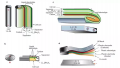
Strictly speaking there are four kinds of cells based on construction. This diagram does an excellent job of showing them, but unfortunately I can’t find the original source to credit and I found it in a cache so there is no link. If someone knows where it comes from, it would be great to know.

1696335638684.png

a. Cylindrical
The cylindrical cell is a stack up of the anode, separators, and cathode soaked in electrolyte (a Li compound in an organic solvent) tightly rolled into a cylinder shape and inserted in a can. The very tight rolling contributes to excellent capacity characteristics. There are cylindrical LiFePO₄ cells, though they have a polymer type stack up.

b. Coin (not relevant)

c. Prismatic
The prismatic cell is a stack up just like the cylindrical cell but folded like a letter. The shape is more efficient for larger battery construction but the capacity per cubic volume is reduced. There are prismatic LiFePO₄ cells, though they have a polymer type stack up.

d. Pouch
The pouch cell is a stack up of polymer cathode and anode layers, with a polymer electrolyte layer and separators. For improved performance a liquid or gel electrolyte made of a Li compound disolved in an organic solvent is used to enhance the performance of the solid electrolyte.

Pouch cells are enclosed in a metal-polymer pouch and pressure is applied to maximize the electron flow through the layers. (When the “puff up” due to oxygen that evolves from breakdown of the electrolyte they lose capacity as the layers separate.)

Checking what can currenly be purchased I find that for prismatics LiFePO₄ cells are common, Lithium Cobalt (like an “18650”, generically) are uncommon (enough that what I could find was not in stock or no longer offered), and non-LiFePO₄ polymer cells don’t seem to be a thing.

This is subject to revision because it turns out to be very hard to navigate the offerings of Li cell and battery vendors in a way that leads to certainity about what they will sell you—that is, unless you want to talk to a salesman.
 

Thread Starter

Externet

Joined Nov 29, 2005
2,624

Attachments

Last edited:
Top