Yes. Any of them, depending upon the particulars of the application. Phototransistors and LDR's are the most popular because they require the least amount of circuitry though both tend to be slow (Cadmium disuphide in particular can have a time constants that ranges into the 10ths of seconds). Photodiodes can be very fast though they require more circuitry than the other two to perform useful functions. It all depends on the demands of the application.
A little more detail might help in getting the best answer to your question. What sort of light levels are you interested in-- bright sunlight (or brighter)? Indoor room lighting? Outdoor nighttime, under a full moon? Starlight? It would help to know.
Are you interested in accurately quantizing (i.e., measuring) small changes in light level, or simply detecting when a given amount of change occurs? And, if you need to measure these changes, what are your accuracy requirements?
Over what kind of time scale are you interested in detecting these changes? Are you interested in changes which occur over a period of hours, days, weeks or months? Milliseconds, microseconds or nanoseconds? It would help to know your response speed requirements.
And finally, how small a change is "very small"? +/- 50%? 10%? 1%? 1 ppm? 1 ppb? It would help to know.
Both phototransistors and CdS LDRs have significant sensitivity variation with temperature, which could make reliable detection of small light intensity changes difficult. CdS cells also have memory effects which can be very significant, as well as aging effects.
Photodiodes are much more stable, but they produce a relatively smaller output signal and designing the electronics to process their output can be a bit of a challenge.
Thanks @DickCappels and @OBW0549 for replying.
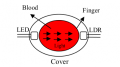
I want to build a system which detects the changes in intensity of light passing through a human forefinger. I am illuminating one side of finger with an LED, and by placing a suitable sensor on the other side of the finger, I want to detect changes in light intensity due to changes in blood pressure. So I would like to suggest you an appropriate sensor.
Also any other cuff-less technique to measure blood pressure would be appreciated.
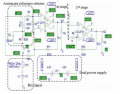
The equivalent circuit of the bio-signal is given below:
An LED + LDR might work, but since blood is red and CdS LDRs are most sensitive to green light, you might not get much of a response from the LDR. A phototransistor might be better for this purpose since they respond more to red light.
In either case, I expect an arrangement like this could be used to measure pulse rate. But for measuring blood pressure I don't think it would work very well; there are too many other things (finger position, skin temperature, ambient light, etc.) that would overwhelm any response you would get from changes in blood pressure.
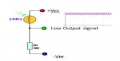
Assuming an NPN phototransistor (I don't know of any other kind), I imagine you would simply connect the transistor collector to +Vcc, and the emitter to R1 and the output signal. As for the amplifier, I cannot comment because it would take more time than I have available right now to study it.
Interesting approach, using an IR LED and phototransistor in a reflection mode. You might try replicating their setup and seeing if you get the same results.
They say "Figure 2 shows the PPG sensor (1260) that works on Photoplethysmography principle whose output is analog signal (optical signal) which is detected by photo diode that varies with respect to changes in blood volume where the input is taken from a 660 nm Red LED. (...) Figure 3 shows the process of photoplethysmography where a bright LED light is used as an input which is allowed to pass through the finger (since light can easily pass through the finger) and the transferred light is detected by a light detector like photo diode etc. As per the principle, light absorbed at other end varies according to the variations of blood volumes in the finger. The sensor used here is simple to use and accurate in results."
So they're using a photodiode, but what particular kind I cannot tell.
You might take a look at this paper from the Univ. of Latvia, for a different approach:
@bertus
I have an Arduino Uno board. I can use the analog/digital pin input to read in the values supplied by the robomart sensor.
I want to know if the sensor will be able to detect the minute changes in the intensity of light passing through the finger, which is illuminated by an LED on opposite side, as shown:
I will use the sensor instead of LDR as shown in the following figure:
@bertus
I have an Arduino Uno board. I can use the analog/digital pin input to read in the values supplied by the robomart sensor.
I want to know if the sensor will be able to detect the minute changes in the intensity of light passing through the finger, which is illuminated by an LED on opposite side, as shown:
I will use the sensor instead of LDR as shown in the following figure:
I'm not familiar enough with photometry to tell for sure, but I suspect the robomart sensor may not be sensitive enough or give enough resolution to be much use in your application. That's just my suspicion, though...

 Facebook
 Google
 GitHub
 Linkedin