Light Emitting Diode Troubleshooting / Replacement

Thread Starter

swen

Joined Aug 1, 2014
46
Getting more confused now. I need a white LED, and the forward voltage on the chart shows 3.0 to 3.4, while my measurements across my working LEDs are 2.35 - 2.99.

Also, if LEDs are directional, then I have a potential problem. The LEDs on the board appear to be symmetrical, with no distinguishing marks or flat spots or one lead longer. And the ones on eBay appear symmetrical, too.
 

dl324

Joined Mar 30, 2015
18,362
The LEDs on the board appear to be symmetrical, with no distinguishing marks or flat spots or one lead longer.
You're seeing it, but not seeing it.

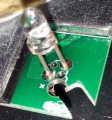
upload_2017-3-24_14-0-46.png

The flat edge is on the right, the '+' on the board marks the anode. Additionally, the "cup" in the package is usually the cathode.

Polarity can usually be checked with the diode check function on a DMM or by a simple test circuit.

Forward voltage depends on current. Yours may be running at a lower current.
 

bertus

Joined Apr 5, 2008
22,938
Hello,

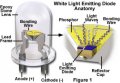
When you hold the led agains the light, you will see a cup and a arm:

ledintrofigure1.jpg

Those will lead you to the correct position.

Bertus
 

bertus

Joined Apr 5, 2008
22,938
Hello,

Did you see the picture I posted?
I can see the cup in your led in the picture.

The voltage accoss the led is dependend on the current through the led.
It might be that there is a lower current used as normaly, so the voltage will be lower.

Bertus
 

ian field

Joined Oct 27, 2012
6,536
Getting more confused now. I need a white LED, and the forward voltage on the chart shows 3.0 to 3.4, while my measurements across my working LEDs are 2.35 - 2.99.

Also, if LEDs are directional, then I have a potential problem. The LEDs on the board appear to be symmetrical, with no distinguishing marks or flat spots or one lead longer. And the ones on eBay appear symmetrical, too.
Ambiguity over forward volt drop reinforces my suggestion a few days ago to buy 4 identical LEDs and replace them all in one go.

Vf can vary significantly with current, but also slightly with manufacturer/manufacturing process.

Except for sudden failure - LED brightness tails off very slowly over the life expectancy. Even if you managed to identify the original type number, the new replacement could be slightly but noticeably brighter than the old ones. It won't be the same batch, so parameter spread will probably be different as well.
 

Thread Starter

swen

Joined Aug 1, 2014
46
I'm sorry, I accidentally posted my question twice when I saw the original hadn't (I thought) posted. I deleted the duplicate.
dl324, looking more carefully at my LEDs, I do indeed see a flat side! I never knew about that apparently seriously important facet of LED installation.

Bertus, perfect picture. I don't know why I had it in my head that LEDs were bi-directional.

"It might be that there is a lower current used as normaly, so the voltage will be lower."

Does this mean that an LED rated at 3.0 to 3.4 will probably work for me?
 

bertus

Joined Apr 5, 2008
22,938
Hello,

As dl324 said, check if the leds are in parallel.
If that is the case, you should check the leds on forward voltage.
The slightest difference in foward voltage will unbalance the current distribution.

Bertus
 

ian field

Joined Oct 27, 2012
6,536
I'm sorry, I accidentally posted my question twice when I saw the original hadn't (I thought) posted. I deleted the duplicate.
dl324, looking more carefully at my LEDs, I do indeed see a flat side! I never knew about that apparently seriously important facet of LED installation.

Bertus, perfect picture. I don't know why I had it in my head that LEDs were bi-directional.

"It might be that there is a lower current used as normaly, so the voltage will be lower."

Does this mean that an LED rated at 3.0 to 3.4 will probably work for me?
Most LED colours have a specific voltage associated with them.

Most white LEDs are blue LEDs with yellow phosphor over the emitting area.

Those normally drop somewhere around 3.4V when operated within the stated current.
Hello,

As dl324 said, check if the leds are in parallel.
If that is the case, you should check the leds on forward voltage.
The slightest difference in foward voltage will unbalance the current distribution.

Bertus
That's one of the reasons I suggested buying 4 identical and replacing them all in one go - at least a decent chance of all from the same batch.

IMO: the TS has been given more than enough information now to get the job done...................
 

John Berry

Joined May 17, 2016
72
Getting more confused now. I need a white LED, and the forward voltage on the chart shows 3.0 to 3.4, while my measurements across my working LEDs are 2.35 - 2.99.

Also, if LEDs are directional, then I have a potential problem. The LEDs on the board appear to be symmetrical, with no distinguishing marks or flat spots or one lead longer. And the ones on eBay appear symmetrical, too.
Hello, hear is a quick and easy way to check if your led works and which is the positive leg.
just connect it to a cr2030 button cell battery and if the positive lead of the led is connected to + of cell it will work... :)
 

Attachments

Thread Starter

swen

Joined Aug 1, 2014
46
Got it. I even tried the LED with a cr2032 battery, but while it was still on the board. Whether or not I replace one LED or four, I want to know if the specs for the white LED in my chart above will work for my need.
 
swen said:
Also, if LEDs are directional, then I have a potential problem. The LEDs on the board appear to be symmetrical, with no distinguishing marks or flat spots or one lead longer. And the ones on eBay appear symmetrical, too.
The pic you posted shows the FLAT on the LED or the - polarity.
 

John Berry

Joined May 17, 2016
72
Got it. I even tried the LED with a cr2032 battery, but while it was still on the board. Whether or not I replace one LED or four, I want to know if the specs for the white LED in my chart above will work for my need.
They look like basic 5mm led's, my last pack of 50 cost about 99 Pence from Aliexpress.
If it was me I would just replace the one led, or replace all four if you wanted.
In my opinion there is nothing to get technical about hear - just replace the led, if it still does not work then that's a different matter.... John :)
 

Thread Starter

swen

Joined Aug 1, 2014
46
"just replace the led, if it still does not work then that's a different matter.... John"

That's what I'm going to do, but just want to know if the LEDs I order, having the voltage specs I showed on the chart, will work.
 

ian field

Joined Oct 27, 2012
6,536
"just replace the led, if it still does not work then that's a different matter.... John"

That's what I'm going to do, but just want to know if the LEDs I order, having the voltage specs I showed on the chart, will work.
How many times do you need it explained to you that each LED colour has a specific forward volt drop?
 

Kjeldgaard

Joined Apr 7, 2016
476
"just replace the led, if it still does not work then that's a different matter.... John"

That's what I'm going to do, but just want to know if the LEDs I order, having the voltage specs I showed on the chart, will work.
You write in one of the first post that you can measure 6 volts on the defective LED.

This means that the drive voltage is high enough to drive an LED whether its forward voltage is 2.6 Volt or 3.7 Volt.

But buy at least four LEDs, so you can change all the LEDs if there is too much difference in color or brightness difference.
 

Thread Starter

swen

Joined Aug 1, 2014
46
Thanks Kjeldgaard, that's exactly what I needed to know. Being a non-circuit person, I didn't know if 3.0-3.4V (forward) would be too low (or even too high, based on my voltages of the good LEDs) for the LEDs in my circuit.

Thanks again!
 
So, the color gives a range of voltages AND the actual forward drop creates an intensity variation within the lot. The LED's themselves can easily see a 5x change in current.

What, I think, everyone was concerned about is replacing one, the intensity might stand out. Replacing all 4 has a bettter chance of being the same brightness. Actually buying a bunch and measuring Vf and binning/matching (the histogram approach) them gives you the best intensity match.

They are run by current, not voltage. So, if a LED was driven by a 5V source and you wanted to operate it at 20 mA, you would size a resistor the be R<=(5-Vf)/20e-3. When the voltages are lower, the variations in Vf are more pronounced.
 

Thread Starter

swen

Joined Aug 1, 2014
46
What, I think, everyone was concerned about is replacing one, the intensity might stand out
I think that's what happened. I got the 5mm white LEDs and I replaced the one bad one. It works. But it is 2-3 times too big and way too bright. It barely fits, and bulges out of the platform. Now will have to start over with 3mm LEDs.
 

djsfantasi

Joined Apr 11, 2010
9,237
I think that's what happened. I got the 5mm white LEDs and I replaced the one bad one. It works. But it is 2-3 times too big and way too bright. It barely fits, and bulges out of the platform. Now will have to start over with 3mm LEDs.
And that's why I advocated a more conservative approach. It may take longer or require extra work, but you avoid the work of debugging and reworking the solution. If we had found the supply voltage, identified the resistors and physically measured the size... we'd be done by now.

It's ok. I know my OCD approach doesn't work for everyone.
 
If we knew you couldn't measure the size, all you need a known object (say a dime in the US) and place it so you can calibrate the dimension. A ruler is even better. So, you can easily convert to the real dimension once you know something. I could have easily measured the dimension of a US coin. It's very likely the leads were 0.025" square. So, we could have gone from there.

I just did it with your uploaded pic: 0.230/0.025 = 1.44/x; x=0.156" or 3.96 mm or 4 mm LED
 
Top