Level Shifting of Op-Amp Circuit Output

Thread Starter

irobot

Joined May 16, 2015
24
Hi All

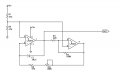
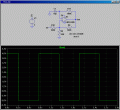
Is there a simple way to level shift the output of this simple triangle wave op-amp oscillator to
swing from 0V to about 2 volts P-P? Obviously the output in the schematic rides on a DC level of about 2.5V

This is a very low frequency oscillator (.1 – 10Hz) used to modulate various voltage controlled audio circuits.
I would prefer to not have to use a split supply. This topic has been discussed in several other posts and I have tried various op-amp circuits with no success.

I realize that rail-rail op amps are not perfect, but If I can get the output to come within about 50-100mV of ground that would be fine.

Would it be possible to just use a few bipolar transistors of some sort?

Thanks in advance to your replies,
Mike
 

Attachments

AnalogKid

Joined Aug 1, 2013
12,045
Since the output is a symmetrical waveform, a very large coupling capacitor will shift the average (centerline) value to 0 V. For example, if it is driving a control input with an impedance of 1K to GND, a minimum coupling cap would be 1600 uF. If linearity and pointy peaks are important, I'd start with 4700 uF.

ak
 

Alec_t

Joined Sep 17, 2013
15,103
I realize that rail-rail op amps are not perfect
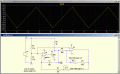
....and unfortunately the LM324 is not rail-to-rail and is far from perfect ;). It can only swing between ~3.5V and 0.5V if you must use a 5V rail. Provided you feed the triangle wave into a high impedance (>~100k) you could use the second opamp to create a negative voltage, which can then be resistively-summed with the output from the first opamp, like this:
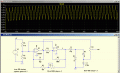
OscOffset.gif
 

DickCappels

Joined Aug 21, 2008
10,661
A couple of ideas.

See if reducing R2 can get the lowest tip close to ground. You might have to add a 1k resistor from the output to ground to help the output get very close to zero volts.

You might want to try AC coupling As Analogkid indicated, but couple to a resistor that is connected to a DV level equal to 1/2 the amplitude (+1.25 volts D.C.) to the lowest tip reaches right down to 0 volts.

There also the possibility of using diode clamp, The anode of a diode 1.25 volts + 1 diode drop for temperature compensation and the cathode would connect in place of the resistor in Analogkid's suggestion.

An active clamp can give better performance but pulse forming and signal delays would be needed -use as a last resort.
 

Thread Starter

irobot

Joined May 16, 2015
24
Alec t -

Interesting solution. That's exactly what I need.

As for the LM324, I was lead to believe that this is a "rail-to-rail" device . . . . what would you recommend
for a dual op-amp in an 8 pin DIP or SOIC package?
 

Alec_t

Joined Sep 17, 2013
15,103
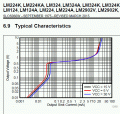
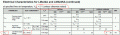
The LM324 inputs can go down to the ground rail, but they and the output can only go to within ~1.5V of the +ve rail. Its output can get to ~0.6V above ground. Nevertheless a LM324 can be used in your application. I can't recommend a particular alternative opamp in either package. You might need to consider a SMD type.
 

MikeML

Joined Oct 2, 2009
5,444
The LM324 inputs can go down to the ground rail, but they and the output can only go to within ~1.5V of the +ve rail. Its output can get to ~0.6V above ground. Nevertheless a LM324 can be used in your application. I can't recommend a particular alternative opamp in either package. You might need to consider a SMD type.
When sinking low currents, the output will get to a few mV above gnd=vss=0V, even when powered with 5V.

324.gif
324a.gif
 
Last edited:

Thread Starter

irobot

Joined May 16, 2015
24
Ian -

Just a plain triangle waveform, symmetrical sawtooth. Doesn't have to be op amps. Needs to be stable though. Possibly use a UJT ?
 

Alec_t

Joined Sep 17, 2013
15,103
A conventional UJT circuit will give a sawtooth waveform (i.e slow rise sudden fall), not a symmetrical triangle.
 

ian field

Joined Oct 27, 2012
6,536
A conventional UJT circuit will give a sawtooth waveform (i.e slow rise sudden fall), not a symmetrical triangle.
That's why I asked what type of sawtooth - I was going to suggest buffering the sawtooth from a Programmable Unijunction with a source follower JFET.

The TS seems to have the textbook sine/square op-amp oscillator producing a symetrical wave.
 

Thread Starter

irobot

Joined May 16, 2015
24
MikeML -

Thanks for the input (pun not intended!) . . . Yeah, this helps . . . I would need an integrator on the output to go from square to triangle waveform. I will experiment with this circuit and post my results . . .
 
Top