LED voltage measurement question

Thread Starter

Lucky-Luka

Joined Mar 28, 2019
181
Hi all
I'm starting building simple circuits to better understand the theory related to them.
As soon as i've finished my first ever super simple circuit something isn't clear at all...
I'm talking about my LED voltage measurement.
I have a breadboard with a 5V power supply attached.
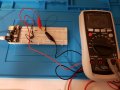
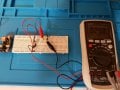
When the power supply is disconnected from the board and when the button on the breadboard is pressed and the power supply is attached to the breadboard I can assume that what I read in the voltmeter is right but I cannot understand what's going on when the power supply is attached to the breadboard and the button on the breadboard is not pushed. Why do I read -1.308V (power on) and -1.496V (power off)?
Thanks for your help.

Luca
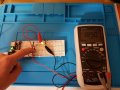
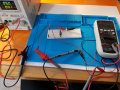
1_89V.jpg -1_308V.jpg -1_496V.jpg 29_8mV.jpg
 

dl324

Joined Mar 30, 2015
18,326
Welcome to AAC!

The first thing you should do is learn how to draw a schematic. Most of us are quickly bored looking at someone's wiring.

I have no idea what power on or off means. If you don't have the LED powered you shouldn't measure any voltage across it (I'm assuming that's what you're doing).

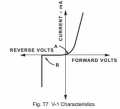
The forward voltage of an LED depends on chemistry and forward current. Without a datasheet/part number and the current, no one can tell you if the voltage you measured was reasonable.
upload_2019-3-28_18-56-16.png

Not my figure. There's a typo in the title. It should be V-I characteristics, not V-1.
 

Thread Starter

Lucky-Luka

Joined Mar 28, 2019
181
Thanks for your replies and suggestions.
It looks like my problem is related to stray voltages. Let's assume I don't want to usa batteries, is there a way to get rid of stray voltages in my little project?
Thanks

Luca
 

Tonyr1084

Joined Sep 24, 2015
9,744
Try this: Power up your supply and measure the voltage. Don't have anything attached to the supply other than your volt meter. No LED's no caps no resistors, nothing! Then, with the meter still connected, unplug the power supply. You should see that the output voltage remains near full output for a few seconds, maybe even a minute or so. The supply probably has capacitors that are holding and delivering that charge, and the charge is not being completely depleted when you're taking your next measurement.

On a different hand, if you're reading voltages on your bread board (BB) with the switch off - it could be your meter is just reading some static level of charge. Disconnect your meter from your project and see what it reads with the leads not connected to anything. THEN take the leads out of the meter. You may see a change in the reading. It could be you're picking up some stray capacitance from the leads themselves.

Some meters have a zeroing feature where you short the leads together before you start taking readings. You zero the meter to negate any charges that may be associated with the lead lengths. Measuring a precision resistor with a regular meter - you'll find error but that's because of your meter test leads offering line resistance.

There's another possibility: Your meter's battery may be weak. I've seen weak batteries cause the meter to read strange things. There are possible other causes as well, which we can't tell from here. You're the principal investigator and we have to rely on what you tell us. Best we can do is point you in the right direction. Oh - and yes, a schematic will elicit a look. Pictures of breadboards are not so fondly received.
 

Thread Starter

Lucky-Luka

Joined Mar 28, 2019
181
I have upgraded a little bit my system.
The problem is gone: 59mV voltage read, which is ok.
Stray voltages seem to be the culprit.
Thanks for your suggestions indeed.
I've downloaded Fritzing so next time I'll post some schematics insted of pictures.

Luca

59mV.jpg
 

Ya’akov

Joined Jan 27, 2019
10,235
What do you mean by "stray voltage"?
Stray voltage is like stray cats, if you feed them they'll never leave. If you ignore them they won't leave either but at least you aren't out the food.

There's a message in that somewhere, but unfortunately I suspect it's not here.
 
Top