Led Light resistor question

Thread Starter

usertemp

Joined Dec 28, 2022
18
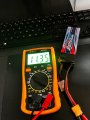
Did you ever measure the actual voltage of that LiPo battery? If not, please do (assuming you haven't charged or used it much since you took that current measurement).

The two data points we have are: 150 mA @ 12.75 V and 780 mA @ 14.72 V.

That large an increase with just a 2 V change in voltage leads me to suspect that there is no current limiting resistor and they are relying primarily on the resistive behavior of many LEDs (which makes it a very bad design, especially for an automotive application).

I'm guessing that the nominal forward voltage of the LEDs in this thing is 3.0 V (or something close) and they have four in series giving a nominal Vf per string of 12 V. That means that each LED is nominally carrying about 40 mA of current (if operating at the total current of 290 mA in the data sheet).

If your LiPo battery was really at 11.1 V, I'm surprised you got much current at all -- and getting 170 mA (i.e., a bit more current that at 12.75 V) is very strange, so I suspect your LiPo voltage is at somewhat higher.

Was it the exact same LED strip that you used with both batteries? The difference from one strip to another could easily count for the difference in results.

The best way to drive these is with a current driver. LED strings have become so common that there are a lot of very cheap options out there. I don't work with them much, so I'm not familiar with what's actually available. I know you are looking for a module rather than building something yourself. It's also apparent that you want to use ultra-cheap components, which is going to make it a lot harder to do it right.

Because there is no overhead voltage available at the intended operating voltage, using two or three series diodes may not work well. But it might be worth a try and it is easy to do, particularly as a test.

You might try putting a resistor in series with the LED strip that is about 10 Ω (somewhere between 6.8 Ω and 15 Ω). But you're going to need 2 W resistors. That should protect the string from burning out when the engine is running, but there are some caveats here. First, the value that works for one strip might not work well for the next. Second, since these are on the outside of a car, the temperature variation is going to be pretty extreme and that is going to impact the behavior, possibly so much that it will be very noticeable and annoying. But, if not, then life is good. If it is, then you can always revisit and seek a better solution (such as a proper current driver).
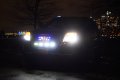
Here it is
 

Attachments

Thread Starter

usertemp

Joined Dec 28, 2022
18
Did you ever measure the actual voltage of that LiPo battery? If not, please do (assuming you haven't charged or used it much since you took that current measurement).

The two data points we have are: 150 mA @ 12.75 V and 780 mA @ 14.72 V.

That large an increase with just a 2 V change in voltage leads me to suspect that there is no current limiting resistor and they are relying primarily on the resistive behavior of many LEDs (which makes it a very bad design, especially for an automotive application).

I'm guessing that the nominal forward voltage of the LEDs in this thing is 3.0 V (or something close) and they have four in series giving a nominal Vf per string of 12 V. That means that each LED is nominally carrying about 40 mA of current (if operating at the total current of 290 mA in the data sheet).

If your LiPo battery was really at 11.1 V, I'm surprised you got much current at all -- and getting 170 mA (i.e., a bit more current that at 12.75 V) is very strange, so I suspect your LiPo voltage is at somewhat higher.

Was it the exact same LED strip that you used with both batteries? The difference from one strip to another could easily count for the difference in results.

The best way to drive these is with a current driver. LED strings have become so common that there are a lot of very cheap options out there. I don't work with them much, so I'm not familiar with what's actually available. I know you are looking for a module rather than building something yourself. It's also apparent that you want to use ultra-cheap components, which is going to make it a lot harder to do it right.

Because there is no overhead voltage available at the intended operating voltage, using two or three series diodes may not work well. But it might be worth a try and it is easy to do, particularly as a test.

You might try putting a resistor in series with the LED strip that is about 10 Ω (somewhere between 6.8 Ω and 15 Ω). But you're going to need 2 W resistors. That should protect the string from burning out when the engine is running, but there are some caveats here. First, the value that works for one strip might not work well for the next. Second, since these are on the outside of a car, the temperature variation is going to be pretty extreme and that is going to impact the behavior, possibly so much that it will be very noticeable and annoying. But, if not, then life is good. If it is, then you can always revisit and seek a better solution (such as a proper current driver).
Or even this one

https://www.aliexpress.com/item/100...316723361794998994e8a80!12000016846440077!rec
 

Thread Starter

usertemp

Joined Dec 28, 2022
18
Ok, further to my post, neither the MaxLinear XR46004 or Taiwan Semi TS19601 are available from mouser any longer, I bought some a year ago and they had quite a few thousand. Checked them on the Digikey site and they are both listed as no longer manufactured, which is pretty sad because they are the best design of their type that I've found. However, Digikey have some TS19601 in stock, so they are available at the moment.
What about Lm2596?
https://www.aliexpress.com/item/1005001621899005.html?spm=a2g0o.cart.0.0.6f4b38da2gE1GK&mp=1
 

MisterBill2

Joined Jan 23, 2018
27,519
It seems like the TS has some LEDs that really must be used with an external resistor. I base that conclusion on the statement that they burn out immediately. That is what happens when an LED without an internal current regulator is connected across 12 volts. I have seen it done by an unknowing fool who did not believe me. The flash is very bright, though.
 
Last edited:

PaulEE

Joined Dec 23, 2011
474
Ditto on a resistor bank. The brightness will vary between engine off and on, but at least they won't die. I'd also consider some inline fuses so that if they do pull too much current (but less than the car circuit fuse), the fuse will blow instead of the LEDs. Probably an amp or two, but you'd have to look at the specs of the LEDs to know what current they expect in the first place.

Paul
KI5VNH
 

MisterBill2

Joined Jan 23, 2018
27,519
The easy solution is to choose a resistor value to run the LEDs at less than the absolute maximum allowed. Then the system voltage variations will not cause any problems. Very simple, and it will provide much longer LED lifetimes.
 

PaulEE

Joined Dec 23, 2011
474
The proper way to do this is a constant-current module after you determine what the LEDs are rated, by the way. That way, whether 10V or 15V is going to them, the module maintains the proper current. That's typically how strings of LEDs are run. Light output is proportional to current through the LEDs. Constant-current, constant brightness.

Paul
KI5VNH
 

MisterBill2

Joined Jan 23, 2018
27,519
So do we get an explanation as to which of the methods was finally used? THAT will be useful for others in the future.
AND, why is there an issue with brightness changing with the engine speed? As the car goes faster the light gets brighter.
That might be a really cool effect.
And if the final voltage and current information is available, let us know that information as well. LED lighting information is always handy to know.
 

Tonyr1084

Joined Sep 24, 2015
9,744
Bill: At an idle operating voltage may be 13.6V. At higher than idle operating voltage may go up to 14.5V but should stabilize around 13.8V once the battery has been recharged. Once the voltage has stabilized, other than idle, the brightness should remain constant. And at idle, the difference in brightness may not be noticeable.

My snow blower has a headlight that varies with engine RPM but that's a magneto type generator. As the engine speeds up so does the output. There is no regulation on it. I have some spare HID kits I'd like to toss on it but I don't think it will do the initial fire-up. Haven't tried it so I don't know for sure. But on the bench, with a 13.8V 19A PS they don't fire. And I don't know why not. But this isn't an attempt to hijack the thread, just making a comment about lights and engine RPM's on a regulated system versus an unregulated system. My engine magneto has no regulation and I don't know what amperage it's capable of supporting. For now it lights a single automotive incandescent bulb like a turn signal lamp (not brake light).
 
Last edited:

MisterBill2

Joined Jan 23, 2018
27,519
A "lighting" winding on a small gas engine is certainly far different even from the battery charging arrangement on an actual motorcycle, and both are vastly different from an automotive 12 volt electrical system. I have seen many cars with lights that dim at idle waiting at a light, but not so many of them recently.
 
Top