Thank you for your interest!how is the project progressing? Have you found the white LEDs to ne slow? Would red LEDs work? Multiple LEDs?
Owing to the 'hurly-burly' of the holidays - I've yet to run any tests
Best regards
HP
Thank you for your interest!how is the project progressing? Have you found the white LEDs to ne slow? Would red LEDs work? Multiple LEDs?
I think after you run some tests, you'll find that this discussion was mostly unwarranted.Owing to the 'hurly-burly' of the holidays - I've yet to run any tests--- My initial experiments will be with a 25 ('ultra-bright white') LED 'head' salvaged from a torch...
Best regards
HP![]()
I can't address this question directly, but as an interesting side note, the human eye responds MUCH faster to green LEDs than to red ones. If you feed an LED with a square wave, you can see the green one flicker up to about 60 hertz, while the red one seems to be steadily on at around 15 Hz. This is why stop lights should be green."Somewhat" dim memory was evidently an understatement; turns out I was wrong.
I took a PIN photodiode, put it in series with a 1000Ω load resistor and gave it 10V of reverse bias to reduce its capacitance, then illuminated it with various red, green and white LEDs driven by my pulse generator while observing the voltage across the load resistor with my oscilloscope.
The red and green LEDs gave output rise and fall times of around 100 ns. The white LED (not a high-power illumination-type LED, just an ordinary 5 mm indicator type) showed rise and fall times of about 200-250 ns. But there was no observable afterglow from the white LED on any timescale-- nanoseconds, microseconds or milliseconds.
Santa is bringing me some 3 watt white LEDs to play with, and once we get past Christmas I'll rig up a high-power driver for them and give them a try. I'll also put together a fast transimpedance amplifier for the PIN photodiode which will hopefully take any detector speed limitations (like stray capacitance across that 1000Ω resistor) out of the picture.
But for now, the bottom line is it appears I was wrong about that "tail."
Please see post #40I think after you run some tests, you'll find that this discussion was mostly unwarranted.
Consider what you're 'scoping; how fast is it? I don't know what a Coolidge RA type rotor is, but does it spin faster than 20,000RPM? Your stroboscope (whether LED or flash tube) would be pointless if it is faster than the intended target. This flash-tube stroboscope goes up to 20,000 flashes per minute. That's 333Hz. When your strobe frequency is 333Hz, what should your turn on and turn off time be?
I say 1.5mS rise and 1.5mS fall is more than sufficient; anything faster than that is excessive. That's just enough time for it to turn all the way on and all the way back off. I say you don't need a blazing fast light source and a cliff-edged square wave of light. Hell, you don't even need to let the [LED/tube] turn all the way off. The persistence of vision in your painfully slow human eyes will iron out all the details.
I've posted Stroboscope stuff on the forum before.
BTW, here's a COTS stroboscope employing LED tech, and it's 15 times faster than the flash tube model I linked to earlier.
http://en-us.fluke.com/products/vib...ols/fluke-820-2-led-stroboscope.html#features
If you need anything faster than that, I think a different technology would be more appropriate.
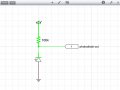
Hola Gopher,If you don't have a photodiode (faster than photo transistor), make your own by simply using a old-school green LED - cathode connected to ground and anode connected to a 1M resistor and other end of resistor connected to ground.
Then connected the resistor cathode node to an amplifier. Always make sure the absorbing LED is longer wavelength than your transmitter LED - but not too much. An IR LED will not detect flashing from a blue or green LED. As mentioned above, lots of newer high-brightness GaN LEDs are emitting blue or UV and red-shifted with phosphors. That means, you cannot use certain green LEDs to detect blue light.
Good luck.
hey, I think I know that one... the resistor is in parallel with the led to accelerate its discharge time when rapid switching is applied... all LED's have a very small amount of capacitance in them, ain't it?Like this....
Now you're just teasing me.hey, I think I know that one... the resistor is in parallel with the led to accelerate its discharge time when rapid switching is applied... all LED's have a very small amount of capacitance in them, ain't it?
Now you're just teasing me.![]()
@atferrari & #12Like this....

Ok, now I'm officially confused.You can also reverse bias to make them more sensitive (use in low frequency because of higher capacitance)
Yes. All diodes have capacitance and capacitance limits frequency.Ok, now I'm officially confused.
So LEDs do have some inherent capacitance after all that interferes with their ability of being switched at high frequency... right?

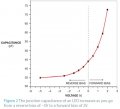
There is a good discussion here on LED capacitance and turn-on/turn-off time.So LEDs do have some inherent capacitance after all that interferes with their ability of being switched at high frequency... right?
I take offense to the term "antique" calculatorThat's just the sort of issue I was 'afraid of'--- Clearly 'low intensity' LEDs have rather low 'persistence' (as evinced by 'antique' calculators, and their ilk) wherein the strobing of the display may be 'detected' via a photo transistor --- I might have guessed such performance from high output devices was too much to hope for
That's an interesting point!-- In my experience diode pumped YAGs tend to 'start' rather slowly - but then I expect there's a difference between application specific instrumentation and 'hacked' pointers
Many thanks four responses!!!![]()
I miss @Hypatia's Protege, too, but I don't think she's coming back.I take offense to the term "antique" calculator. In this regard though, which version are you thinking of; the red type or the blue type. The blue type, which are not led but, I believe were Vacuum Fluorescent Display , the red were LEDs and the flicker was likely due to slow circutiry and not any afterglow.
or about half the people on this long dead thread. RIP @OBW0549I miss @Hypatia's Protege, too, but I don't think she's coming back.
Now, he's the one I especially miss ...or about half the people on this long dead thread. RIP @OBW0549
Agreed! -- the flicker was down to strobing of the 'digits' (i.e. sequential 'hard' driving of each digit 'in turn' as it were) -- a necessary expedient considering disparity of luminous output LED to LED despite drive current (back in the day) -- hence 'equalization' of apparent brilliance was achieved via a "hit 'em hard' but very briefly" scheme... -- To say nothing of batter conservation....the red were LEDs and the flicker was likely due to slow circuitry and not any afterglow.
Nothing personal @joeyd999 -- Nor anyone else (except, perhaps, @Aleph(0) 's DESERTION!) - The new forum software (as regards the blog feature) 'un-did' years of work --My fault, of course, for relying on a third-party feature (to wit: the 'old' blog feature) -- still it left us 'high and dry' -- Well... in @Aleph(0) 's case perhaps 'low and definitely WET' (Phillips vodka from plastic bottlesI miss @Hypatia's Protege, too, but I don't think she's coming back.