Facebook
 Google
 GitHub
 Linkedin

Ok, this is where I stand at this point, power-wise:
After quite a bit of tests and experimenting, I got these two results:
I was expecting for lower, and not higher, power being drawn when using a crystal because the datasheet says that's the most efficient external oscillator mode. But I'm guessing that power is higher because the 31 kHz internal oscillator never stops, and with the external crystal there are two oscillators working simultaneously.
Since my program needs to check for an event only once every two seconds or so, what I did was use the crystal to asynchronously run Timer1 in counter mode and then put the device to sleep while that's happening. The device wakes up very briefly to check the status of said event, and then goes back to sleep until the next interrupt. That resulted in a power draw of only 11.2 µA average.
I consider that to be a significant improvement.
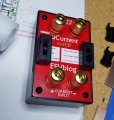
And btw, I have a new toy . I did those measurements using an australian µCurrent device bought directly from none other than EEVblog's Mr David Jones himself. It's a beautiful and quite useful little gadget.
After quite a bit of tests and experimenting, I got these two results:
- 15.3 µA are drawn by my circuit when using the internal low power 31 kHz oscillator as the clock source
- 19.4 µA are drawn when using an external 32.768 kHz crystal as the MCU's clock source
I was expecting for lower, and not higher, power being drawn when using a crystal because the datasheet says that's the most efficient external oscillator mode. But I'm guessing that power is higher because the 31 kHz internal oscillator never stops, and with the external crystal there are two oscillators working simultaneously.
Since my program needs to check for an event only once every two seconds or so, what I did was use the crystal to asynchronously run Timer1 in counter mode and then put the device to sleep while that's happening. The device wakes up very briefly to check the status of said event, and then goes back to sleep until the next interrupt. That resulted in a power draw of only 11.2 µA average.
I consider that to be a significant improvement.
And btw, I have a new toy
. I did those measurements using an australian µCurrent device bought directly from none other than EEVblog's Mr David Jones himself. It's a beautiful and quite useful little gadget.