LEADING Power Factor Correction Problem

Thread Starter

oh_well1500

Joined Jul 30, 2024
4
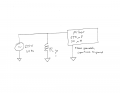
20240730144530123-1.pngQUESTION,I can get into specifics later, but on a conceptual level, I have 277 V 60 Hz from a three phase source powering a low pass filter that has enough capacitance that dozens of them at the same facility are causing a LEADING power factor and the utility company is demanding a fix. Could I fix this simply by introducing a shunted inductor with the right amount of inductance to lower the apparent power to more acceptable levels?
 

WBahn

Joined Mar 31, 2012
32,776
This looks like a homework problem.

What happens if you add an inductance as indicated? What affect, mathematically, does it have? Does it lower the apparent power? What level is considered "more acceptable"?

A good place to start would be to draw a schematic showing the actual circuit you need to analyze, instead of a rectangle with some values and notes written on/near it.
 

Papabravo

Joined Feb 24, 2006
22,066
View attachment 328212QUESTION,I can get into specifics later, but on a conceptual level, I have 277 V 60 Hz from a three phase source powering a low pass filter that has enough capacitance that dozens of them at the same facility are causing a LEADING power factor and the utility company is demanding a fix. Could I fix this simply by introducing a shunted inductor with the right amount of inductance to lower the apparent power to more acceptable levels?
Was the utility kind enough to specify the pf it measured? How low is it? Have they also specified what value they would like to see? It is hard to know what success or done might mean without some numbers. That is your problem, not our problem.
 

MisterBill2

Joined Jan 23, 2018
27,358
The immediate issue with adding a shunt inductor is going to be heat, followed closely by excess power dissipation. Thus a low resistance series inductor could cancel out the current pulses drawn by the capacitors.
 

MisterBill2

Joined Jan 23, 2018
27,358
OK, it seems that the "low pass" filters are probably intended to keep distortion products either out or in to the connected load.
So we certainly need to be aware of both the filter components and the load characteristics. Is it a rectifier sort of load, such as a power supply for LED lighting? Or variable frequency rives for all the blowers in a building climate control system? Does the loading vary at all or not?
More information required to avoid a proliferation of random guesses.
The fix will probably be more complex if it is a large number of loads al on different circuits.
 

Thread Starter

oh_well1500

Joined Jul 30, 2024
4
Thank you for the understanding, sorry the filter was messy and I wanted to strip this down to the fundamentals so I could better assess what was going "wrong" or more likely what I was misunderstanding. Below is the actual representation of what I built in the lab today, I moved away from the filter (being almost one big capacitance bank) and really just have capacitors in series represented by the capacitor below, and in parallel I really have a 13 mH inductor in parallel. It performed a little better than the simulation, in terms of total amperage decreasing (that was the original goal of the project, to PF correction in order to get less no load current draw) reading at 20 amps compared to the simulations 24 amps. My question is this Harald, why is this the limit? Why am I not able to achieve lower total current if the current on the inductor line is reading 60 amps and the current on the capacitor line is reading 60 amps in practice, why is this 20 amps present?

1722466695295.png
 

Thread Starter

oh_well1500

Joined Jul 30, 2024
4
I am aiming to have a lot of current in the shunt inductor! Hopefully, I want to minimize the total current, and I thought I could achieve that near resonance, but I am puzzled as to why inductor line reads 60 amps, cap line reads 60 amps, but input and ground line reads 20 amps. Firstly I am looking for an explanation of what I am misunderstanding, this is my first PFCC project I am tackling in practice, and then if I can't extrapolate myself, I would be interested in suggestions on how to get that 20 amp reading even lower.
 

MisterBill2

Joined Jan 23, 2018
27,358
The current flowing in a resonant circuit is not limited by external resistances, Thus the current, or voltage, can be quite a bit more. The power is limited, though. That part does not change.
 

kaindub

Joined Oct 28, 2019
176
How do you avoid having alot of current flow in that shunt inductor?? That is what is puzzling me.
Remember that an inductor has an impedance. no matter that it has a low DC resistance, the AC impedance will be far higher, (depending on the inductor value) so the AC current flowing will be low.
 

kaindub

Joined Oct 28, 2019
176
I am aiming to have a lot of current in the shunt inductor! Hopefully, I want to minimize the total current, and I thought I could achieve that near resonance, but I am puzzled as to why inductor line reads 60 amps, cap line reads 60 amps, but input and ground line reads 20 amps. Firstly I am looking for an explanation of what I am misunderstanding, this is my first PFCC project I am tackling in practice, and then if I can't extrapolate myself, I would be interested in suggestions on how to get that 20 amp reading even lower.
Something wrong with your simulation. The impedance of a 550u cap at 60Hz is 482ohms. So a current a little over 2 amps will flow through it.
Also if you get the value of the inductor correct, the current through it will be 180 deg out of phase with the cap current.
 

MisterBill2

Joined Jan 23, 2018
27,358
Aside from power factor correction, the other intention of all PFC circuits is improving efficiency. In the circuit shown in post #7, if only one amp flows in the inductor, that will be 277 WATTS of heat in that one ohm resistance. Normally, heat generated in a filter is considered wasted power.

So once again, I suggest that the inductance should be IN SERIES with your capacitive load presented by those filters in the capacitor low-pass filter that is the load input. Consider that a series LC circuit presents a resistive impedance at resonance.
 

Thread Starter

oh_well1500

Joined Jul 30, 2024
4
What is confusing me Kain, is I built the circuit, with a 12.8 mH inductor, in parallel with a capacitor bank of 550 uF, and I am measuring 60 amps on the cap bank line, 60 amps on the inductor line, and 20 amps on the input current before the node.
 
Was the utility kind enough to specify the pf it measured? How low is it? Have they also specified what value they would like to see? It is hard to know what success or done might mean without some numbers. That is your problem, not our problem.
What if someone asked you, in general, how you would approach this problem, and to reason about how to solve it? What would you say?

And yes there are a lot of cases, but if someone said one million dollars for the best answer, what could you come up with?

And yes we know you have other things to do, blah, blah, blah, but since you're here browsing questions anyhow, how about some kind of an answer to get them thinking, then ask for more information???

You think that would be ok?
 

Danko

Joined Nov 22, 2017
2,153
Why am I not able to achieve lower total current if the current on the inductor line is reading 60 amps
and the current on the capacitor line is reading 60 amps in practice, why is this 20 amps present?
V_sup = 360 V
I = 60 A through inductor and capacitor.
P consumed by resistor 1 Ω = (I^2)*R = 3600 W.
P_tot = 3600*2 =7200 W.
I_active = P_tot / V_sup = 7200 / 360 = 20 A.
ADDED:
According your current 60 A through L and C,
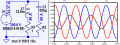
simulation should be looks like this:
1722640973098.png
 

Attachments

Last edited:

Papabravo

Joined Feb 24, 2006
22,066
What if someone asked you, in general, how you would approach this problem, and to reason about how to solve it? What would you say?

And yes there are a lot of cases, but if someone said one million dollars for the best answer, what could you come up with?

And yes we know you have other things to do, blah, blah, blah, but since you're here browsing questions anyhow, how about some kind of an answer to get them thinking, then ask for more information???

You think that would be ok?
Well, I don't know how you do engineering, but I need numbers to quantify a problem for several reasons, the most important of which is to know what "done" means. If the requirements are reasonable then reasonable efforts are warranted. I did not spend decades as a consultant by taking on speculative projects with ill-defined objectives.
 

MisterBill2

Joined Jan 23, 2018
27,358
Now for a reality check: Does it really make sense to compensate for a capcitive load power factor with a parallel resonant circuit???Most often, to compensate for a phase lead (leading current power factor) the plan would be to insert a series lagging current element, which would be an inductor. So why not try that in the simulator? The best part will be that when the load current drops the inductor current also drops. Much more efficient.
 
Top