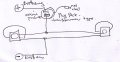
Depending on the age, manufacturer, and previous application of those two old land-line phones, there may be a polarity problem that can be solved by swapping the red and green wires to the phone that has the problem. The two phones in series with a single 9 volt battery will work just fine if they are both off hook. On some party line systems there was a need to pull up one of the cradle pins to engage the microphone. Funny that nobody mentioned that. If one phone has an electret microphone instead of a carbon mic then it is probably polarity sensitive. That was an issue with some of the electronic phones at one time.
...If one phone has an electret microphone instead of a carbon mic then it is probably polarity sensitive. That was an issue with some of the electronic phones at one time.
It is true that the problem was solved, but the fix was not retroactive to all of those phones that had the problem. So there are still quite a few polarity sensitive phones around. That may be the case in this instance. AND also, there are still surplus phones with that party line feature in the surplus stream. With the handset hung on hook they are impossible to spot.
It is true that the problem was solved, but the fix was not retroactive to all of those phones that had the problem. So there are still quite a few polarity sensitive phones around. That may be the case in this instance. AND also, there are still surplus phones with that party line feature in the surplus stream. With the handset hung on hook they are impossible to spot.
I believe if a LED limited to a couple of mA is added in parallel to each telephone, an indication of "intended communication" would tell the operator someone lifted the handset at the far telephone. Have not tried it yet.
On a desk style phone the place where the handset is placed when the call is completed is referred to as the cradle. Each side of this has a "pin", about 1/4 inch diameter. that is pushed down by the handset being placed in the cradle. On some telephones used with party lines the microphone was not connected until the white pin was pulled up about 1/2 inch. This was done so that a person picking up the phone would not disrupt a conversation in progress by the other party on that line.
That same switch was also occasionally used in special installations to disconnect all of the other phones on that line at that location. In those installations it was called the privacy key.
There is no equivalent to these functions on a cell phone.
On a desk style phone the place where the handset is placed when the call is completed is referred to as the cradle. Each side of this has a "pin", about 1/4 inch diameter. that is pushed down by the handset being placed in the cradle. On some telephones used with party lines the microphone was not connected until the white pin was pulled up about 1/2 inch. This was done so that a person picking up the phone would not disrupt a conversation in progress by the other party on that line.
That same switch was also occasionally used in special installations to disconnect all of the other phones on that line at that location. In those installations it was called the privacy key.
There is no equivalent to these functions on a cell phone.
It is entirely possible that either the microphone itself has failed or one of the wires in the handset cord has failed. A simple resistance check can locate the problem. But you will need to open the handset by unscrewing the cap on the mouthpiece first. It may even be that the microphone cartridge is missing. That happens some times. I should have suggested the resistance check much sooner, sorry about that. Unfortunately nobody considered the possibility that a phone could be defective or even damaged. But that does happen.
It is entirely possible that either the microphone itself has failed or one of the wires in the handset cord has failed. A simple resistance check can locate the problem. But you will need to open the handset by unscrewing the cap on the mouthpiece first. It may even be that the microphone cartridge is missing. That happens some times. I should have suggested the resistance check much sooner, sorry about that. Unfortunately nobody considered the possibility that a phone could be defective or even damaged. But that does happen.
In theory a WE DM2500 set can break. But the abuse required is so extreme it would probably also injure the abuser.
You made me nostalgic, I might pick up a genuine set and put my Cortelco analog line adapter on it to connect it to my VoIP service. Those Cortelcos are pretty amazing, cheap as dirt and full featured.
It is entirely possible that either the microphone itself has failed or one of the wires in the handset cord has failed. A simple resistance check can locate the problem. But you will need to open the handset by unscrewing the cap on the mouthpiece first. It may even be that the microphone cartridge is missing. That happens some times. I should have suggested the resistance check much sooner, sorry about that. Unfortunately nobody considered the possibility that a phone could be defective or even damaged. But that does happen.
An audio choke is a coil of wire, usually wound on an iron core. The choke allows the DC power from you battery to pass (with some loss) but blocks the audio signal. Using a relay coil as the choke may work.
One to try may be an old plugpack power supply. Not a switch mode one, but the old heavy transformer based ones. Not as a power supply, but feed the battery to the phones via the mains pins so you use the transformer primary coil as the audio choke.
DO NOT CONNECT TO THE MAINS.
But if you do not have a parts bin, maybe stick with how you are going.
The phones will work very well in series if they both work at all. the advantage when doing this in a kids play setup is that when not in use there is no battery drain. And since kids may not always remember to hang up both phones that does matter,My guess now is that either there is a wrong connection inside the phone or a fault in the microphone connection on the phone that does not talk. Those phone cords do break inside. And if it is new enough to use modular connection cords, those connections are also subject to failure.

 Facebook
 Google
 GitHub
 Linkedin