L vs. C

Thread Starter

Wendy

Joined Mar 24, 2008
23,798
OK, starting over:

#3.png

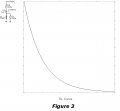
after this circuit settles down, R1 will have zero volts across it since the coil will effectively short the DC to ground. When S1 one is pressed however the surge voltage across R1 will be 10V, and discharge according to the curve shown in the Figure 1.

Does anyone disagree with the above statement? This is what I was trying to talk about when I started this thread.
 
Last edited:

Papabravo

Joined Feb 24, 2006
22,082
OK, starting over:


after this circuit settles down, R1 will have zero volts across it since the coil will effectively short the DC to ground. When S one is pressed however the surge voltage across R1 will be 10V, and discharge according to the curve shown in the Figure 1.

Does anyone disagree with the above statement? This is what I was trying to talk about when I started this thread.
It looks fine by me. This of course means that the instantaneous value of the change in current when the switch opens is:

\( \cfrac{di}{dt}=1\times10^{-6}\text{ Amperes/sec} \)

and steadily decreases as the voltage across the resistor returns asymptotically to 0.
 
Last edited:

Thread Starter

Wendy

Joined Mar 24, 2008
23,798
The coil is a short in DC, so R1 has zero volts starting condition after the circuit has settled down. It gets the spike (created by L1) shown in the diagram when the push button is pressed.
 

xox

Joined Sep 8, 2017
936
The coil is a short in DC, so R1 has zero volts starting condition after the circuit has settled down. It gets the spike (created by L1) shown in the diagram when the push button is pressed.

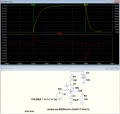
Okay, this is confusing. I tried it in the simulator and it showed a spike of ~371mV with those component values. Increasing the inductance to 1H seemed to yield 5V, which is what I expected for both cases. In any event I never was detect a 10V spike through R1. May be just a limitation in the simulation. Do you have any recommendations for further reading which might help me understand the mechanism a little better?


Inductors look like short circuits in steady-state DC circuits.

But it will have an effect if the DC is turned on and off.


That makes sense. The change in the field is what really matters. So for a moment at least, such a DC circuit "behaves" like an AC circuit.
 

Thread Starter

Wendy

Joined Mar 24, 2008
23,798
Understand the simulator I use is it is between my ears, I just wanted to check my understanding of inductors in the real world. Which is why I started this thread.
 

Papabravo

Joined Feb 24, 2006
22,082
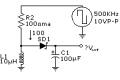
So, what would the voltage be across C1?
Should be 1 Schottky diode drop below +10V after reaching steady state.
Just curious what you mean by "100Ωma", as a value for the resistor.
EDIT: Wrong answer. Because there is no discharge path from C1 to GND the capacitor voltage keeps rising by ever smaller amounts as the voltage across the inductor exceeds the P-P value of the source.
 
Last edited:

crutschow

Joined Mar 14, 2008
38,512
So, what would the voltage be across C1?
That's an odd circuit.
The inductor will pull the voltage negative, when the square-wave goes low.
The only time the diode may conduct is when the the square-wave is high.

What, exactly, do you think it should do?
 
Last edited:

Papabravo

Joined Feb 24, 2006
22,082
That's an odd circuit.
The inductor will pull the voltage negative, when the square-wave goes low.
The only time the diode may conduct is when the the square-wave is high.

What, exactly, do you think it will do?
It appears to charge the capacitor to a higher voltage than the positive peak of the generator. Looks like it asymptotically approached about 13VDC.
 
Top