KVL in transfomers

MrAl

Joined Jun 17, 2014
13,702
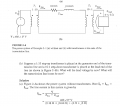
Do I write KVL equations for Primary side and secondary side of transformer correctly?
View attachment 340146
Hi,

The very first thing you should do here is figure out how to express an impedance of a resistor in series with an inductor.
The inductor is represented as either "s*L" or as "j*w*L", and this is just with s=j*w. Thus, when you add the two, you get:
Z=R+j*w*L
and since X is w*L we can write:
Z=R+j*X
if you like.
The magnetude is then:
A=sqrt(R^2+X^2)
and the phase shift is:
Ph=atan2(X,R)
Note that R is the resistance and also the real part, and X is the reactance and also the imaginary part.

I assume the core can be represented as an "ideal" transformer with only a winding ratio 'a' as parameter, meaning the output voltage Vout is:
Vout=Vin/a
from the input of that part of the schematic to the output, not including the inductors and resistors.
The output current is the input current multiplied by 'a':
Iout=Iin*a
 

Thread Starter

linhvn

Joined Nov 6, 2024
297
Hi,

The very first thing you should do here is figure out how to express an impedance of a resistor in series with an inductor.
The inductor is represented as either "s*L" or as "j*w*L", and this is just with s=j*w. Thus, when you add the two, you get:
Z=R+j*w*L
and since X is w*L we can write:
Z=R+j*X
if you like.
The magnetude is then:
A=sqrt(R^2+X^2)
and the phase shift is:
Ph=atan2(X,R)
Note that R is the resistance and also the real part, and X is the reactance and also the imaginary part.

I assume the core can be represented as an "ideal" transformer with only a winding ratio 'a' as parameter, meaning the output voltage Vout is:
Vout=Vin/a
from the input of that part of the schematic to the output, not including the inductors and resistors.
The output current is the input current multiplied by 'a':
Iout=Iin*a
So is this KVL correct??
1736703235196.png
 

MrAl

Joined Jun 17, 2014
13,702
So is this KVL correct??
View attachment 340217
It looks like you have the right idea, but it also looks like you are not reading all of the replies you get.
In the past replies we told you that you can not add a resistance to a reactance directly, but you are doing it again.
R1+X1 does not mean anything useful. You have to write at least R1+j*X1, which will then later resolve into a real value.

You seem to have the right idea about everything else though, and if you do not understand the "j*X1" then what you should do is short out both inductors so you only have R1 and R2, then solve that first. After you do that, come back to the original problem.

You are going to have to learn about adding resistances and inductances in series when doing these kinds of problems. If you don't you will have a lot of problems not only with this question but even more so when you get to the more advanced questions with mutual inductance.

Do you have questions about doing R1+j*X1 ?
 

schmitt trigger

Joined Jul 12, 2010
2,085
In plain English, you must learn how to mathematically manipulate complex numbers, which can be expressed in either polar (Z, theta) or rectangular (R +jX) notation.
 

MrAl

Joined Jun 17, 2014
13,702
In plain English, you must learn how to mathematically manipulate complex numbers, which can be expressed in either polar (Z, theta) or rectangular (R +jX) notation.
Yeah and there's also the A*e^(j*TH) with TH being the phase angle.
I usually prefer the r+j*i form for these problems though, until the end of the calculation when the (magnitude, phase) form is useful. That's because a lot of software can handle the rectangular form easily.

One of the first 'good' symbolic calculators I got in the past could handle both the rectangular form and the (magnitude,phase) form without having to manually convert. It was pretty cool and I haven't seen that in any math software yet.
This means that when you would go to add something like a+b*j plus c+d*j you did not have to present it in that form, you could even do a+b*j plus (A,TH) with A being the amplitude and TH the phase angle. No need to convert (A,TH) into the rectangular c+d*j form first. I thought that was very clever of them (Texas Instruments). They even allowed "A /_ TH" where I used "/_" to indicate the usual "angle" sign we see sometimes when used for that.
Too bad though, Texas Instruments took a dive which totally turned me off of their calculators when they decided to make all variables of upper case equal to all lower case, which meant that a=A and A=a for every calculation. That was the DUMBEST thing they ever did. That meant that "Resistor" would be changed to "resistor", and worse yet, "R" would be changed to "r". That meant that you could not enter a formula like R=r+1 because it would change to r=r+1. In the first case R and r are separate variables while in the second case r and r are both the same obviously. No way. That also meant that I could not use programs I wrote for the previous calculator for the new calculator without modifications.
I used it for a short time then set it on a shelf and there it lay for a good 20 years or more.
They also refused to repair one of my much older calculators, the TI58 which although old and outdated I still liked it and wanted to keep it just as an antique calculator. It had red LED's not the more typical LCD's we see now.
 
Top