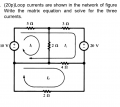
Kirschoff rule on this question

Thread Starter

sirdasara

Joined Jan 18, 2026
5
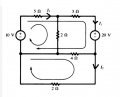
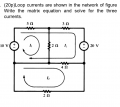
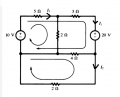
Hello guys, first of all I'm new here so if this is the wrong forum I'm sorry. I want to ask a simple question, while applying KCL, do we calculate the voltage on 5ohm as 5(I1+I3) or 5(I1-I3) ? and can somebody please give me the solution. My solution matrix is (I calculated using 5(I1+I3) because they point to same direction):

[7 0 5] [I1] [10]
[0 6 -4] [I2] =[0]
[5 -4 12] [I3] [-20]

and I calculated I1 ~= 4.79A. Is this correct? Normally I divide all cells to their individual currents but this question specifically wants us to solve this way.
1768766118577.png
 

WBahn

Joined Mar 31, 2012
32,703
Hello guys, first of all I'm new here so if this is the wrong forum I'm sorry. I want to ask a simple question, while applying KCL, do we calculate the voltage on 5ohm as 5(I1+I3) or 5(I1-I3) ? and can somebody please give me the solution. My solution matrix is (I calculated using 5(I1+I3) because they point to same direction):

[7 0 5] [I1] [10]
[0 6 -4] [I2] =[0]
[5 -4 12] [I3] [-20]

and I calculated I1 ~= 4.79A. Is this correct? Normally I divide all cells to their individual currents but this question specifically wants us to solve this way.
View attachment 362309
As this is a homework problem, we can't give solutions, only guidance of how to get a bit further.

You've found a potential solution, namely I1 = 4.79 A. (Plus, you can also get the corresponding values of I2 and I3).

Imagine someone came up to you and asked you to verify if those values are correct. How could you do it without starting from scratch and solving for them yourself?

One of the beautiful things about most engineering problems is that the correctness of a solution can usually be determine from the solutions themselves by seeing if they actually solve the problem.

So let's see how we could do it.

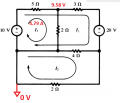
I1 is the only loop current flowing through the vertical resistor, so start there. Let's define the bottom of the 10 V supply as our common reference node. The voltage across the vertical resistor is (4.79 A)(2 Ω) = 9.58 V

1768769770894.png

That means that the voltage on the top center node is 9.58 V and the voltage across the 5 Ω resistor is 0.42 V, making the current through it 84 mA.

Since this is the sum of I1 and I3, this makes I3 equal to -4.706 A.

If that doesn't match what your solution yields for I3 (within reasonable roundoff), then something is wrong. If it does agree, then you can keep going. I have to leave for a meeting, so I'll let you push forward from here.
 

MrChips

Joined Oct 2, 2009
34,628
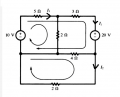
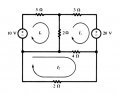
Compare the two diagrams. The currents are the same. Nothing has changed expect that the current is placed in the branches. Use KCL to analyze the currents at each node. Use KVL to analyze the voltage around the loop.

1768769473884.png

1768769486110.png

I1 is the current flowing in the 5 Ω resistor.
I3 is the current flowing in the 3 Ω resistor.
I2 is the current flowing in the lower 2 Ω resistor.
 

Attachments

WBahn

Joined Mar 31, 2012
32,703
Compare the two diagrams. The currents are the same. Nothing has changed expect that the current is placed in the branches. Use KCL to analyze the currents at each node. Use KVL to analyze the voltage around the loop.

View attachment 362317

View attachment 362318

I1 is the current flowing in the 5 Ω resistor.
I3 is the current flowing in the 3 Ω resistor.
I2 is the current flowing in the lower 2 Ω resistor.
No they are not the same.

In the diagram as given, I1 is the only loop current flowing through the vertical 2 Ω resistor.

In your diagram, the current in that resistor is (I1 - I3)
 

MrChips

Joined Oct 2, 2009
34,628
No they are not the same.

In the diagram as given, I1 is the only loop current flowing through the vertical 2 Ω resistor.

In your diagram, the current in that resistor is (I1 - I3)
Do it either way and the end result is the still the same, i.e. the current flowing in the 5 Ω resistor is still the same, whether you want to call it I1 or (I1 + I3). Call it I5 for all I care.
 

Thread Starter

sirdasara

Joined Jan 18, 2026
5
Thank you guys so much. Your answers match mines and I really appriciate your effort. By the way this is not a homework just old exam questions and I am studying for an exam. I respect the fact that homework solutions are not allowed and just wanted to state that. Again, thank you so much.
 

WBahn

Joined Mar 31, 2012
32,703
Do it either way and the end result is the still the same, i.e. the current flowing in the 5 Ω resistor is still the same, whether you want to call it I1 or (I1 + I3). Call it I5 for all I care.
If the end result is the grade awarded to the work submitted, then it wouldn't be the same either way.

In the "real world", you get to choose how you will go about solving a problem. On a homework assignment or exam, if you choose to not follow the directions, it's reasonable to expect a poor grade.
 

MrAl

Joined Jun 17, 2014
13,667
Compare the two diagrams. The currents are the same. Nothing has changed expect that the current is placed in the branches. Use KCL to analyze the currents at each node. Use KVL to analyze the voltage around the loop.

View attachment 362317

View attachment 362318

I1 is the current flowing in the 5 Ω resistor.
I3 is the current flowing in the 3 Ω resistor.
I2 is the current flowing in the lower 2 Ω resistor.
Hi there,

What you are indicating with the added arrows is the branch currents. They are different than the loop currents (original).

To see the difference graphically, note that I2 does not flow ONLY through the 4 Ohm resistor, it also flows through the 2 Ohm resistor and the 10v voltage source, as well as the 20v voltage source. That's because there's no general way to restrict the flow to only the 4 Ohm resistor. Even if there was only one other branch it would still not be the same as the loop current.
Also note that there are specific loops given as well.
Another variation for this circuit would be mesh analysis, but they are not asking for that either as we can see from the upper right loop which spans two smaller loops.

Because we can do a loop analysis OR use branch currents to solve this, we should get the same result. The only problem with that is the problem statement is asking that it be solved using loop currents not using branch currents.
 

WBahn

Joined Mar 31, 2012
32,703
Thank you guys so much. Your answers match mines and I really appriciate your effort. By the way this is not a homework just old exam questions and I am studying for an exam. I respect the fact that homework solutions are not allowed and just wanted to state that. Again, thank you so much.
Even though it's not homework in actuality, it is homework in spirit in that your goal is to learn, which is usually best achieved by you doing as much of the work, and struggling though as much of the frustration, as possible. Which is why we still only try to guide you a bit at a time or give hints that will help you make the needed connections. From a more practical matter, we do get people that are just wanting someone to do their work for them who think they can trick us into doing it by claiming that it's not homework. Those people are usually pretty easy to spot, however, because they seldom make any genuine effort and don't want to actually engage in a discussion, but just want the answer given, usually claiming that it is just to check their results.
 

MrChips

Joined Oct 2, 2009
34,628
Regardless of what the question is asking, suppose you needed to determine the voltages at each node and the current flowing in each resistor, it doesn't matter what method you choose. I would have done it this way:

KCL example2.jpg
 

WBahn

Joined Mar 31, 2012
32,703
Regardless of what the question is asking, suppose you needed to determine the voltages at each node and the current flowing in each resistor, it doesn't matter what method you choose. I would have done it this way:

View attachment 362434
So would I. But it is of absolutely no help to the TS since they were specifically asking for assistance with setting up the solution according to the dictates imposed by the problem.
 

Thread Starter

sirdasara

Joined Jan 18, 2026
5
Thank you all for your answers. As @WBahn said, current loops and directions were specifically given in the question and it wanted us to solve accordingly. If I could, I would apply the loops the same as @MrChips method but I wanted to learn about I3 I1 relation on the specifically drawn current loops (When they point the same and their starting point is the same). And since WBahn's calculations matches mine, I have learnt it.
 

WBahn

Joined Mar 31, 2012
32,703
Thank you all for your answers. As @WBahn said, current loops and directions were specifically given in the question and it wanted us to solve accordingly. If I could, I would apply the loops the same as @MrChips method but I wanted to learn about I3 I1 relation on the specifically drawn current loops (When they point the same and their starting point is the same). And since WBahn's calculations matches mine, I have learnt it.
Note that I never calculated an answer. I started the process of verifying whether or not your proposed answer is correct and left it up to you to finish.

In fact, your answer is NOT correct, which is why it is important to verify your answers as independently as possible. I showed you how to start working from the answer and seeing it it produces results that are free of contradictions. But you need to work it all the way through, because contradictions only show up at the very end (the solution either does or doesn't "close").

Another alternative is to use a different approach entirely to solve the problem and compare results. When verifying a result, you are not bound by the constraints given in the problem -- use any method you like, just use a different one. It is unlikely that you will make the same mistake in both approached (unlikely, but not impossible, which is why determining if the proposed solution closes or not is generally the stronger indicator of correctness).

In this case, you can significantly simplify the given circuit.

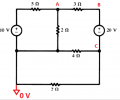
Let's start with the basic circuit and label some nodes:

1768951333786.png

If you look at the original problem, you will see that I1 is the current flowing downward through the vertical 2 Ω resistor, which you claim is 4.79 A.

In the diagram above, that current is equal to (Va / 2 Ω). So we only need to determine Va to see if your answer (at least for I1) is correct.

Notice that the bottom two resistors are in parallel since the are both connected to Node C on one side and 0 V on the other. So they can be combined into a single resistor that is 1.333 Ω.

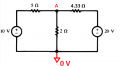
That then means that the combined resistor is in series with the 20 V source and the 3 Ω resistor and we can rearrange them however we like as long as they remain in series. This gets us to:

1768951913997.png
Solving this for Va is very simple and yields a voltage of 7.11 V, which results in a current through the 2 Ω resistor of 3.55 A, which is significantly different than your result.

You really should work through the verification that I started for you and see for yourself that it doesn't close.
 

Thread Starter

sirdasara

Joined Jan 18, 2026
5
Yes, I calculated Va as 7.11V as you said, but in the main question when I try to do KVL mesh analysis I calculate as 5(I1+I3) + 2I1 -10 = 0 . Because I1 loop and I3 loop points to the same direction. And then I obtain various equations for I2 and I3. The main question is: is it correct that I use 5(I1+I3)? Now you said 4.79A = I1 is wrong I'm confused because that's what I've calculated.
 

WBahn

Joined Mar 31, 2012
32,703
Yes, I calculated Va as 7.11V as you said, but in the main question when I try to do KVL mesh analysis I calculate as 5(I1+I3) + 2I1 -10 = 0 . Because I1 loop and I3 loop points to the same direction. And then I obtain various equations for I2 and I3. The main question is: is it correct that I use 5(I1+I3)? Now you said 4.79A = I1 is wrong I'm confused because that's what I've calculated.
If I1 is 4.79 A, the Va is 9.58 V. So there are only three possibilities:
1) Va is 7.11 V and I1 is not 4.79 A.
2) I1 is 4.79 V and Va is not 7.11 V.
3) Va is not 7.11 V and I1 is not 4.79 A.

There is no fourth possibility in which Va is 7.11 V and I1 is 4.79 A -- those two claims are mutually exclusive. At least one, possibly both, are wrong.

So now the effort needs to be focused on finding out which, if either is correct.

If you follow through on verifying whether or not I1 can be 4.79 A, you will discover that the problem doesn't close, so it is not correct. That doesn't mean that Va is, indeed, 7.11 V (we could have made a mistake there, too). So it might be worth seeing if it will close.

I can't tell you where you went wrong in setting up your matrix equation because you didn't show your work.

Do yourself a huge favor and get in the habit of presenting your work fully and methodically. This will make it less likely that you will make a mistake, make it a lot easier to find and fix most mistakes that you do make, and give the grader plenty of opportunity to see what you did right and wrong so that they can award as much partial credit as possible. Also, check the correctness of every answer you get and show that check as part of your work. If you do that in school, you will see your grades shoot up. If you keep doing it at work, you will see a lot more promotions and bonuses come your way.

First, take care of the EE stuff -- and ONLY the EE stuff. Set up your equations so that they clearly match the problem. Don't simply things at this stage.

After you have written the EE stuff, go through and carefully verify that you are satisfied that it is correct. These equations are the mathematical representation of the circuit in the problem. Any mistakes at this point mean that you are simply solving a different circuit and the math beyond this point neither knows nor cares, so it is critical that this be checked before proceeding.

EE Stuff:
Sum of voltage gains around each loop must be zero:
I1: + (10 V) - (I1 + I3)(5 Ω) - (I1)(2 Ω) = 0
I2: - (I2 - I3)(4 Ω) - (I2)(2 Ω) = 0
I3: + (10 V) - (I1+I3)(5 Ω) - (I3)(3 Ω) - (20 V) - (I3 - I2)(4 Ω) = 0

Math Stuff:
Rearrange loop equations into standard form:
I1: (7 Ω)(I1) + (0)(I2) + (5 Ω)(I3) = +10 V
I2: (0)(I1) + (6 Ω)(I2) - (4 Ω)(I3) = 0
I3: + (5 Ω)(I1) - (4 Ω)(I2) + (12 Ω)(I3) = -10 V

Extract the matrix form of the equations:
[7 Ω, 0, 5 Ω] [I1] [10 V]
[0, 6 Ω, -4 Ω] [I2] = [0]
[5 Ω, -4 Ω, 12 Ω] [I3] [-10 V]

Note that I can divide both sides of each row by 1 Ω to get a cleaner representation:
[7, 0, 5] [I1] [10 A]
[0, 6, -4] [I2] = [0]
[5, -4, 12] [I3] [-10 A]
 
Last edited:

MrAl

Joined Jun 17, 2014
13,667
Regardless of what the question is asking, suppose you needed to determine the voltages at each node and the current flowing in each resistor, it doesn't matter what method you choose. I would have done it this way:

View attachment 362434
Hi again,

Yeah I like that better too, it's actually mesh analysis. It works on a lot of networks, but from what I understand it does not work on some networks that are non-planar. It's great for these simpler ones though.

I usually use Nodal Analysis though even though it could result in one more equation.
 
Top