KETTLE OF DEATH (jj) AC Voltage stepdown question

strantor

Joined Oct 3, 2010
6,875
A dimmer rated at 1 kW or more
You're unlikely to find an ordinary light dimmer rated this high, but there triac power controllers, exactly the same as a dimmer, for use with power tools (esp. Those with Series wound motors). My go-to unit for these type of things is the "Router Speed Controller" from Harbor Freight. Surely there are devices on the other side of the pond appropriately rated for your higher voltage.
 

KMoffett

Joined Dec 19, 2007
2,918
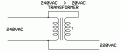
An easy way to step down you line voltage is a Buck/Boost transformer connection. You get a step-down control transformer with primary equal to your line voltage and a secondary equal to voltage you want subtract. Wire the primary across the line. Wire the secondary in series with the one side of line to the load. (attached). Of course this depends on whether you line voltage is stable. Otherwise the step down subtraction voltage will vary in proportion to the input voltage. The phasing of the secondary connection will either cause a buck or boost.

Ken

TransformerBuckingBoosting.gif

Oh, the secondary current rating should be equal to or greater than the load current.
 
Last edited:

takao21203

Joined Apr 28, 2012
3,702
in the 1930s radios usually had selector switches for different line voltages, like 6 or different positions.

To worry so much about a kettle getting a little more voltage, I cant follow, bcz it will do nothing.

They dont work them just on the margin of catching fire.

Anyway kettles dont cost much. I use it always when cooking, its faster than the microwave / I can heat something at the same time.

instant noodles first I use hot water from kettle then a few minutes microwaving, though if you wait this is not required.

But I add frozen things often, and if I heat up water in the microwave until boiling it takes considerably long time.

A picture of the kettle?
 

BR-549

Joined Sep 22, 2013
4,928
I would try it.....it was built in the 30s.

Install bottom cover. Fill with water. Plug it in to your voltage. Verify operation by listening for bi-metal click. It's connecting the resistors I believe.

If it's not....just monitor current for a while. It probably has a greater operational voltage range, than anything modern.
 
Top