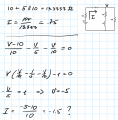
You should adopt some consistent conventions which will help you avoid easy-to-make-but-hard-to-catch errors like this.
When applying KCL, write the equation as currents into the node equals currents out of the node. This eliminates minus signs in the setup equation and makes it easier to verify that the equation is correct at a glance. When we try to write all of the terms on one side, with some of them positive and some of them negative, it makes it easy to get tripped up.
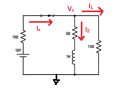
While writing the equations down by inspection is fine, until you get a bit more comfortable and confident, it might be better to annotate your diagram with symbolic currents and then write you set up equation in terms of them first.
You should avoid using variables that directly match either common generic equation variables (like I, R, and V) or that match relevant units (like V). If there is only one of something -- like one resistance -- this isn't a biggie. But if there are more than one, you want to use a unique identifier for it to avoid getting confused at some point.
Ix = I1 + I2
Then write each current in terms of the voltages and resistances.
One thing to keep in mind is that Ohm's Law involves voltage differences across resistances. The voltage at a particular node has no meaning except in relation to some reference point. Always be sure to indicate what your reference point is -- don't force the reader to make assumptions about what you intended.
Write this equation in the same order as the one it is replacing. This makes it easy to confirm that each term was done correctly.
Finally, properly track the units throughout your work. Most mistakes you will make will mess up the units, allowing you to catch them right then before wasting a bunch of time on work past the point at which it was guaranteed to be wrong.
You should adopt some consistent conventions which will help you avoid easy-to-make-but-hard-to-catch errors like this.
When applying KCL, write the equation as currents into the node equals currents out of the node. This eliminates minus signs in the setup equation and makes it easier to verify that the equation is correct at a glance. When we try to write all of the terms on one side, with some of them positive and some of them negative, it makes it easy to get tripped up.
While writing the equations down by inspection is fine, until you get a bit more comfortable and confident, it might be better to annotate your diagram with symbolic currents and then write you set up equation in terms of them first.
View attachment 288438
You should avoid using variables that directly match either common generic equation variables (like I, R, and V) or that match relevant units (like V). If there is only one of something -- like one resistance -- this isn't a biggie. But if there are more than one, you want to use a unique identifier for it to avoid getting confused at some point.
Ix = I1 + I2
Then write each current in terms of the voltages and resistances.
One thing to keep in mind is that Ohm's Law involves voltage differences across resistances. The voltage at a particular node has no meaning except in relation to some reference point. Always be sure to indicate what your reference point is -- don't force the reader to make assumptions about what you intended.
Write this equation in the same order as the one it is replacing. This makes it easy to confirm that each term was done correctly.
Finally, properly track the units throughout your work. Most mistakes you will make will mess up the units, allowing you to catch them right then before wasting a bunch of time on work past the point at which it was guaranteed to be wrong.
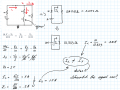
Thank you for your help WBahn and MrChips, this fixes the negative sign. Can you explain why I get different Ix when I use the equivalent resistance method?
Thank you for your help WBahn and MrChips, this fixes the negative sign. Can you explain why I get different Ix when I use the equivalent resistance method?
I don't understand this explanation. I am using to equivalent methods for calculating Ix but the yield different Ix values I don't understand where re arror is. Please help. Thank you.
I don't understand this explanation. I am using to equivalent methods for calculating Ix but the yield different Ix values I don't understand where re arror is. Please help. Thank you.

 Facebook
 Google
 GitHub
 Linkedin