Joule Thief Help getting started

Thread Starter

davebert

Joined May 22, 2010
23
Hi Guys and Gals,
I haven't been messing with electronics for a while and now I have a small project I want to make. I need to light 3 IR Led's:
Forward Voltage 1.5
Forward Current 100mA
Battery 2-AA for 3V

I could do this easily a few different ways with just resistor or resistors depending if parallel or series circuit and battery type and voltage, but the efficiency would be lousy. Someone suggested a "joule thief". Another suggested a Q5252 IC and yet another a LM3410 IC circuit. I bought some LM3410's and man are they small. And SMT too. I wasn't prepared for that. o_O The Q5252's are still on the way so I figured the regular old joule thief would be the way to go. I never made one and the designs are all over the place but a lot of differences between them. So I have some axial inductors on order, some transistors(2N3904), some resistors, I have capacitors etc. I never wound or used an inductor in my life but read enough to use it but was going to use the axial ones as I have no toroids(yet) and I want the project to remain small. I also ordered some SOT23 adapter boards for the LM3410 for later. That said, am I on the right track to make a joule thief with one transistor, an inductor, a resistor, and the 3 Led's in a serial circuit and expect it to do what I want? Any advice or help get me started will be much appreciated. First the bread board, then the pcb. :p
Thanks
 

iONic

Joined Nov 16, 2007
1,662
Are these IR LEDs to be wired in series or parallel? 100mA or 300mA may be a stretch for some Joule Thieves.
In my opnion, the new "Jewel Thief" circuits are these.

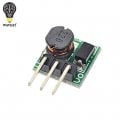
They boost .9V - 5V to 5V with an efficiency greater than the hand built ones. They are tiny as hell and I believe produce 300+mA.
41kOHiJcCxL._SX385_.jpg
https://www.amazon.com/gp/product/B07JFYRB1H/ref=ppx_yo_dt_b_asin_title_o06__o00_s00?ie=UTF8&psc=1

I have purchased from this vendor and did receive them in working order.

I'm not trying to sell you on this particular device, but merely want to let you in on their existence. There are multiple devices that do essentially the same thing.
 

Colin55

Joined Aug 27, 2015
519
You aren't going to get 300 milliamps out of a couple of AA cells for very long.
For all the mucking around with a joule thief, you might just as well use a couple of resistors.
With the reply above, how are you going to adjust the output to 1.7v ????
Most Joule Thief circuits can't convert 3v to a lower voltage.
 

Bernard

Joined Aug 7, 2008
5,784
There are many versions of adjustable DC-DC converters inc. CV-CC. We seldom have enough information
to judge suitability of a OP's project.
 

Thread Starter

davebert

Joined May 22, 2010
23
Are these IR LEDs to be wired in series or parallel? 100mA or 300mA may be a stretch for some Joule Thieves.
In my opnion, the new "Jewel Thief" circuits are these.

They boost .9V - 5V to 5V with an efficiency greater than the hand built ones. They are tiny as hell and I believe produce 300+mA.
View attachment 168117
https://www.amazon.com/gp/product/B07JFYRB1H/ref=ppx_yo_dt_b_asin_title_o06__o00_s00?ie=UTF8&psc=1

I have purchased from this vendor and did receive them in working order.

I'm not trying to sell you on this particular device, but merely want to let you in on their existence. There are multiple devices that do essentially the same thing.
iONic,
Thanks for pointing me to that booster. Kind of something I bought the chips to make one but already made. Uses different IC but quite similar. Now the big question... If my circuit on batteries alone will last 9.33 hours, will this booster using 2-AA batteries make them last longer and if so, how much longer? The circuit can be wired either parallel or series, whichever is best.
Thanks
 
Last edited:

Thread Starter

davebert

Joined May 22, 2010
23
There are many versions of adjustable DC-DC converters inc. CV-CC. We seldom have enough information
to judge suitability of a OP's project.
My project just needs to light the 3 IR LED's with the specs above, for as long as it can with 2-AA batteries. It will be switched on for approximately 3 hours at a time. Series or parallel circuit is fine but efficiency is the goal.
Thanks
 

Thread Starter

davebert

Joined May 22, 2010
23
You aren't going to get 300 milliamps out of a couple of AA cells for very long.
For all the mucking around with a joule thief, you might just as well use a couple of resistors.
With the reply above, how are you going to adjust the output to 1.7v ????
Most Joule Thief circuits can't convert 3v to a lower voltage.
Colin,
I never heard of joule thief until a few weeks ago and watched all kinds of videos showing how you could light an LED with a so called dead battery. I was excited as I need to find a way to make batteries last longer in a project. But I also knew my particular LED's were going to draw 100mA with a forward voltage of 1.5V as opposed to the LED's everyone was using in there demo's..So here I am. In search of. :D
 

iONic

Joined Nov 16, 2007
1,662
iONic,
Thanks for pointing me to that booster. Kind of something I bought the chips to make one but already made. Uses different IC but quite similar. Now the big question... If my circuit on batteries alone will last 9.33 hours, will this booster using 2-AA batteries make them last longer and if so, how much longer? The circuit can be wired either parallel or series, whichever is best.
Thanks
Think about it...if your circuit on batteries alone last 9.33hrs and you ADD additional electronics(adding additional power consumption) the result will be a shorter duration.
If your goal for efficiency is so that you can extend the operating time, then the battery/LED(w limiting R) is your best bet. the only thing that would help the operating time would be to limit the current to each LED to something lower than the rated amount(depends on your use requirements).
The only other way to increase time of operation would be to use batteries with a greater current rating. An Alkaline Battery will have about 2500mAH of Juice. In parallel you can double that, but you are restricted to the 1.5V or less. A single 18650 Lithium battery can have 5000mAH and provide 3.7V. Bottom line is, your power requirements don't change, but the power available does if you choose batteries that will have more "gas-in-the-tank."

If efficiency truly is the goal, then add no additional parts necessary and reduce the current somewhat for the circuit with larger limiting resistors. Series or parallel makes no difference.

Battery Life = Ampere Hours / Current

At 300mAH
LED current @ 100mA
2.8mAH/300mA = 9.33Hrs

Reduce the LED current to 80mA
2.8mAH/240mA = 11.66Hrs

You could use a variable resistor to reduce the current and determine the point at which the LEDs will not function to your satisfaction and then dial that back some to get a workable resistor value.

The joule-thief will just suck up lots of your juice in parts and poor efficiency.
 
Last edited:

Thread Starter

davebert

Joined May 22, 2010
23
Think about it...if your circuit on batteries alone last 9.33hrs and you ADD additional electronics(adding additional power consumption) the result will be a shorter duration.
If your goal for efficiency is so that you can extend the operating time, then the battery/LED(w limiting R) is your best bet. the only thing that would help the operating time would be to limit the current to each LED to something lower than the rated amount(depends on your use requirements).
The only other way to increase time of operation would be to use batteries with a greater current rating. An Alkaline Battery will have about 2500mAH of Juice. In parallel you can double that, but you are restricted to the 1.5V or less. A single 18650 Lithium battery can have 5000mAH and provide 3.7V. Bottom line is, your power requirements don't change, but the power available does if you choose batteries that will have more "gas-in-the-tank."

If efficiency truly is the goal, then add no additional parts necessary and reduce the current somewhat for the circuit with larger limiting resistors. Series or parallel makes no difference.

Battery Life = Ampere Hours / Current ( Ampere)
Well I thought that was what a "joule thief"did. To oscillate the output to use less energy by flashing the LED at a high rate bute so fast the human eye would see it as on all of the time. So what good is a joule thief except to boost low voltage into usable voltage?
Thanks
 

Bernard

Joined Aug 7, 2008
5,784
What are the receivers ? Can they use pulsed IR ? If so what duty cycle ?
Average discharge battery, AA alk., voltage is about 1.225 V, is this enough ?
 

Thread Starter

davebert

Joined May 22, 2010
23
What are the receivers ? Can they use pulsed IR ? If so what duty cycle ?
Average discharge battery, AA alk., voltage is about 1.225 V, is this enough ?
The receiver is a PS3 Eye camera. I am sure it can us pulsed IR. The AA batteries have 2800 mA hours and I will use 2 in series for 3V.
Thanks

p.s. I ordered some buck boosters just to play around with.
 

Norfindel

Joined Mar 6, 2008
326
A CC boost led driver seems like the IC for the job.

Let's see if we can guess how much runtime could you expect to get:

According to Duracell (see attachment). An AA cell at 100 mA lasts around 24 hours until they discharge to 1v. That's 2.4 Ah. The curve runs at about 1.2v on average, so that's around 2.88 Wh. There are two batteries, so 5.76 Wh.

The leds need 100 mA and 1.5v each, so 4.5v and 100 mA = 0.45 W.
Assuming 70% efficiency, the power required will be around 0.64 W.

5.76 Wh / 0.64 W = 9 hours

Makes sense?
 

Attachments

Thread Starter

davebert

Joined May 22, 2010
23
A CC boost led driver seems like the IC for the job.

Let's see if we can guess how much runtime could you expect to get:

According to Duracell (see attachment). An AA cell at 100 mA lasts around 24 hours until they discharge to 1v. That's 2.4 Ah. The curve runs at about 1.2v on average, so that's around 2.88 Wh. There are two batteries, so 5.76 Wh.

The leds need 100 mA and 1.5v each, so 4.5v and 100 mA = 0.45 W.
Assuming 70% efficiency, the power required will be around 0.64 W.

5.76 Wh / 0.64 W = 9 hours

Makes sense?
Makes perfect sense. I already had figure 9.33 hours based on the info I got here:
https://sciencing.com/energizer-watthour-battery-specs-7425932.html
But that is lousy battery life and I am now starting to realize a joule thief is not the answer. :oops: So I will likely use a wall wart or USB power to finish the project. Or a battery box with 2 D batteries with 21,000 mA hours divided by 300 = 70 hours. Now that is more like it! :p Wishful thinking.
Thanks
 
Last edited:

Bernard

Joined Aug 7, 2008
5,784
Pulsed IR @ 10% duty cycle will give 10 X battery life ?
A V higher than 3 V would be better to work with. 3 v is minimum for many DC-DC converters.
 

Thread Starter

davebert

Joined May 22, 2010
23
Pulsed IR @ 10% duty cycle will give 10 X battery life ?
A V higher than 3 V would be better to work with. 3 v is minimum for many DC-DC converters.
I was saying if I used D batteries I would have more capacity for longer intervals between battery changes. The DC-DC converters I ordered have a minimum V of 0.9V and some others I ordered have a min of 2.5V. I am sure to learn a lot with this project as I am somewhat a noob and am learning as fast as I can. :)
Thanks
 

iONic

Joined Nov 16, 2007
1,662
Well I thought that was what a "joule thief"did. To oscillate the output to use less energy by flashing the LED at a high rate bute so fast the human eye would see it as on all of the time. So what good is a joule thief except to boost low voltage into usable voltage?
Thanks
Yes, but you had to step up the voltage from 1.5V to 3.0V or whatever it ends up using to light the LED as 1.5V would not. It takes energy to do that, and it's not very efficient at doing it either. That's why I suggested the boost circuits as they are more efficient than the home-made Joul-thief. BERNARD's idea of Pulsed IR is not something I had thought of, but could be a great solution.
 

Thread Starter

davebert

Joined May 22, 2010
23
Yes, but you had to step up the voltage from 1.5V to 3.0V or whatever it ends up using to light the LED as 1.5V would not. It takes energy to do that, and it's not very efficient at doing it either. That's why I suggested the boost circuits as they are more efficient than the home-made Joul-thief. BERNARD's idea of Pulsed IR is not something I had thought of, but could be a great solution.
I thought a joule thief was a "pulsed" circuit for an LED and I was using IR LED's so I thought I was thinking correct. So tell me more about the "pulsed IR" as maybe that will work then.
Thanks,
Dave
 
Last edited:

Thread Starter

davebert

Joined May 22, 2010
23
I guess I will call this thread closed as I am just going to use USB power for my project. I guess I thought a joule thief could do more than it really can and is more of a gimmick than a useful device. But I can honestly say I learned a lot about a lot of related things anyway.
Cheers,
Dave
 

iONic

Joined Nov 16, 2007
1,662
I guess I will call this thread closed as I am just going to use USB power for my project. I guess I thought a joule thief could do more than it really can and is more of a gimmick than a useful device. But I can honestly say I learned a lot about a lot of related things anyway.
Cheers,
Dave
The Joule thief really enables you to boost the output voltage so that you can drive the LED. It does not give you free energy.
I think the pulse method that bernard mentioned sounds like a good way to add longevity. For that you would need a PWM(Pulse With Modulation) circuit. The Q I have is "Is there an ideal frequency that the IR LED's need to be at?" Creating a PWM circuit is no big deal.
 

Thread Starter

davebert

Joined May 22, 2010
23
The Joule thief really enables you to boost the output voltage so that you can drive the LED. It does not give you free energy.
I think the pulse method that bernard mentioned sounds like a good way to add longevity. For that you would need a PWM(Pulse With Modulation) circuit. The Q I have is "Is there an ideal frequency that the IR LED's need to be at?" Creating a PWM circuit is no big deal.
Yeah, I thought I could gain some battery life by using a joule thief as the circuit was in my thinking, pulsed. The link to the IR Led's is below. I would be interested in the PWM circuit that runs off of batteries to achieve my goal for another try at it later on.
Thanks

http://www.farnell.com/datasheets/2047392.pdf
 
Top