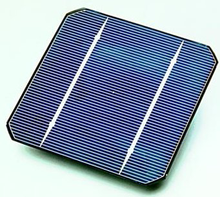
These are not the typical type of cell ... they have open circuit voltage of 0.664V and a max power voltage of 0.553V
So 24 in series will show 15.93V with no load and 13.27V at maximum power of 117W....
This maybe a little too high voltage for your inverter. The problem maybe the inverter switches of because input is too high ... give inverter link or check it's operating range.
Just to solder these cells together is a great achievement , they are extremely fragile and the soldering difficult (I've made some panels myself)
I hope the glass and silicon holds up ... when the panel gets warm the air inside will expand and want to push out , and when cool suck humid air in ....
There is the need for a cheap DIY encapsulating system , I've tried a few ... cheapest may be normal fiberglass and resin on the back and clear cast resin on the front...
Then the inverter is probably shutting down because the input voltage is too high , maybe open up the panel and disconnect two of the cells from the chain.
You have plenty of spare cells , I would try first try encapsulating one cell ... see if 40 gms is enough to cover 1 cell it may be enough to cover a few (solder on the buss wire so it will work ) ... normal fiberglass resin is much cheaper (you can probably find it locally) and can be used for the back , you could just carefully glue the back to a sheet of glass and when that's set put clear cast over the face ... I haven't worked with the product pictured I hope it's UV resistant.
Encapsulation is the biggest cost , more than the cell itself! It maybe worth trying covering the whole thing in standard resin with a thin layer of glass fiber for strength .. this resin is only $3/liter where I live(Thailand), it will stop some of the light getting to the cell and reduce power output, but could be the most cost effective solution ....
I tried in the sunset when the voltage wire 12 holes and 11 V same thing nothing changed.
15 V and higher failure light has been turned on .
11.5 and lower the inverter will not working.
Between of those it’s like in the middle of the working the failure lights turning on and off and on and off and making a weird noise
There was not any mention of the supply voltage at the inverter input connection. And since the inverter voltage does vary so much I am wondering if it is a regulated output inverter or a non-regulated output inverter. Both types are available, but the ones with a regulated output are more complex internally. The non-regulated inverters need a more constant input voltage to deliver the rated output voltage.
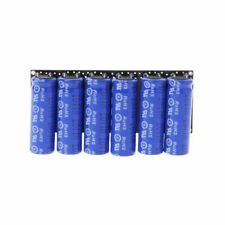
One other idea is to add a stabilizing capacitor across the solar cell array output, which may improve the inverter operation. Several thousand microfarads rated at 20 volts or more should help a bit. I am guessing that the inverter has a higher momentary current requirement during each cycle of the output voltage.
One other idea is to add a stabilizing capacitor across the solar cell array output, which may improve the inverter operation. Several thousand microfarads rated at 20 volts or more should help a bit. I am guessing that the inverter has a higher momentary current requirement during each cycle of the output voltage.
I think that's a good idea , it will also help other issues(passing clouds) ... but use super caps , they're just as cheap and 1000 times more effective
The solar panel is a very unconventional design , the first thing I would suggest is to carefully test the panel . This cannot be done with an inverter ...
Put the panel in strong sunlight with a voltmeter measuring output voltage .... then start to load it measuring the current , use whatever you have at hand , mains electric kettle , car lights , resistance wire ... make sure it can deliver 50W constantly for an hour , then 100W for an hour ...
In a standard panel the cells are bonded to the front glass sheet providing good thermal transmission keeping the temperature of the cells down... In TS design they are surrounded by insulating air between wood and glass ... just standing in sunlight the cells will get very hot , once current is drawn the cells will get even hotter there maybe all sorts of expansion issues perhaps breaking the flow of current ....
Wood is definitely not a good choice it has a moisture content which may cause problems....
Anyway we need to be confident the panel can deliver power over extended periods , and what voltage it has at various outputs.
I'd love to see a picture of the panel ...
The manufactures of the cells used has gained a few extra % efficiency by using 5 bus wires ... this means the silver wires running over the face of the cell can be less wide , allowing for more of the surface to generate power ...
Down side is double the amount of work soldering on the bus wire (flat profile , tin coated copper bus wire is soldered onto the silver bus wire on the cell) ... a real nightmare job ! Standard cells have 2 or 3 bus wires.
A friend of mine called me one evening after his shift. Said his car wouldn't start. He suspected his timing belt was probably due for a changing so he had one with him. When I got there I asked if he had gasoline. "Yeah, a quarter tank." Looking at the gas gauge confirmed what he said. We changed the belt. Made sure everything was correct and buttoned it up. The car didn't start. Convinced we did something wrong we tore it all down again - right there in the parking lot, in the dark. We had flashlights. Checked everything and made sure everything was correct. Couldn't find any problem so we put it all back together again. Still wouldn't start. Again I asked about the fuel. We dribbled a little gasoline into the throttle body and cranked the car. It started right up but stalled as soon as the gas we dribbled in had been consumed. So it wasn't a timing issue, nor was it ignition. He assumed he had a bad fuel pump. So we left the car for the night.
Next morning (Saturday) we arrived with a new pump. Pulled the fuel tank down and removed the old pump. Looking into the tank it was clear what the problem was - - - no fuel. The gas gauge was stuck at the quarter mark.
The moral of the story - "Make sure everything is in working order." So my question: Do we know the inverter works when powered from batteries? I didn't see anyone ask that question yet.
BTW: My friend felt like a complete arse. Twice into the timing belt and once into the fuel tank all because he had no fuel. And I had asked him if he had fuel.
A friend of mine called me one evening after his shift. Said his car wouldn't start. He suspected his timing belt was probably due for a changing so he had one with him. When I got there I asked if he had gasoline. "Yeah, a quarter tank." Looking at the gas gauge confirmed what he said. We changed the belt. Made sure everything was correct and buttoned it up. The car didn't start. Convinced we did something wrong we tore it all down again - right there in the parking lot, in the dark. We had flashlights. Checked everything and made sure everything was correct. Couldn't find any problem so we put it all back together again. Still wouldn't start. Again I asked about the fuel. We dribbled a little gasoline into the throttle body and cranked the car. It started right up but stalled as soon as the gas we dribbled in had been consumed. So it wasn't a timing issue, nor was it ignition. He assumed he had a bad fuel pump. So we left the car for the night.
Next morning (Saturday) we arrived with a new pump. Pulled the fuel tank down and removed the old pump. Looking into the tank it was clear what the problem was - - - no fuel. The gas gauge was stuck at the quarter mark.
The moral of the story - "Make sure everything is in working order." So my question: Do we know the inverter works when powered from batteries? I didn't see anyone ask that question yet.
BTW: My friend felt like a complete arse. Twice into the timing belt and once into the fuel tank all because he had no fuel. And I had asked him if he had fuel.
I suggested checking the inverter by running it from a car battery back in post #14. AND I have several times asked to measure the voltage at the inverter input terminals. THAT voltage will tell a lot, and it may not be the same as the voltage at the solar cell output terminals.
So once again I am going to suggest running the inverter from a 12 volt car battery, at least for a long enough time to verify that the output voltage is 220 volts and is stable. The battery could still be in the car, no need to remove it, but be careful to get the polarity correct. And if there is an ammeter in series with the power connection, change the connection so that it is direct, and measure the voltage at the inverter input terminals. That is different than checking at the solar cell terminals.
@MisterBill2 yes, post #14, I see that now. I sort of speed read over it and didn't notice it. Perhaps I'm not the only one to miss that.
The whole reason for recounting the timing belt story is to suggest to the TS to fully diagnose the problem. In other words, "Know the inverter works!" So far I haven't seen him/her address whether it works or not. After all, you wouldn't replace the circuit breaker, wiring and switches just because the light didn't come on. The FIRST thing you'd check is whether the bulb is good or not.
So I second MisterBill2's suggestion - prove out that the inverter works from a car battery. And yes, I also agree with making sure the polarity is correct. Making a single mistake with that can end this project. Please. Prove it works. Then tell us what you find.
In another discussion several months ago the problem was found to be the clip leads that the TS was using. I have discovered that some of those clip leads are very thin, perhaps#28 wire, and very poor quality on top of that. OK for attaching a digital multimeter to read volts, but too much resistance for any other purpose. And if the inverter is calculated to draw a bit over 4 amps average then it probably draws more for a few milliseconds and that could be the problem. And really, that might not show up checking terminal voltage. So we must wait and see.
Our world is huge. Things "over there" are different to things here. A car over there has 3 wheels and you can lift it with one hand. Its little battery is maybe 5AH?
Our world is huge. Things "over there" are different to things here. A car over there has 3 wheels and you can lift it with one hand. Its little battery is maybe 5AH?

 Facebook
 Google
 GitHub
 Linkedin