IR Illuminator

Thread Starter

Wendy

Joined Mar 24, 2008
23,797
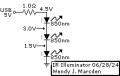
I used an LED strip I scavenged from a Harbor Freight torch They practically give them away. I used it in this project. However I’m finding any light from that backroom objectionable. So I’m planning to replace this white LED light with 880nm 1W IR LEDs. I'm going to use this design:
IR Light #2.png
Ideas welcome. The LEDs are cheap, but with a loonngg lead time. It's making me crazy (crazier). After I have them I'll tweak the resistors as needed on a case by case bases.

[MODERATOR: Fixed link to “project”]

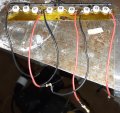
So the parts finally came in and I built the circuit. It is basically as shown above only mounted on a light on a steel plate cut to 5.0” x 1.0" with the layer of Kapton tape on it to insulated the one Watt LED's from the steel plate I tried using copper tape I had kicking around in my storage box but that didn't work out too well if I ever have to do it again I'll just use super glue on the steel plate and then have the LED's touching as I've shown.

For those of you who are not familiar with kapton tape it is a high temperature tape designed to mask a circuit board as it goes through a solder flow machine so it can handle a soldering iron direct with no problem. I also used my SMT hot plate I made a couple of years ago to help the solder flow smooth.
20240722_210847.jpg

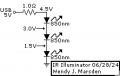
after trying the original schematic I've discovered that the voltage drop of three LED's what's considerably higher than I expected so I now have 0.75Ω on order.
IR Light #3.png

I used an LED strip I scavenged from a Harbor Freight torch They practically give them away. I used it in this project. However I’m finding any light from that backroom objectionable. So I’m planning to replace this white LED light with 880nm 1W IR LEDs. I'm going to use this design:
IR Light #2.png
Ideas welcome. The LEDs are cheap, but with a loonngg lead time. It's making me crazy (crazier). After I have them I'll tweak the resistors as needed on a case by case bases.

[MODERATOR: Fixed link to “project”]
 
Last edited by a moderator:

WBahn

Joined Mar 31, 2012
32,706
You aren't leaving yourself much room for your current-limiting resistor to do a good job of maintaining a stable current in the LEDs as they heat up.
 

Thread Starter

Wendy

Joined Mar 24, 2008
23,797
They are basically going to be waving in the breeze As for wattage think 1/2W Max.
0.5A x 1V =0.5A . As it happens the resistors are 10W each.
 
Last edited:

WBahn

Joined Mar 31, 2012
32,706
They are basically going to be waving in the breeze As for wattage think 1/2W Max.
0.5A x 1V =0.5A . As it happens the resistors are 10W each.
I'm not talking about power dissipation, I'm talking about regulating the current well.

Your initial calculation called for a 1 Ω resistor in order to achieve 0.5 A in your string based on the assumption that each LED would drop 1.5 V.

But the package says that the forward voltage is between 1.4 V and 1.6 V (and I'd be a bit suspicious that those are the actual limits since IR LEDs commonly have forward voltage specs that span something like 1.4 V to 2.2 V). But let's use their numbers.

At 1.4 V each, the current with 1 Ω resistor would be 800 mA, while with 1.6 V it would be only 200 mA. And this is assuming that your USB supply voltage is actually 5 V. The USB spec allows ±5%, or 4.75 V to 5.25 V. That increases the range of currents to
1050 mA down to zero.

The very fact that you are choosing to reduce your resistance by 25% in response to the actual current drawn by LEDs you happen to have is a strong indication that you don't have sufficient overhead voltage in order to meet your needs.
 

Thread Starter

Wendy

Joined Mar 24, 2008
23,797
This is not a failure critical project. The numbers I am currently using are based on actual measurements. And I can tweak the component as I need to. My current goal is to get as close as I can to 0.5A and not 1ma more. As I have said the goal is to eliminate my 3D printer workspace and not have light at night.
 

WBahn

Joined Mar 31, 2012
32,706
This is not a failure critical project. The numbers I am currently using are based on actual measurements. And I can tweak the component as I need to. My current goal is to get as close as I can to 0.5A and not 1ma more. As I have said the goal is to eliminate my 3D printer workspace and not have light at night.
If you want to have "not 1 mA more", then if you are using a circuit like this with such low overhead, you are going to need to stay well away from 0.5 A since, as the LED heats up, the forward voltage drops, which will result in the current increasing.
 

AnalogKid

Joined Aug 1, 2013
12,049
If you are not critically low on available 5 V current, I would change to 1 resistor per LED. You will get much more predictable and stable performance. As above, changes in an LED Vf will cause much smaller changes in its current.

If you go with an even number of LEDs, having two in series would be a good compromise between total circuit current and LED current stability.

ak
 

Thread Starter

Wendy

Joined Mar 24, 2008
23,797
My personal design goals where to use 5V which is plentiful around my 3D printer. It has been a fun exercise pushing my limits of what I can do.Soldering with one hand is always going to be a challenge. Two or one LEDs Would create a need for higher wattage resistors (and more of them).
 
Last edited:

AnalogKid

Joined Aug 1, 2013
12,049
Two LEDs Would create a need for higher wattage resistors (and more of them).
Two series LEDs running on 5 V at 20 mA needs a 100 ohm resistor. The power dissipated in the resistor is 40 mW. That's not much. A 1/10 W resistor would be fine, and a 1/4 W resistor will be cold.

ak
 

WBahn

Joined Mar 31, 2012
32,706
Two series LEDs running on 5 V at 20 mA needs a 100 ohm resistor. The power dissipated in the resistor is 40 mW. That's not much. A 1/10 W resistor would be fine, and a 1/4 W resistor will be cold.

ak
She's running the LEDs at 500 mA, not 20 mA.

Two of her LEDs in series would need a 4 Ω resistor and would dissipate about 1 W.
 
Last edited by a moderator:
WBahn

Joined Mar 31, 2012
32,706
One of the advantages of an IR LED is the low Vf they have. Create less heat all around.
If you are running things from a fixed voltage source, such as your 5 V USB source, then the Vf of the LED doesn't matter -- the same power is being drawn, you are just shifting more of it to the current-limiting resistor.
 

tonyStewart

Joined May 8, 2012
231
You are planning to operate with 0.75 ohm 10W resistors.

Kapton is also a thermal insulator but convenient.
Note that optical loss increases with junction temperature and MTBF drops 50% for every 10'C temp rise in the junction.

Ideally, these should be active current regulated as the specs for the nearest case equivalent below are much higher voltage and current.
https://www.inolux-corp.com/datasheet/VSCEL/INV-K1TOIR_v1.0.pdf
These have a Vf tempco of -1.2 mV/'C which corresponds to a 96 mV *3 rise on the resistor at 80'C rise above 20'C for 3 LEDs in series.

I would use 1.5 sq"/W minimum for your steel heatsink. so for 9 LEDs or 9 W, it ought to be much wider. If you had an Alum Clad PCB then 1 sq"/W.
 

Thread Starter

Wendy

Joined Mar 24, 2008
23,797
I have powered it up and installed.Each leg was approx 0.35A. I will be making another improved version.

more later
 

Thread Starter

Wendy

Joined Mar 24, 2008
23,797
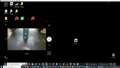
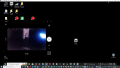
Here are pictures of my 3D printer in the light and not using the IR light to illuminate a tool I picked just to use as a model.
240729 3D Printer.png 240728 3D.png
..................................................................................................................................................................................................................................................Day...............................Night
 
Last edited:
Top