Ir beam break sensor help

Thread Starter

Rachel Waltemire

Joined Feb 22, 2018
11
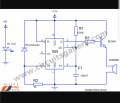
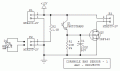
I'm not sure if this is the right place yo ask but here goes anyway. What I want this circuit to do is to go off when something breaks the beam. I originally set it up using a pir sensor but the object is a ball that's not generating enough heat to set off the pir sensor. Which led me to the ir beam break set up. My problem is this runs a buzzer and I want it to switch on a set of led light strips. I think I need a relay in where the buzzer is but I'm lost on what kind. I have a little background with thus stuff. But have forgot most of what I learned so I'm trying to remember what I leaned. Any help would be great..
 

Attachments

ebp

Joined Feb 8, 2018
2,332
It will be somewhere between really really easy and not very complicated, depending on the LEDs you want to light up.

Please tell us some more about the LEDs - the voltage and current required, if you know. Are you talking about those flexible strips or something else? You say "a set" - please elaborate.
 

ericgibbs

Joined Jan 29, 2010
21,391
hi Rachel,
If you also explained the flight path of the ball, the type of ball, etc it would help.
Driving a relay is not a problem, its detecting the ball in flight.

What you asking should be 'do-able'.

E
 

Thread Starter

Rachel Waltemire

Joined Feb 22, 2018
11
It says the working voltage on the leds are 12v/2a. Yes they are just the ones that come in a roll and im using two 3 foot sections with the sensor. I'm not sure why I put ball. Brain fog moment. What I'm trying to do is set up lights on a corn hole board. I want the lights to go off when the bag goes in the hole. So the sensors will be about 2 foot from each other. I have 2 12v rechargeable battery packs I'm using that are 12v/ with 3a max charge/discharge current.
 

AnalogKid

Joined Aug 1, 2013
12,045
II want the lights to go off when the bag goes in the hole.
Are you sure you don't mean that you want the lights to come ON when the bag goes in the hole? Not to be picky about semantics or anything, but in electronics, off means - wait for it - off.

A corn hole target hole is six inches across. Why are the sensors 2 feet apart?

How long should the lights be on / go off / whatever?

What about a bag that is hanging over the edge of the hole enough to block the beam, but does not fall through?

There are dozens if not hundreds of *different* LED strips on rolls. Which one is yours? Datasheet? Link to website?

Depending on your answers, this can be done with a 555 plus a power transistor, or more simply with no 555 and just one power MOSFET.

There is no technical reason to use IR. A photo transistor and a red LED will work, and the visible LED will act as a pilot light. A reflective sensor also will work, and makes the wiring easier.

ak
 
Last edited:

Thread Starter

Rachel Waltemire

Joined Feb 22, 2018
11
Obviously I meant that i wanted them to turn on when the bag went thru. I can't believe I made an actual mistake and typed off. I'm usually perfect in my wording....

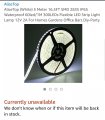
As far as the led strip I can not find a datasheet for it. They are just ones I bought off Amazon. A picture is below of the ones I bought

The lights I really just want to flash for about 2 seconds. Just enough to show the bag went thru.

I know the hole is only 6 inches. The reason for the 2 feet is to help with the bag not being detected when it's just part in the hole. I have a cross beam 2x4 in the middle of the board. My plan was the attach one end the circuit to the cross 2x4 as low as I can then do the same for the one up top. That will give me more play for the bag that is not the whole way in the hole.

I also want to use the 2x4s to attach the circuit to because I don't want it to get bounced around alot if it is on the bottom of the playing surface.
 

Attachments

ebp

Joined Feb 8, 2018
2,332
Those strips typically are configured as groups of three LEDs and a resistor in series, all such groups in parallel and with cut points between each group. With a total length of 5 m and 300 leds, that would be 100 groups, 5 cm or about 2" per group. Each group would take 20 mA, so a yard would be 18 groups for 360 mA, 720 mA total.
 

Thread Starter

Rachel Waltemire

Joined Feb 22, 2018
11
Yes the leds are the ones that have 3 leds and a resistor. The resistor is 151 which if I looked up correctly is 150 ohms. It has the cut point every group of 3 leds.

While the led staying on until the bag is removed would be neat we normally throw all 8 bags one right after the other so the leds need to come on again without being removed that way it has the ability to come on again if the next bag is thrown thru the hole.
 

AnalogKid

Joined Aug 1, 2013
12,045
Am I correct in my thinking that I would need a relay in order to turn the leds on when the beam was broken?
A relay will work if driven by a timer circuit, but a medium-sized power transistor will take less power to operate, last way longer, not flicker the lights due to shock, etc. And it the transistor is MPSFET, it can act as it's own timer.

Do you have any particular parts in mind for the beam part of the circuit?

ak
 

Thread Starter

Rachel Waltemire

Joined Feb 22, 2018
11
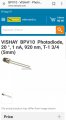
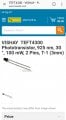
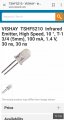
I bought the parts that were on the circuit diagram above. I realized when I looked it up I actually bought a photo diode instead of a photo transmitter. I also got an ir emitter also. I attached the photos of the ones I bought. I also attached a phototransistor I was looking at.

I also have a mosfet but I'm not sure it would even work for this. It's N-Channel Power Mosfet - 30A 60V P30N06LE.
 

Attachments

AnalogKid

Joined Aug 1, 2013
12,045
Flashing as the bag goes through the beam is easy. Holding the lights on for 2 s takes an actual timer circuit. There are many variations of two basic circuits. To decide which one ...

If a bag gets hung up on the side of the hole, or bags pile up under the board and cause the beam to remain broken, do you want the lights to flash on for 2 seconds only or stay on as an indicator that the beam is occluded?

ak
 

Thread Starter

Rachel Waltemire

Joined Feb 22, 2018
11
I mainly just wanted a simple flash of the lights as it went through. If the lights didn't go off then I would know the bags have blocked the sensor and I would just simply move them. It doesn't have to be super fancy just a simple flash of lights when the bag goes through.

I wanted to play with placement of the circuit in reference to the board once I got it made to try and get it low enough that it doesn't pick up hangers on the board just ones that go the whole way through the hole.
 

AnalogKid

Joined Aug 1, 2013
12,045
Something like this covers the basics. Note - this is a starting point for discussions, not a final schematic.
P1 - power input
P2 - LED emitter
P3 - LED lights output
EDIT: R1 should be at least 100K. Decrease C1 to the minimum acceptable flash.

ak
Cornhole-Sensor-1.gif
 
Last edited:

Bernard

Joined Aug 7, 2008
5,784
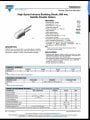
What is part # of IR emitter ? If it has narrow beam width, like 6 deg. we might get 2 ft. separation. A cone concentrator might help on receiver. Al foil or tape, 5mm small end 1/2 in. dia. large end about 1.5 in. long.
I used small wood blocks, drilled to fit Tx & Rx. Have also used plastic lenses to narrow the beam on Tx for longer ranges.
 

Thread Starter

Rachel Waltemire

Joined Feb 22, 2018
11
I have attached the info for the ir emitter I have. I'm sorry but at this point I'm a little confused. I'm sorry please bear with me. I learned this stuff once already but then had a health issue that made me forget alot of things. I'm trying to put this all together in my jumbled brain now.
 

Attachments

AnalogKid

Joined Aug 1, 2013
12,045
The circuit in post #1 will work with some changes.
Replace the BC548 with the P30N06LE. Source to GND, gate to pin 3, drain to the - side of the LEDs, LED + side to Vcc.
Decrease C1 to 22 uF
Be sure to use a CMOS 555.
Increase R2. A photodiode cannot source enough current to make 4 V across 1K.

ak
 

Bernard

Joined Aug 7, 2008
5,784
Transistor emitter & FET should work just fine. Cone reflector about triples range; with 3mm Rx would make cone 3
mm X 15 mm X 30 mm. I would use the 555 circuit slightly modified; drawing tomorrow out of time for now
must get ready for dining & dancing.
 
Top