Instrumentation amplifier gain issue and offset - INA111

Thread Starter

Aagash

Joined Jun 7, 2017
43
Hi all ,

I'm working on INA 111 instrumentation amplifier where I'm input the value of 120 Vp-p and 68kHz frequency and set the gain (as given in datasheet - equation ) to 100 - gain ,

When I'm connecting the input from a Function generator , the value is amplified correctly and output of about 12 Vp-p approx.

But When the Input is connected from the pair of electrodes from the Human body ( which senses the voltage drop ) of 120 Vp-p , the output of INA 111 is not gained properly - output of 2.5 Vp-p with offset of 1V (irregular and improper gain) .

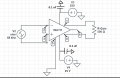
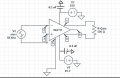
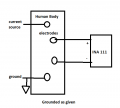
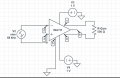
2,3 pin -> connected to Electrode wire terminal from human body OR Function generator for Checking.

6 -> output pin , 5 -> grounded .

Please help to fix this issue , thanks in advance !
abc.PNG
 

crutschow

Joined Mar 14, 2008
38,316
You much have the human body connected to circuit ground (it will not work properly with a floating source as you show in the schematic).
The amp input needs a return for its input bias current.

And I believe the INA11 needs more than a ±1V supply to properly operate.
 

Thread Starter

Aagash

Joined Jun 7, 2017
43
You much have the human body connected to circuit ground (it will not work properly with a floating source as you show in the schematic).
The amp input needs a return for its input bias current.

And I believe the INA11 needs more than a ±1V supply to properly operate.

----------------------------------------------------------------------------------------------------------------------------------------------------------------------

Sorry there's been a mistake in schematic at power supply voltages , its +/- 15 V dc .
I even tried having my body connected to ground ,no improvements .

kindly say the possible reasons for my error , Thanks !

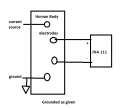
Please find the modified circuit .

abc.PNG

abc1.png
 
Last edited:

Audioguru

Joined Dec 20, 2007
11,248
Your modified circuit still has the inputs floating which was explained before and is wrong. Connect each input to ground with a 1M resistor.
 

Thread Starter

Aagash

Joined Jun 7, 2017
43
Hi all ,

Sorry there's been a mistake in schematic at power supply voltages , its +/- 15 V dc .
I even tried having my body connected to ground ,no improvements .

------
I'm working on INA 111 instrumentation amplifier where I'm input the value of 120 Vp-p and 68kHz frequency and set the gain (as given in datasheet - equation ) to 100 - gain ,

When I'm connecting the input from a Function generator , the value is amplified correctly and output of about 12 Vp-p approx.

But When the Input is connected from the pair of electrodes from the Human body ( which senses the voltage drop ) of 120 Vp-p , the output of INA 111 is not gained properly - output of 2.5 Vp-p with offset of 1V (irregular and improper gain) .

2,3 pin -> connected to Electrode wire terminal from human body OR Function generator for Checking.

6 -> output pin , 5 -> grounded .
----------------

kindly say the possible reasons for my error , Thanks !

Please find the modified circuit .

------


abc.PNG

abc1.png
 

Thread Starter

Aagash

Joined Jun 7, 2017
43
Your modified circuit still has the inputs floating which was explained before and is wrong. Connect each input to ground with a 1M resistor.
Could you say why are we connecting the inputs to ground through high resistance , what could possibly happen .

Won't there be a voltage drop at the input terminals , is it given for bias current reduction ?

Thank you !
 
Last edited:

Thread Starter

Aagash

Joined Jun 7, 2017
43
Your modified circuit still has the inputs floating which was explained before and is wrong. Connect each input to ground with a 1M resistor.
It is a differential input and both terminals are connected to the Inverting and Non-inverting terminals of the INA 111 , so how do we really have a ground , however (human body) the subject is grounded .
 

Audioguru

Joined Dec 20, 2007
11,248
I said to connect each input to ground with a 1M resistor, not a series resistor.
The INA111 has Jfet inputs that do not have a bias current, only a very small leakage current.
Your schematic does not show a human body connected to the circuit ground.
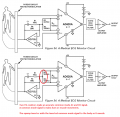
An ECG circuit has the body connected to an inverted AC and DC common-mode voltage (instead of ground) that cancels AC and DC interference.
 

Thread Starter

Aagash

Joined Jun 7, 2017
43
I said to connect each input to ground with a 1M resistor, not a series resistor.
The INA111 has Jfet inputs that do not have a bias current, only a very small leakage current.
Your schematic does not show a human body connected to the circuit ground.
An ECG circuit has the body connected to an inverted AC and DC common-mode voltage (instead of ground) that cancels AC and DC interference.
Thank you !
 

Thread Starter

Aagash

Joined Jun 7, 2017
43
I said to connect each input to ground with a 1M resistor, not a series resistor.
The INA111 has Jfet inputs that do not have a bias current, only a very small leakage current.
Your schematic does not show a human body connected to the circuit ground.
An ECG circuit has the body connected to an inverted AC and DC common-mode voltage (instead of ground) that cancels AC and DC interference.
As you've said , the common mode noise cancellation is a making floating input , but may reduce the offset ?

Can you please give the schematic for grounded human body (non floating input) and taking the voltage across it to INA.111 with proper gain and without offset .
 

Audioguru

Joined Dec 20, 2007
11,248
The common mode cancellation is not making the inputs float. Instead the common mode cancellation biases the inputs at 0V. Your circuit had both inputs differentially fed from a signal generator but since the signal generator is not connected to 0V then both inputs are floating.

The maximum input offset voltage of an INA111B is 1mV so with your gain of 100 the output offset voltage will be 0.1V maximum.

The ECG circuit I show has low gain in the instrumentation amplifier that feeds a highpass filter that blocks any offset voltage. Then an output opamp gives plenty of gain.
 

Attachments

Top