Inrush current limiter

nsaspook

Joined Aug 27, 2009
16,329
I have a 220V - 100V transformer, to power some home electronics from Japan. It's a massive beast, and when I flip on the power to the transformer, the breaker pops. So does the one out in the hall feeding the entire apartment, so I can't just replace my own with a slow-blow breaker. If I reset the breakers and hold them, past the initial inrush, the setup works fine after that, since the electronics draw very little power - a few dozen watts total.

I can't find anyone here with a sensible-sized 100V transformer, so I would like to build something that will limit the inrush current into the one I have. My idea was an inline power resistor of around 20 ohms, which would limit the current from the wall to around 11 amps. The breakers are rated to 16 amps, so that should be fine. I would then have a relay that would short across the resistor, after about a second, so the resistor would only be in the circuit for the initial power up, then power would flow directly to the transformer with nothing in the way.

I don't have all that much experience with AC and power supplies. Does this sound reasonable?
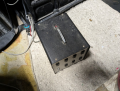
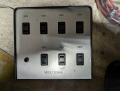
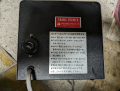
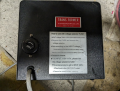
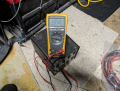
I just looked in my shed. I have one of my old Japanese anything to anything transformers I used on Japanese equipment when I worked for Fujitsu.
1711130642786.png
1711130663082.png
1711130681022.png
1711131861097.png
The magic of Google translate

It's a hunk or iron so it still works after all these years. I have another but don't need them anymore.
1711130827667.png
 
Last edited:

MisterBill2

Joined Jan 23, 2018
27,547
I also suggested the use of an electric heater as a device that can handle the power dissipation safely. The concept being that the transformer only needs to be switched on once and then not switched off for quite some time. What would be interesting is to know the results from using a motor soft starter.
Can you provide an estimate, or an accurate, weight for that transformer? That can provide a bit of a clue.
As an alternative smaller transformer, I suggest investigating a dealer in used industrial materials, if there is such a place locally.
And, it might also work to put the transformer primary and secondary in series and use it as an auto-transformer. Of course there are two ways to do that and one of them will not work.
 

Hymie

Joined Mar 30, 2018
1,347
Although the primary winding resistance might be quite low (<10Ω) it will have some inductance that will represent an impedance at 50Hz.

If you were to add an NTC in series that has a cold resistance of say 10R, you are likely to reduce to inrush current to <20A which should stop the breaker popping. If you estimate the maximum secondary load current, and then half it for the primary winding current – your chosen NTC should be rated for this continuous current.
 

nsaspook

Joined Aug 27, 2009
16,329
I also suggested the use of an electric heater as a device that can handle the power dissipation safely. The concept being that the transformer only needs to be switched on once and then not switched off for quite some time. What would be interesting is to know the results from using a motor soft starter.
Can you provide an estimate, or an accurate, weight for that transformer? That can provide a bit of a clue.
As an alternative smaller transformer, I suggest investigating a dealer in used industrial materials, if there is such a place locally.
And, it might also work to put the transformer primary and secondary in series and use it as an auto-transformer. Of course there are two ways to do that and one of them will not work.
I have a 1.5 KVA Japanese transformer that will likely work (doesn't trip my already loaded breaker) for the OP. I'll PM to see if he wants it for the price of shipping.
 

MisterBill2

Joined Jan 23, 2018
27,547
I have a 1.5 KVA Japanese transformer that will likely work (doesn't trip my already loaded breaker) for the OP. I'll PM to see if he wants it for the price of shipping.
My recollection is that a good 1.5 KVA transformer weighs about 22 pounds, which is quite a few Killograms, and that the shipping cost will be quite impressive.
Of course the ones that I recall were industrial rated, so that a 1.5 KVA transformer could deliver the full 1.5 KVA output power continually for weeks or years with no problems. My 100 watt rated travel transformer becomes too hot to hold after delivering 75 watts for half an hour.
 
I'm in Europe - Prague, Czech Republic. A large city, but the electronics supply houses that were common in my younger days are disappearing even from US cities. In any case, I don't think it's a problem for any large company to ship here. The modules on AliExpress are listed for around fifty cents into offer, although I'm not sure what they would say about just one. But sometimes you can even get things like that free as engineering samples.
If you want to go the Amazon route, Amazon.de has a ton of them and they should ship to the Czech Republic. In fact if you want the simplest possible solution which doesn't involved playing with wiring at 220V there's a plug-in unit that goes between the wall socket and the device which might do the job for you.
 
Last edited:

Sensacell

Joined Jun 19, 2012
3,785
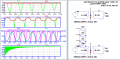
A circuit with a couple back-to-back MOSFET switches (a robust, fast AC switch) that is controlled to switch-on the mains when the voltage is MAXIMUM would solve the problem with almost no losses.
If the circuit is switched on at or near zero, there is no flux in the core to oppose the incoming voltage, so the current builds up over the half cycle and saturates the core, then it looks like just a nasty low resistance. (boom)

If you switch it on at max voltage, the inductance of the primary limits the current, the volt/seconds being much lower, and the core doesn't saturate. (no boom)

I used to have this gigantic Topaz Ultra-Isolation transformer, I recall vividly that plugging it in would blow the breaker randomly, depending on the phase angle when I closed the circuit, about 50% of the time.
 
Last edited:

MisterBill2

Joined Jan 23, 2018
27,547
The interesting thing is that while the B/H plots always start from 0/0, I do not recall much discussion in the transformer class as to what effect that first bit had on transformer operation. Certainly it should have a real effect. It is a question as to if the traces in post #29 are partly simulation artifacts, or representative of reality.
 

Sensacell

Joined Jun 19, 2012
3,785

mdagli1

Joined Dec 4, 2012
18
We used thermistors from a company I used to work for on static frequency converts that were used for aircraft but they were on the DC line after a bridge rectifier and large capacitors. We also put an input filter and inductor choke on the inputs too. On the bigger converters where the thermistor would over load, we used a contactor and a timer with a resister to charge the capacitors as that would be a DC short surge. Hope that helps.
 
Last edited:

MisterBill2

Joined Jan 23, 2018
27,547
We used thermistors from a company I used to work for on static frequency converts that were used for aircraft but they were on the DC line after a bridge rectifier and large capacitors. We also put an input filter and inductor choke on the inputs too. On the bigger converters where the thermistor would over load, we used a contactor and a timer with a resister to charge the capacitors as that would be a DC short surge. Hope that helps.
Those DC inrush reducers were for a very real but quite different issue. That was the capacitor charging surge, which can be much larger and last quite a bit longer. The same scheme is still in common use today, especially in high voltage supplies that use solid-state rectifiers. Back in the old days, the tube rectifiers provided a similar softstart as they started conduction slowly, as the filaments reached operating temperature.
 
Top