Inductive proximity sensing

Thread Starter

bug13

Joined Feb 13, 2012
2,002
Hi guys

I help my friend to replace a bettery in his Nissan Note smart key. And I saw that there is only one coil in the key run along the outside edge of the PCB. (The coil is only on one plane, say on the X plane).

My question is: how can the smart key know that the key is close to the car/door(with only one coil, on one plane, not on 3 planes with 3 different coils), so the person with the key can open that door.

Note: the type of smart key that I am talking about is the one that you keep the key in your pocket/bag, and you just need to walk to the car, and open the door with a button press.

I always thought that I need 3 coils on X, Y and Z plane to just that.

Thanks guys!!
 

chartman37

Joined Jul 8, 2015
3
It's the other way round... how does the car know there is key nearby.... because the 'key' is a radio transmitter and the coil on one plane is the transmitetr aerial...
 

chartman37

Joined Jul 8, 2015
3
That would mean a powerful transmitter in the car, driving an inductive loop, and the key fob to be inside that loop... Plus the key fob would need an inductive loop to harvest the energy from the transmitter AND it wouldn't have a battery...
 

pwdixon

Joined Oct 11, 2012
488
That would mean a powerful transmitter in the car, driving an inductive loop, and the key fob to be inside that loop... Plus the key fob would need an inductive loop to harvest the energy from the transmitter AND it wouldn't have a battery...
But if the key is powered wouldn't that mean the transmitter would be running all the time and exhaust the battery rather quickly?
 

chartman37

Joined Jul 8, 2015
3
That would work...It's a common way of doing things... the key fob would have to power up every so often to listen for a message. 50mS or so every second would work, with the transmitter sending once every~ 0.9 seconds... and keep the fob average battery consumption down in the uA.
 

AnalogKid

Joined Aug 1, 2013
12,135
According to Nissan, the car transmits a signal to the fob when you touch a button on the door, so the fob is in low power receive mode all the time. The fob transmits the security code to the car, and the door unlocks. The handshake takes milliseconds. Don't know what the max range is, but insurance institutes recommend 10 cm or less so someone can't jump into your car and drive it away while you are gassing up.

ak
 

alfacliff

Joined Dec 13, 2013
2,458
a few years ago, the military fired up a radar system on the west coast, one of the side effects was that people with "key fobs" couldnt unlock their cars for miles around. a lot of the fobs operate near 433.9 mhz with only microwatts power.
 

Thread Starter

bug13

Joined Feb 13, 2012
2,002
Thanks for all the replies, the part that most interests me is: How can the car/smart key tell the smart key is within, say 10cm, of the door/car. What sort of sensor or technology it use to detect that.

I guess is there is a coil in the car, and the coil is driven to, say 128khz. And the coil in the smart key can pick this up. But these is only one coil in the smart key. And I don't understand how can it get an consistent reading of the magnetic field while the coil in the smart key is only on one plane (say x plane).

My concern is the smart key can be on different orientation while it's in the user's pocket/bag. Different orientation will get different reading even at the same distance from the car/door.
 

OBW0549

Joined Mar 2, 2015
3,566
Thanks for all the replies, the part that most interests me is: How can the car/smart key tell the smart key is within, say 10cm, of the door/car. What sort of sensor or technology it use to detect that.
There is no sensor. These remote keyless entry systems operate with low-power RF transceivers at either 315 MHz (US) or 433 MHz, and at distances beyond a meter or two the received signal is so weak the receiver cannot successfully decode the encrypted identification; and when it cannot, the car won't open.

Google "remote keyless entry" and you'll find all the information you could possibly want.
 

Thread Starter

bug13

Joined Feb 13, 2012
2,002
There is no sensor. These remote keyless entry systems operate with low-power RF transceivers at either 315 MHz (US) or 433 MHz, and at distances beyond a meter or two the received signal is so weak the receiver cannot successfully decode the encrypted identification; and when it cannot, the car won't open..
I apologize for confusing you and maybe other people here. Maybe Wikipedia is better at descripting the type that I am referring to:
https://en.wikipedia.org/wiki/Remote_keyless_system

From "Smart Key" section, first line:
Some cars have a proximity system that is triggered if a keylike transducer is within a certain distance of the car
That's the one I am referring to.

Now back to my question:
Regulation requires that, these sort of smart key is not allowed to (origional: can't) unlock the door if the key is more than 10cm (on top of my head figure) away from the door/car. I would like to know how they detect that kind of range.

Here is my guess and concerns:
I guess is there is a coil in the car, and the coil is driven to, say 128khz. And the coil in the smart key can pick this up. But these is only one coil in the smart key. And I don't understand how can it get an consistent reading of the magnetic field while the coil in the smart key is only on one plane (say x plane).

My concern is the smart key can be on different orientation while it's in the user's pocket/bag. Different orientation will get different reading even at the same distance from the car/door.
 
Last edited:

AnalogKid

Joined Aug 1, 2013
12,135
Also, while radiated em fields have polarization and orientation, real world antennae are not as critical as their calculations indicate. If a transmitting and receiving antenna pair do not have the same polarization, the received signal will be weak, but not zero.

ak
 

Thread Starter

bug13

Joined Feb 13, 2012
2,002
I'm sure they don't do any range measurement. Rather, if the received signal strength is below some threshold the key distance is deemed to be >10cm.
The reason why I believe they do proximity sensing is there are usually two mode on those key:
  1. It can be use as a normal remote to lock or unlock a door with a press of a button on the key itself, it usually have a range of a few meters.
  2. Or, the smart key can be put into your pocket or bag, a user needs don't need to take the key out of press any button on the key. A user only need to walk right next to the door, and the door will be unlock, and only the door the user stand next to can be unlock. It usually only work if a user stand right next to the door.
I think, and I don't know much about RF, but if using only signal strength, signal strength can be reduced simply by holding the key in your hand(in a fist), so it will not have consistence result. And I don't think the in-consistence result can pass any legal requirement.

And I think it's hard to tell which door the user standing next by using signal strength.

That lead me to think they are using inductive proximity sensing.
 

Thread Starter

bug13

Joined Feb 13, 2012
2,002
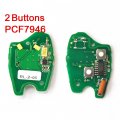
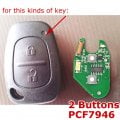
A little more info, two pic that I found on google:

There is a PCB antenna and a big inductor on the PCB. That's why I am guessing they are using inductive proximity sensing.

01.jpg Renault-2-Buttons-PCB-Board-PCF7946_3524112_c.jpg
 

AnalogKid

Joined Aug 1, 2013
12,135
you: only the door the user stand next to can be unlock. It usually only work if a user stand right next to the door.

me: Exactly right. When acting as an rfid tag, the range is very limited - on purpose. That way a stranger can't open the passenger door while you are getting in the driver door.
you: I think, and I don't know much about RF, but if using only signal strength, signal strength can be reduced simply by holding the key in your hand(in a fist), so it will not have consistence result. And I don't think the in-consistence result can pass any legal requirement.

me: There is no legal requirement. There are non-legal industry recommendations, but they are just guidelines. The system is designed with hands/pockets/winter coats in mind.

you: And I think it's hard to tell which door the user standing next by using signal strength.

me: Actually, it is very easy. There is a transmitter/receiver in each door, and the range does not include the other door.

you: That lead me to think they are using inductive proximity sensing.

me: Nope. It is plain old RF. The key fob does not radiate anything most of the time. It sits as a very low power receiver waiting for the proper wake up code. Then it transmits back its own code. At high frequencies inductive loops have all of the orientation problems you have pointed out. Radio has none of these.

ak
 

Thread Starter

bug13

Joined Feb 13, 2012
2,002
you: only the door the user stand next to can be unlock. It usually only work if a user stand right next to the door.

me: Exactly right. When acting as an rfid tag, the range is very limited - on purpose. That way a stranger can't open the passenger door while you are getting in the driver door.
What do you mean by "acting as an rfid tag"? Do you mean there is an actual rfid circuit in there, or using the rf signal strength to serve the same function?

And what is that big coil/inductor in the pcb in my last post?
 

GopherT

Joined Nov 23, 2012
8,009
@bug13
You referred to the Remote Keyless entry Wikipedia site. I think you will find the "smart key" page more useful.

https://en.wikipedia.org/wiki/Smart_key#


The car sends a 125kHz signal to initiate a response from the smart key fob. The smart key fob must send a code fast enough and from close enough proximity with the right code.

Multiple antenna on the car.
 
Top