Ignition coil primary and secondary side identification

Thread Starter

Autobike

Joined Feb 23, 2018
99
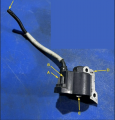
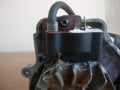
Hi. this is an ignition coil from a Makita 2 stroke string trimmer.
ignition coil pic

A and B: these two tabs directly connected to a button. when i press that button the engine stalls. so i think it acts as an ignition kill button.
C: this is where the spark plug cap fits.
D: body.
E: this is where we measure the air gap ( in between this point and flywheel magnet ).

i'm trying to figure out primary and secondary side of this coil and get the resistance reading. if you can guide me or provide a simple diagram of a similar type coil that would be much appreciated. thank you :)
 

LowQCab

Joined Nov 6, 2012
5,101
On these types of sealed Ignition-Units,
You can not measure the Resistance of the the 2 Coils because of the built-in Electronic-Circuitry.

They are NOT repairable.
If it does not work as expected, purchase a new one.
.
.
.
 

MaxHeadRoom

Joined Jul 18, 2013
30,562
It appears to have four connections, if so the pri. and sec. may be separately, i.e isolated/insulated, if so four connections are needed.
Unlike the older Auto ignition coil in #3
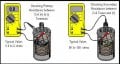
Measure between C & E and A & B
 

LowQCab

Joined Nov 6, 2012
5,101
Hi. this is an ignition coil from a Makita 2 stroke string trimmer.
ignition coil pic

A and B: these two tabs directly connected to a button. when i press that button the engine stalls. so i think it acts as an ignition kill button.
C: this is where the spark plug cap fits.
D: body.
E: this is where we measure the air gap ( in between this point and flywheel magnet ).

i'm trying to figure out primary and secondary side of this coil and get the resistance reading. if you can guide me or provide a simple diagram of a similar type coil that would be much appreciated. thank you :)
.
You would get more appropriate answers if You would clearly state exactly what
the problem is that You are trying to solve.

Small Garden-Equipment-Engines do NOT have any serviceable Ignition-parts.
The Coil is sealed and contains unknown Electronic-Circuitry,
so the Windings are NOT individually accessible, and measurable.

There are no similarities to "Old-School" "Automotive-style" Ignition-Systems,
where the Ignition-Coil is only an Ignition-Coil, with no other internal devices.
.
.
.
 

Tonyr1084

Joined Sep 24, 2015
9,744
AFAIK; that's a magneto coil. The passing magnet on the flywheel develops a charge, then as the magnet passes a certain point there's an electronic switch inside that breaks contact causing the high voltage spike. I doubt it's a "Primary" & "Secondary" coil arrangement. Rather, I believe - and could be wrong - that the coil is tapped, not center tapped. When what is the smaller side of the coil breaks (open) the larger, high energy side sparks. Of course I could be wrong. Happens from time to time.

Like others are asking, what are you trying to accomplish?

As a kid I once took a lawn mower coil, the kind with breaker points, and spun the crank shaft with a motor. The coil was connected to an ordinary lamp. Back then they didn't have CFL or LED lighting. THE LAMP LIT! My dad was surprised to see that work. I'm sure I was exceeding the lamp's designed voltage, but the current was so brief that the lamp didn't burn out. Well, it might have if I had run it longer; I only ran it for a few seconds.

So what is your goal?
 

BobTPH

Joined Jun 5, 2013
11,463
I'm sure I was exceeding the lamp's designed voltage,
That is not how induction back EMF works. The voltage rises only as high as required to keep the current flowing. A spark plug is an open circuit, so the voltage rises to the level needed to bridge the spark gap. The light bulb is a low resistance so the voltage rises only to the voltage it would drop at the induced current in the coil.
 

Thread Starter

Autobike

Joined Feb 23, 2018
99
@LowQCab @liteace @MaxHeadRoom @Tonyr1084 @BobTPH thank you so much for your replies. actually i thought it's quite easy to measure the resistance like we do in our motorcycle ignition coils. but now i understand. as you suggest this coil is different.

actually i'm trying to rule out my ignition coil. let's say if i stop the engine when it's hot and then try to start it after several minutes. it's quite hard to start the engine again.

i checked it by grounding spark plug to the engine externally and sometimes it didn't produce spark. i suspect it's the ignition coil.

found this video from youtube. it's a different brand but apparently that coil has the same setup. but i think it's meaningless to measure the resistance without my manufacturer's specs.

so will try to find a matching coil and replace. thx again.
 

MisterBill2

Joined Jan 23, 2018
27,186
The pictures in post #3 do not look even remotely like the magneto package the TS is asking about. Not even the same principle, as post #3 shows a transformer, while the magneto uses a magnet speeding by the pole pieces. The main benefit of the newer technology is that it costs less to produce and install.
 

Tonyr1084

Joined Sep 24, 2015
9,744
This is the magneto the TS is asking for help with:
D & E are the iron core.
C (off screen) is the ignition wire that goes to the plug.
A & B might be common to one and other and likely
are the kill circuit, but I'm not positive on that one. It's
possible A might go to a key switch while B could be
something like a sensor switch that prevents operation
unless an operator is in a safe position; such as a tractor
with a switch under the seat. The engine won't run if the
operator is not sitting in the driver seat. (for example!)
Screenshot 2024-08-09 at 11.41.27 AM.png
 

MaxHeadRoom

Joined Jul 18, 2013
30,562
Also A & B could be the trigger pair, one for supply (or GND?) and the other trigger signal.
Normal operation for an ignition coil is the spark occurs when the trigger SW opens.
 

Tonyr1084

Joined Sep 24, 2015
9,744
The way I remember it as a kid, there was a "trigger" wire coming off of the magneto. When the magnet swung past the mag it generated a charge. A capacitor set of points would open. At that opening you got the spark. Modern mag's have something like, and I'm guessing, a hall transistor that senses the moment of the magnet passing. Depending on where the sensor is positioned it fires the spark. The wire that comes off of the mag, in this case there are two wires, A & B is grounded when you want to kill the ignition.

When I was 14 I had a mini-bike with no brakes. The best way to slow it down was to ground the ignition. Only in cases of emergency would I step on the centrifugal clutch. The friction would bring the bike to a quick stop. I added the kill switch after my throttle stuck open once. Faced with a full power 4 HP motor pulling a kid weighing 135 pounds was frightening. I had to ditch the bike in the grass. Then run back to the bike and choke it to death. Right after that I decided it would be more fun to ride if I didn't have to worry about a run-away situation.

A and B: these two tabs directly connected to a button. when i press that button the engine stalls. so i think it acts as an ignition kill button.
It would appear from description that either A or B might be ground. Shorting A to B seems to kill the engine.
 

MisterBill2

Joined Jan 23, 2018
27,186
At least some of those engines boasted "CD ignition system", no telling exactly how that worked. But with the magnet passing a number of things that looked like "poles" it could be a charged capacitor with an SCR for discharge. But totally encapsulated like the one in the picture, except a much longer segment close to the rotor partof the flywheel.
 

Tonyr1084

Joined Sep 24, 2015
9,744
At least some of those engines boasted "CD ignition system", no telling exactly how that worked. But with the magnet passing a number of things that looked like "poles" it could be a charged capacitor with an SCR for discharge. But totally encapsulated like the one in the picture, except a much longer segment close to the rotor partof the flywheel.
Yeah, something like that.

So Autobike did we help you solve the problem?
 

debe

Joined Sep 21, 2010
1,413
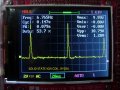
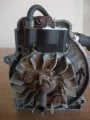
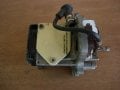
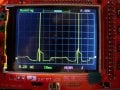
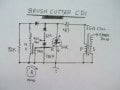
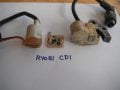
This is a Ryobi ign coil from a brush cutter, it has internal electronics. It canbe either CDI or solid state switching. But im sure this one is CDI switching going by the wave form on the CRO.IGN RYOBI CRO.JPGIGN TESTER.1.JPGIGN TESTER.2.JPGIGN TESTER.3.JPG
 

debe

Joined Sep 21, 2010
1,413
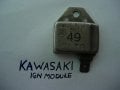
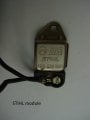
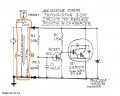
There is another type uses a seperate switching module on the coil. Usualy a transistor switching circuit. Also the circuit that is inside these particular modules. Wave form of the primary ign pulse.IGN MODULE KAWASAKI.JPGIGN MODULE.STIHL.JPGATOM MOD red circ.jpgWIPAC ATOM MOD. CRO.JPG
 
Top