IGBT single phase PWMrectifier

Thread Starter

dhuwarakesh

Joined Apr 20, 2024
22
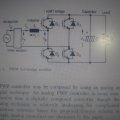
I am studying this circuit which is IGBT based pwm rectifier with power factor control,all theory about sensing the current and output voltage and supplying a respective pwm switching through a feed back make sense to me,but i am caught at one simple thing(mostly my inability to understand).

It is the following
if only pwm pulse should control the current through dc load capacitor which in turn supply load R,I see a short through diode(s1 igbt's) and diode(s3 igbt's) through load R for positive cycle and similarly through other two for negative cycle,what is the explanation,should I never turn off all the switch and should they always be PWM'ed
 

Attachments

Ian0

Joined Aug 7, 2020
13,132
If no transistor is ever switched on, then the circuit defaults to an ordinary bridge rectifier, and output is equal to the peak voltage of the AC waveform (325V for a 230V AC input), but no power factor correction occurs.
To achieve power factor correction, the circuit behaves as a boost converter stepping the output up to 400V DC and forcing the input current to be sinusoidal.
 

Thread Starter

dhuwarakesh

Joined Apr 20, 2024
22
So the only mode it is meant to operate is boost(i.e)dc out voltage is higher than supply volatge.am i correct?

If I remove the inductor at input,then irrespective of on/off condition of switches,it will be just a bridge rectifier.
 

Ian0

Joined Aug 7, 2020
13,132
So the only mode it is meant to operate is boost(i.e)dc out voltage is higher than supply volatge.am i correct?
Yes.
If I remove the inductor at input,then irrespective of on/off condition of switches,it will be just a bridge rectifier.
No, it will be a fire.
At various points in the cycle Q3 and Q4 conduct simultaneously to store energy in the inductor. Without the inductor, it is a dead short across the mains.
 

Ian0

Joined Aug 7, 2020
13,132
I meant to say removing the inductor and avoiding the state(both upper and both lower turn on simultaneously).
In which case, the IGBTs are superfluous, and it defaults to being a standard bridge rectifier. It can't correct the power factor without the inductor.
 

Thread Starter

dhuwarakesh

Joined Apr 20, 2024
22
In power factor control mode

What will happen at sudden ac power disconnection.
in that case inductor has finite magnetic energy which is yet to charge the capacitor/load. will it take some path through the filter capacitor at ac input.

Is there a safe/particular point at which the power disconnection should be performed such that current through inductor is close to zero.
 

Ian0

Joined Aug 7, 2020
13,132
What will happen at sudden ac power disconnection.
in that case inductor has finite magnetic energy which is yet to charge the capacitor/load. will it take some path through the filter capacitor at ac input.
Correct
Is there a safe/particular point at which the power disconnection should be performed such that current through inductor is close to zero.
Because it operates generally about 100kHz the energy stored in the inductor is small, and the filter capacitor can cope with it.
 

Ian0

Joined Aug 7, 2020
13,132
Noted.
but application I am reading states switching frequency not that high,somewhere in the range of 5-10 kHz.
Maybe, depends on the application and power. Something of the order of 1kW would be 100kHz. Larger industrial things would be a lower frequency, and they would have commensurately larger filter capacitors.
Also, operating frequencies are increasing as technology improves. If you text is quite old, then it might specify a lower frequency than the semiconductor manufacturers are recommending nowadays.
 

Thread Starter

dhuwarakesh

Joined Apr 20, 2024
22
Maybe, depends on the application and power. Something of the order of 1kW would be 100kHz. Larger industrial things would be a lower frequency, and they would have commensurately larger filter capacitors.
Also, operating frequencies are increasing as technology improves. If you text is quite old, then it might specify a lower frequency than the semiconductor manufacturers are recommending nowadays.
Yes it is 20 years old text,anyways I mostly try a new concept learned with easily available components(i.e old) so I will set 10 kHz as benchmark.
 

schmitt trigger

Joined Jul 12, 2010
2,089
Can you share the complete circuit description, right now it is truncated in your photo.
Also…. When you take a photo of a computer screen, manually turn off the flash.

The reason I am asking is that, I am quite sure that IGBTs cannot be used as synchronous rectifiers, it is always Mosfets.
But, perhaps there’s a way which I ignore. I would like to be educated.
 

Ian0

Joined Aug 7, 2020
13,132
Can you share the complete circuit description, right now it is truncated in your photo.
Also…. When you take a photo of a computer screen, manually turn off the flash.

The reason I am asking is that, I am quite sure that IGBTs cannot be used as synchronous rectifiers, it is always Mosfets.
But, perhaps there’s a way which I ignore. I would like to be educated.
There is no synchronous rectification happening. The circuit is often seen without S1 and S2 and just with their antiparallel diodes.
 

Thread Starter

dhuwarakesh

Joined Apr 20, 2024
22
Can you share the complete circuit description, right now it is truncated in your photo.
Also…. When you take a photo of a computer screen, manually turn off the flash.

The reason I am asking is that, I am quite sure that IGBTs cannot be used as synchronous rectifiers, it is always Mosfets.
But, perhaps there’s a way which I ignore. I would like to be educated.
My bad sorry,it's not flash just room lighting reflecting off screen.
This is it,other images in paper are about the feedback loop.

Name of the article:
High power factor PWM rectifiers with an analog pulse-width predictor


As Ian0 pointed out it is a pfc with four IGBT for bidirectional operation,if unidirectional is enough any of two upper or lower can be replaced with diode

May be this is some form of a active rectification,with more emphasis taking into consideration the reactive load at the rectified output.(the involvement of active devices will make it a flavour of synchronous as it switching need to be coordinated with ac input)

At AC mains voltage level(230V) IGBT has more selection than mosfet.
 
Last edited:

Thread Starter

dhuwarakesh

Joined Apr 20, 2024
22
If no transistor is ever switched on, then the circuit defaults to an ordinary bridge rectifier, and output is equal to the peak voltage of the AC waveform (325V for a 230V AC input), but no power factor correction occurs.
To achieve power factor correction, the circuit behaves as a boost converter stepping the output up to 400V DC and forcing the input current to be sinusoidal.
As I see this the IGBT built up current on inductor for boost action(upper or lower pair simultaneous turn on) and after boost voltage is applied to dc link capacitor only by diode bridge action and only when dc side is greater than ac side,switches come into play for conduction.

Is my assumption right Or conduction path will be switches also during capacitor load charging

If my assumption is right then the diode selection will be as important as IGBT,and we cannot rely on body diode that may be available on some IGBT?
 
Last edited:
Top