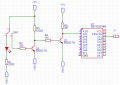
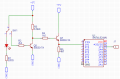
Don't leave the base on transistor Q8 is floating. Pull down the base with a 1 kΩ resistor.
The common emitter configuration of Q7 is an inverter. The common collector configuration is non-inverting and provides no voltage gain. You don't need Q7.
Don't leave the base on transistor Q8 is floating. Pull down the base with a 1 kΩ resistor.
The common emitter configuration of Q7 is an inverter. The common collector configuration is non-inverting and provides no voltage gain. You don't need Q7.
[اقتباس="MrChips، المنشور: 1954735، العضو: 62020"]
لا تترك القاعدة على الترانزستور Q8 عائمة. اسحب القاعدة لأسفل باستخدام مقاومة 1 كيلو أوم.
تكوين الباعث المشترك لـ Q7 عبارة عن عاكس. تكوين المجمع المشترك غير عاكس ولا يوفر أي مكسب للجهد. لا تحتاج إلى Q7.
[/يقتبس]
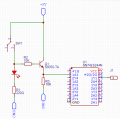
What do you think of it now? Are the values of the two 10k resistors good? I put 74244 to fix the output j perfectly. The switch is a toggle switch. Does it require an anti-rebound circuit?. And thanks
I'm assuming (since the TS doesn't seem inclined to say) that is is part of the assignment. If so, it would be nice to know what the assignment actually is.
What do you think of it now? Are the values of the two 10k resistors good? I put 74244 to fix the output j perfectly. The switch is a toggle switch. Does it require an anti-rebound circuit?. And thanks View attachment 338244
What do you mean by "perfectly"? A lot of people assume that logic gates output "perfect" logic values and design circuits that rely on that. They don't, particularly TTL. That was one of the first mistakes that I made as a student working with digital logic.
As for the switch debouncing, that depends on whether you require a clean signal. You are using a Schmitt-trigger input buffer, so that will help some, but switch bounce can go well beyond what the hysteresis of a Schmitt-trigger can handle. How bouncy is your switch? How tolerant to signal bounce is whatever is being driven by the '244?
Because this is a learning and thinking experiment:
Look at the schematic of how a TTL inverter or buffer is built. The output stage is built to pull down hard to a low lever. They do not pull up well. The output stage has a transistor whose Emitter is sitting on ground. (top choice)
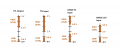
Look at the voltage levels you need to have for TTL. A "0" must be below 0.7V while a "a" only needs to be above 2V.
Because this is a learning and thinking experiment:
Look at the schematic of how a TTL inverter or buffer is built. The output stage is built to pull down hard to a low lever. They do not pull up well. The output stage has a transistor whose Emitter is sitting on ground. (top choice)
Look at the voltage levels you need to have for TTL. A "0" must be below 0.7V while a "a" only needs to be above 2V. View attachment 338308
It's becomes even more clear when one realizes that a TTL input is actually a current-sourcing "output" -- current must be drawn from an input by the previous output to effect a "0" on the input.
It's becomes even more clear when one realizes that a TTL input is actually a current-sourcing "output" -- current must be drawn from an input by the previous output to effect a "0" on the input.
Not amazing (or at least not surprising). The two go hand-in-hand. TTL outputs are intended to drive TTL inputs. Your outputs need to sink all the current that all of the inputs they are driving are sourcing, but since the inputs don't sink current, the outputs don't need to source much. When you want to drive something other than TTL inputs, you should use a suitable driver with TTL-compatible inputs.
Yes.
The source current mainly just needs to drive the parasitic circuit capacitance of the traces and the driven logic circuit inputs to give the desired signal rise-time.
Not amazing (or at least not surprising). The two go hand-in-hand. TTL outputs are intended to drive TTL inputs. Your outputs need to sink all the current that all of the inputs they are driving are sourcing, but since the inputs don't sink current, the outputs don't need to source much. When you want to drive something other than TTL inputs, you should use a suitable driver with TTL-compatible inputs.

 Facebook
 Google
 GitHub
 Linkedin