How/ when did you become enamored with electronics?

Thread Starter

schmitt trigger

Joined Jul 12, 2010
2,027
Early 1960s. My father was a renowned architect. And audiophile. A real one.

A local businessman, who owned several radio and a TV station, asked my father to design his home. Turns out he was also an audiophile, and they became listening pals.
One day he asked my father: “would you like to SEE the music?”
“You mean…See the music???” My father retorted, full of disbelief. “Well, of course!”
Next day, an enormous and heavy Tektronix 565, with the cart included, arrived home. A radio engineer set it up and connected to the amplifier, put a record, and Voilà! Squiggly green lines appeared on the screen, dancing with the music.
To me, it was a magical moment. The myriad buttons and switches, with its mysterious sounding labels, were beyond comprehension.

There and then I decided to become an electronics engineer. I must have been 8 or 10 years old.
 

Lightium

Joined Jun 6, 2012
320
I was fourish and CRT TV had my interest. I used to switch it off/on to watch the dot fade away(knowing there were electrons smacking the screen) Watching static UHF(not knowing about NTSC).
 

dendad

Joined Feb 20, 2016
4,634
My dad had a radio chassis in the shed. I broke open each tube to see what was in them, unwrapped each capacitor and generally trashed everything else. This was probably 65+ years ago.
That was the start, I think, of a lifetime of electronics that still goes on, with many years at a Radio Australia transmitter site, then more years designing and building industrial control equipment. Now it is ham radio with Arduino synthesizers giving life to old sets. Also, 3D printing.
Some of my efforts can be seen here... http://www.sadarc.org/xenforo/upload/index.php?forums/project-workbench.5/
 
Last edited:

BobTPH

Joined Jun 5, 2013
11,463
Science class was the only thing that interested me in grade school. I was particularly fascinated with electricity. So no specific incident. I started reading “Popular Electronics” when in high school and started building circuits completely on my own, I had no one in my life who could offer any help.
 

R!f@@

Joined Apr 2, 2009
10,004
My father brought home a flashlight battery, a light bulb and a bit of wire. I was hooked and made electronics my career.
I did better. :p

During early school days, I got fascinated by bulbs and batteries.
I believe it started when I short circuit batteries ( don't know why spark is coming, itsy bitsy ones ), and eventually ended up short circuiting 220VAC mains with some wires hooked up.
After 30 years or so, I vividly remember the bang and how I went about doing it.
 

R!f@@

Joined Apr 2, 2009
10,004
By the way, I ended up shorting 400VAC too. After my studies, and that my friends I will remember till I die, I believe.
 

BobTPH

Joined Jun 5, 2013
11,463
Just remembered an incident. I had learned about electromagnets in science class, probably sixth grade. I went to the basement and found a nice fat drill bit for the core. Then I liberated a scrap of probably 14ga wire from a construction site, wrapped it around the entire length of the bit. A D-cell taken out of something at home completed my BOM. And voila, a working electromagnet! I think that might be what sold me.
 

LowQCab

Joined Nov 6, 2012
5,101
My Dad was the culprit .........
He worked for the State-of-Florida at the Shands-Teaching-Hospital in Gainesville.
When I was around ~5-ish, (~1962/63),
my Mom would take me and my Sister, in our 1960-Beetle, to pickup my Dad from work.
I would get sent, by my self, on a really scary adventure all the way up to the 5th-floor,
to let my Dad know we were here to pick him up.

His Electronics-Shop shared a huge Shop-Space with the Wood/Metal/Machine-Shop,
which was divided in half by floor to ceiling Parts-Bins that were
jam-packed with with 100% Mil-Spec-Surplus-Electronics-Parts,
they were authorized to buy Mil-Spec-Surplus by the pound at Camp-Blanding-Florida-Military-Base.

I used to spend as much time as possible just going through all the really cool stuff that
was simply not attainable, even in pictures, anywhere else.
I occasionally got to take home a few trinkets to play with,
and my Dad even made me a Power-Supply with a Wood-Base and a 6.3-Volt Filament-Transformer,
2 Binding-Posts, and a crude Switch, which Powered many experiments for ~4 or ~5 years.
Then there was the Home-Made Hi-Fi-Stereo in the Shop, ( and one at Home too ),
along with a Signal-Generator and a giant Dual-Trace-Scope to play with.
As long as I didn't mess with anything on the main Work-Bench, I could dig into anything I wanted.

Around this same time, I got a KnightKit "Ocean-Hopper" Shortwave-Radio-Kit for Christmas.
.
.
.
 

Attachments

Last edited:

cmartinez

Joined Jan 17, 2007
8,722
I was as a kid when I saw a Popular Electronics magazine boasting that it had the schematics for 100 electronic projects in that issue ... I begged my dad to buy it for me and he complied ... I dearly loved the man ...

Anyway, I remember spending weeks staring at its contents, mesmerized whilst at the same time not understanding one bit about how they were supposed to work, even though a brief description of what each of the parts did was present in every diagram.

Then after a year or so, I tried to build a metal detector and failed miserably. In retrospective I must've burned the parts because I had zero experience in soldering. I didn't exactly give up, but I couldn't go on either because of my rather meager budget at the time.

I tried to build my next circuit a couple of years later, and voilá! .. this time it (partially) worked. I bought a "binary counter" chip which I used to try to build a water level meter for my house's water tanks, and the LEDs did light up when the floater was placed near the reed switches in a rod that I had clumsily built ... but I expected the darn things to lit up in a linear way ... Instead, what I saw was what at the time appeared to me a random pattern of lights. Back then I had zero idea of what the word "binary" meant ... So I had to go back and patiently reload my piggy bank. And then back to the drawing board.
 

Ya’akov

Joined Jan 27, 2019
10,226
I think that electronics was just one topic in the range of technological and practical topics I found inherently interesting from as far back as I can remember. I also had a strong affinity for tools in and of themselves. But there are three instances that stand out from early in my life…

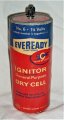
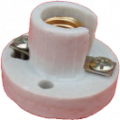
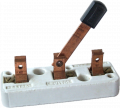
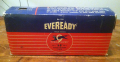
For my seventh birthday, my uncle gave me a gift of a copy of the Dover Edition of the NAVPERS (Bureau of Navy Personal) Basic Electricity book, and a nice wooden box in which there was an Eveready No. 6 “Ignition“ cell, several feet of “bell wire”, and eight ceramic lamp sockets with matching bulbs (including thermally operated flashing ones), and a selection of ceramic-based knife switches, including SPST, SPDT, DPST, and DPDT types. There were no instructions, no learning guide, only the NAVPERS book.

Looking back, it seems strange that he’d expect me—a 7-year old—to be able to make use of these things. I vividly recall spending hours trying different things, exploring circuits and possibilities of combinations, and learning what would and wouldn’t “work”.

1708003737591.png 1708005225747.jpeg1708005427486.png1708005512993.png
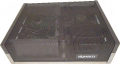
left to right: NAVPERS Basic Electricity, Dover Edition cover, No. 6 cell (6” tall), a lamp holder, a knife switch
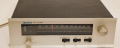
About the same time, my father was building a couple of Dynaco “Hi-Fi” kits:

1708005804926.gif
The Dynaco FM-5 Tuner

1708005897486.png
The Dynaco Stereo 120 Amp
I was fascinated by the components and their functions. Along with the NAVPERS books, I asked a lot of questions. My father was no expert, but he and I looked things up and I began to understand the basic operation of passives, a bit about transistors (and tubes). I also learned about schematic symbols.

The third thing was, as an 11 year old, receiving a Radio Shack 100-in-1 Project Kit:

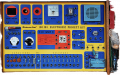
1708006173067.png
I spent endless hours with this.

1708006355526.jpeg
The manual that came with the kit was wonderful, particularly the ”HOW IT WORKS” section.
The theory of operation detailed there was the core of learning and was very well done.

So, that’s what I remember. Electronics mixed in with everything else I did, and while it always figured in, in some way, to my career(s) the breadth of my knowledge and skills was the key to success. I think knowing electronics, though, added to my thinking tools so that even when it wasn’t the subject the reasoning and methods of it were there.
 

atferrari

Joined Jan 6, 2004
5,001
My earliest recollection comes from when I was 5 or 6 years old of a technician coming home to repair a Philips "combinado" (78 RPM tube record player plus an AM radio receiver) ca. 1952. Even now I see him tweaking an adjustable power resistor and I can feel the heat emanating from there. That made for a lasting impression.

It is worth noting that the effect of applying the right hand index and middle fingers to a 220V socket shortly after was not a deterrent.

It took me more than 20 years to actually take off, when building a modified CW xmtr from scratch (AM bands - 80/40 m) and, in parallel, start learning what digital was with a failed CMOS board (imitation of the Big Ben) and a needle multimeter. I couldn't believe that there was a clock??!! in it... Saving up to buy the multimeter was my first serious hobby-oriented effort.

I enjoyed and continue to enjoy the journey...
 

Thread Starter

schmitt trigger

Joined Jul 12, 2010
2,027
Ooooh! Those 100 in one electronics lab kits.
I also received one of those, I believe from Calectro. It had four Germanium transistors.
My father had acquired it on a trip to New York in mid-August. It was intended as Christmas present so they hid it… not very well because I found it. Since it was intended as a surprise, I pretended not to know anything. Yet I did remove the little booklet and read it cover-to-cover. The longest wait until Christmas!
 

nsaspook

Joined Aug 27, 2009
16,249
I don't think I was ever enamored with electronics, I was just born with the knack of quickly understanding how things worked. To understand how old tube radios worked I needed to learn electrical science (and science in general to understand the world) to understand radio. Then I need to learn electronics to understand how that science was implemented as a technology of components and rules to 'make' a radio.
I was enamored with understanding and making things, not technology.
 

Ya’akov

Joined Jan 27, 2019
10,226
I don't think I was ever enamored with electronics, I was just born with the knack of quickly understanding how things worked. To understand how old tube radios worked I needed to learn electrical science (and science in general to understand the world) to understand radio. Then I need to learn electronics to understand how that science was implemented as a technology of components and rules to 'make' a radio.
I was enamored with understanding and making things, not technology.
This is similar to my experience. I would only add that electricity/electronics gave me a new set of thinking tools that helped me understand other, non-electronic topics better and more quickly. The electronic concepts gave me a different way to approach problem solving that I’ve always appreciated.
 

ElectricSpidey

Joined Dec 2, 2017
3,312
I can't say for sure, but I would imagine it was about the time I started messing around with the power packs that come with model trains and slot cars doing things with them they weren't designed to do.

One of my earliest memories is making a "searchlight" from a car headlight and a big Lionel power pack.
 

Lo_volt

Joined Apr 3, 2014
370
I had no one in my life who could offer any help.
This was my frustration growing up. My dad did own a Simpson ohmmeter, but he used it to diagnose pump motors. He knew very little about electronics. A family friend who collected junk loaned me an old tube scope and an audio frequency tone generator. He didn't know how they worked either.

One of the greatest advantages our younger generations have is forums like this. So many times I'd get stuck on a project with no one to help me figure it out. It's one of the reasons I contribute here is to mentor growing minds.
 

MrChips

Joined Oct 2, 2009
34,626
I was building crystal radios by the time I was 13. I discovered Practical Wireless in a bookstore and subscribed for it annually.
I was in a radio repair shop for whatever reason and found that they were off-loading their pile of used battery-operated tube radios. This was the era when people were getting rid of their old 90V, 1.5V battery radios.

1708014209710.png

I mentioned this to my dad. A few days later, there was a horse drawn long wagon loaded with more than 100 old radios outside our house.

1708014463437.png

What a treasure heap that was for me. I spent weeks and months taking the radios apart and saving salvageable components. I bought some rectifiers, power resistors and capacitors and converted some of the radios to AC operation and sold them. Little did I know then about the dangers of a live chassis.
 

Thread Starter

schmitt trigger

Joined Jul 12, 2010
2,027
Live chassis. Boy, does that bring back some “shocking” memories! But even with transformer isolated supplies, the B+ could be as high as 400VDC on some power tubes, that would give you a nice jolt.

Also, both the tubes and the high wattage resistors would burn you. Not to mention the very high power soldering irons required to solder to a metal chassis.
But it was fun!
 

dl324

Joined Mar 30, 2015
18,216
When I was a child, I used to watch my dad working on plumbing and electrical things on the apartments he owned. When I was around 8 or 10, he started sending me to work on plumbing issues for tenants and I decided I was going to be a plumber or electrician. After tearing apart some battery-operated cars and playing with the motors, and getting a crystal radio, I decided I wanted to be an electrician (didn't understand the difference between that and electronics). Sometime during high school, that morphed to electrical engineering.

I started doing electronics as a hobby while I was an R&D technician at HP Labs.
 
Top