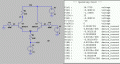
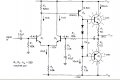
how was the quiescient current set in this transistor power amplifier?

Thread Starter

Santa klaus

Joined Nov 16, 2014
36
the base quiscent voltage of the diff pair is -0.4V and the emitter voltage -1.0V. This gives a quiscent current of 2mA. I don't understand. Why is the base -0.4V or the emitter -1V ? did the author predict that,how? I tried simulating only the diff pair with no input and i don't get the same quiescent values. [this is from the Art of Electronics]
Capture.JPG
 

Thread Starter

Santa klaus

Joined Nov 16, 2014
36
never mind i got it. we use the relation Ic = Hfe x Ib and the input resistor to set the input voltage. My Hfe in simulation was not 250 that's why it didn't work
 

MikeML

Joined Oct 2, 2009
5,444
Note that both bases are effectively supplied from 0V. The base resistors cause a small voltage drop. V(ee) has to be -0.6V or so below the bases, so V(ee) is about -1V, which means the current in R3 is about 14/6800 = 2mA. Since the diff amp is initially balanced, then the current in the emitters is more or less equal, or ~1mA each.
diff.gif

Notice that I didn't need to make any assumption about Hfe.
 

WBahn

Joined Mar 31, 2012
32,993
Note that both bases are effectively supplied from 0V. The base resistors cause a small voltage drop. V(ee) has to be -0.6V or so below the bases, so V(ee) is about -1V, which means the current in R3 is about 14/6800 = 2mA. Since the diff amp is initially balanced, then the current in the emitters is more or less equal, or ~1mA each.
View attachment 90848

Notice that I didn't need to make any assumption about Hfe.
Sure you did. Otherwise how did you get that V(ee) was -1V and not -0.7V or -1.5V or some other value?

You can converge on it very quickly. First assume that there is no voltage drop across the base resistor (infinite beta) and you have Ve ~= -0.6V putting 14.4V across the 6.8 kΩ resistor yielding 2.12 mA. Half goes down each transistor (assuming the output is nulled) giving an Ic of 1.06 mA. The stated beta is 250 giving a base current of 4.2 uA. With a 100 kΩ base resistor, that's a voltage drop of 424 mV. That's almost certainly good enough, but you could go another round and say that Vb = -0.424 V making Ve = -1.024 V (and noting that we don't know Vbe to within more than about 100 mV) making Ic = 1.028 mA making Vb = -0.411 V. Given the uncertainty in Vbe, there's no point in going any further.
 
Top