How to split current from a constant current source

Thread Starter

smileygirl654

Joined Oct 15, 2017
1
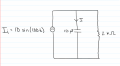
The question I need to answer is: "Determine the amplitude for the current (I) and its phase with respect to the current source in the circuit shown. In the expression for Ii, the unit for current and time is mA and seconds, respectively."

I am struggling with where to even start. I understand that because the capacitor and resistor are in parallel, then the current (Ii) must split, but I have no clue how to go about doing that.

Can I find the capactive reactance and then use that to treat the capacitor like a resistor so that the following equation can be use to solve for I?:
I/Ii = Rc/(Rr+Rc)
I am finding the capacitive reactance by using the equation provided by Ii and taking omega to be 100. With this then Xc = 1/(omega*C)=1/(100*10^-6 F)= 10000 ohms. But, since I don't know I, I feel like this is wrong, because omega would be dependent on the current going into the capacitor. I'm just all around confused.
 

Attachments

RBR1317

Joined Nov 13, 2010
715
I am struggling with where to even start.
If you can find the voltage across the capacitor, then it is easy to find the current through the capacitor. I would use nodal analysis to get the voltage across the capacitor. The capacitor current will be a function of frequency, so check that the result gives what is expected at ω=0 & ω=∞.
 

shteii01

Joined Feb 19, 2010
4,644
Step 1.
Rewrite the current source equation in the form: Ii=Amplitude(2*pi*f*t)
This will give you the frequency at which the source current is oscillating.

Step 2.
Take the frequency from Step 1 and calculate IMPEDANCE of the capacitor. Replace the capacitor in the circuit with the capacitor impedance, this way you now have a purely "resistive" circuit and you can apply all the regular techniques that you learned for the circuits made of resistors.

Step 3.
Now that you have a circuit that has only "resistors", you can apply current divider formula to find current passing through capacitor. If I did this, I would have capacitor impedance in polar form, this way the current would be in polar form also, then just apply some trigonometric stuff to find magnitude and phase angle.
 

MrAl

Joined Jun 17, 2014
13,667
The question I need to answer is: "Determine the amplitude for the current (I) and its phase with respect to the current source in the circuit shown. In the expression for Ii, the unit for current and time is mA and seconds, respectively."

I am struggling with where to even start. I understand that because the capacitor and resistor are in parallel, then the current (Ii) must split, but I have no clue how to go about doing that.

Can I find the capactive reactance and then use that to treat the capacitor like a resistor so that the following equation can be use to solve for I?:
I/Ii = Rc/(Rr+Rc)
I am finding the capacitive reactance by using the equation provided by Ii and taking omega to be 100. With this then Xc = 1/(omega*C)=1/(100*10^-6 F)= 10000 ohms. But, since I don't know I, I feel like this is wrong, because omega would be dependent on the current going into the capacitor. I'm just all around confused.
Hello,

To do this right you can not replace the capacitor with an actual resistance like 1000 Ohms, instead it must be what we might call a "complex resistance" which is an impedance. Luckily this is easy to calculate though. If your cap has value C then the "complex resistance" is:
Zc=1/(j*w*C)

where 'w' is 2*pi*f where f is frequency in Hertz, and 'j' is the imaginary operator. This means it is an imaginary number not a real number like the resistance of a resistor, but it can be handled in the same way. So if you know how to calculate the total resistance of two resistors in parallel then you know how to do a resistor in parallel with a capacitor also (for AC circuits).

Two resistors in parallel produce total resistance RT as:
RT=R1*R2/(R1+R2)

as i am sure you know, so a resistor in parallel with a capacitor has total "complex resistance" as:
ZT=R1*Zc/(R1+Zc)

where Zc is given farther above, and after you simplify that you get the total impedance ZT.

Note you need to work with complex numbers for this problem. If you try to work with capacitive reactance you'll get an approximation but that approximation will sometimes be way off.
 
Top