How to put motors on drawer slides

shortbus

Joined Sep 30, 2009
10,049
At 2 pounds that still sounds like a pretty small monitor. If that is the weight I'd be looking at something similar to how a scissors lift works, or one of the jacks they use today, that comes with your car. And if done right would get away from drawer slides altogether.

Also known as a pantograph mechanism, some like a real scissors lift use hydraulic cylinders, but a car jack uses a screw and would be easy to put a motor on it. Some ideas to look at - https://www.google.com/search?clien...UDCc0KHYDVDsAQ1QIwGnoECBkQAQ&biw=1024&bih=615
 
I forgot to post this https://forum.allaboutcircuits.com/threads/how-to-put-motors-on-drawer-slides.180194/ page yesterday. Ladder chain is inexpensive and available in english and metric units.

I did a curtain back in the 1980's where I replaced the cord with ladder chain the opening distance + some slack.
I then cut slots so the motor could slide and spring-loaded the motor, a 24VAC synchronous motor an d added limit switches. It worked very well. This had inherent overload protection. The chain would slip off.

Bead chain is more expensive and they make sprockets for them.

You MIGHT be able to get away driving one side, but a shaft with two gears might work better. Your essentially attaching a piece of chain to two fixed points. The problem is tension.

A timing belt would get rid of the need to tension.

A spring on each end of the chain did not work as well as even tensioning. Tensionsing is sometimes done with a spring-loaded arm and idler gear.

A rack and pinion and a worm drive might be better for you. The monitor always has to be driven. It can't fall.
 
Last edited:

Thread Starter

TheGuyMain

Joined Jun 28, 2021
21
At 2 pounds that still sounds like a pretty small monitor. If that is the weight I'd be looking at something similar to how a scissors lift works, or one of the jacks they use today, that comes with your car. And if done right would get away from drawer slides altogether.

Also known as a pantograph mechanism, some like a real scissors lift use hydraulic cylinders, but a car jack uses a screw and would be easy to put a motor on it. Some ideas to look at - https://www.google.com/search?clien...UDCc0KHYDVDsAQ1QIwGnoECBkQAQ&biw=1024&bih=615
i considered a scissor lift but its not very compact imo. and i'd still be asking the same motor questions with that design in mind
 

Deleted member 115935

Joined Dec 31, 1969
0
The TV lifting units I have seen

use either a screw / worm gear system,
or a scissors jack type system,

the advantage is no power, they stay put,
so breaking needs are minimal.
 

shortbus

Joined Sep 30, 2009
10,049
I forgot to post this https://forum.allaboutcircuits.com/threads/how-to-put-motors-on-drawer-slides.180194/ page yesterday. Ladder chain is inexpensive and available in english and metric units.

I did a curtain back in the 1980's where I replaced the cord with ladder chain the opening distance + some slack.
I then cut slots so the motor could slide and spring-loaded the motor, a 24VAC synchronous motor an d added limit switches. It worked very well. This had inherent overload protection. The chain would slip off.

Bead chain is more expensive and they make sprockets for them.

You MIGHT be able to get away driving one side, but a shaft with two gears might work better. Your essentially attaching a piece of chain to two fixed points. The problem is tension.

A timing belt would get rid of the need to tension.

A spring on each end of the chain did not work as well as even tensioning. Tensionsing is sometimes done with a spring-loaded arm and idler gear.

A rack and pinion and a worm drive might be better for you. The monitor always has to be driven. It can't fall.
While I can see that working, to me there would need to be a permanent pole or tower above where the monitor would be when raised. Something to mount the upper pulley on. It was my understanding that the TS wanted it to be hidden when not activated.
 

shortbus

Joined Sep 30, 2009
10,049
i considered a scissor lift but its not very compact imo. and i'd still be asking the same motor questions with that design in mind
It would be more compact than any other way. It's why the TV lifts are done that way, and they are self supporting no side frame- drawer slides. While I referenced a car jack that was just a reference, to illustrate what was being suggested. Stop and really look at one, the one in your car trunk. Look at the size of the arms of it around 1/8" thick arms lifting a 2 ton+ car! A screw that keeps it in either the up or down position with no input after it is put in that position! So it can be made from much thinner materials for the 2 pound monitor. And a small DC gear motor to drive the screw. Also when in the down position the mechanism is hidden in the desk or what ever this is in, and most of it when up would be hidden behind the monitor.
 

djsfantasi

Joined Apr 11, 2010
9,237
While I can see that working, to me there would need to be a permanent pole or tower above where the monitor would be when raised. Something to mount the upper pulley on. It was my understanding that the TS wanted it to be hidden when not activated.
FYI, a chain or cable drive can be hidden totally under the desk without a “tower”. The trick is to lift from the bottom of the “slide” rather than pulling from the top.
 

Deleted member 115935

Joined Dec 31, 1969
0
I think the problem might be ,
That motors are very hard to pair with a random application,

I'd suggest a stepper motor, to allow control , but that needs a controller and is more expense thna a simple motor.

Motor size is also difficult to suggest,
you have two basic parameters,
torque and speed,

You need sufficient torque to overcome your resistances, and sufficient speed to move the unit "fast enough"
A "massive" motor , what ever that might be, could well do the job, but would be much more expensive than one that's "just" good enough.

This might be a good place to start
https://uk.farnell.com/nanotec/st4118x1404-a/stepper-motor-2-8vdc-1-4a/dp/2507562
but it might not be, !!

For info on steppers, and controling,


Have fun experimenting,
 

Ya’akov

Joined Jan 27, 2019
10,263
Why would it be noisy? and how would I use a rubber drive belt in the design? I'm inexperienced with this kind of stuff so I'm having a hard time following
I think the problem might be ,
That motors are very hard to pair with a random application,

I'd suggest a stepper motor, to allow control , but that needs a controller and is more expense thna a simple motor.

Motor size is also difficult to suggest,
you have two basic parameters,
torque and speed,

You need sufficient torque to overcome your resistances, and sufficient speed to move the unit "fast enough"
A "massive" motor , what ever that might be, could well do the job, but would be much more expensive than one that's "just" good enough.

This might be a good place to start
https://uk.farnell.com/nanotec/st4118x1404-a/stepper-motor-2-8vdc-1-4a/dp/2507562
but it might not be, !!

For info on steppers, and controling,


Have fun experimenting,
I had suggested a stepper. It has a couple of advantages including the ability to have a nice acceleration-deceleration profile and, the noise it will make is very cool and robotic.
 

MaxHeadRoom

Joined Jul 18, 2013
30,732
I had suggested a stepper. It has a couple of advantages
The L298 stepper drives on ebay are <$2.00 there is a planetary stepper and GB (5:1) on Amazon.
Planetary GB's are the quietist.
The motor is fine at its rated voltage up to a certain RPM, No sophisticated drives needed.
The L298 could be supplied with pulses from a 555.
For the above motor you would need to check your required torque.
You can do this with a simple spring scale.
You generally make the mechanical system, then test for required power and rpm.
The advantage with a stepper at rated voltage, you can stall it with no ill effects.
 

djsfantasi

Joined Apr 11, 2010
9,237
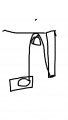
I’m on my phone, so here’s a rough sketch..

The rectangle with a circle is the motor; the circle is a lift drum. The squiggly circle is an idler gear. To fit the cable drive under the desk and increase torque, you can double up the idler gear and add an additional gear at the bottom of travel. The rectangle on the left is the drawer slide. To resolve the synchronization problem, the motor can drive both sides of the lift, with one shaft connecting both lift drums.
0FAE0B3A-56F8-42FC-A210-B0C63021B35F.jpeg
 
Top