How to properly ground my components.

Thread Starter

MB107

Joined Jul 24, 2016
400
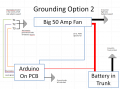
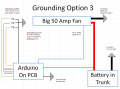
I have just recently completed a PCB with an Arduino Nano33 BLE to control the fan in my car. And now I'm ready to install it. The controller takes inputs from 3 thermisters, radiator temp, condenser temp and under hood temp and generates a 10Hz. PWM signal to control fan speed. I have tested it out on the bench and all works good but all the wires are short on the bench and I am concerned about how, I'm going to ground the components in an actual vehicle. I have three possible options I have come up with. All bench testing was performed as in option 1. But option 2 would be a lot easier to wire. Please keep in mind the front radiator support is one solid piece of metal but the left and right ground points are ~3ft apart, and the radiator support is about 5 ft from the ground location under the dash.

Option 1, Seperate wire for each thermister wire

1645162263879.png

Option 2, All Thermister grounds go to front radiator support
1645162336695.png

Option 3, All Thermister grounds go to front radiator support and Arduino ground.
1645162383244.png
 

DickCappels

Joined Aug 21, 2008
10,661
Given that strange things can happen when starting the engine (many amps, some of it flowing throughout the car's body) the safest approach will be run both the signal leads and the their return paths through insulated wires from the sensors to the controller, otherwise you will need to add protection to the inputs of the controller to protect against over-voltage on the inputs causing SCR latchup. Option 1 is probably your best choice.
 

MisterBill2

Joined Jan 23, 2018
27,522
It is NEVER a best choice to use body metal as a signal path for any portion of any signal that needs to be reliably delivered to an input.Thus all of the temperature sensors need a common return to that little control board. The sensors can share one common lead, but that lead must not also conduct any power. Thus option #1 is the closest, but the arduino stil needs a separate connection to the battery negative.
 

Picbuster

Joined Dec 2, 2013
1,058
Given that strange things scan happen when starting the engine (many amps, some of it flowing throughout the car's body) the safest approach will be run both the signal leads and the their return paths through insulated wires from the sensors to the controller, otherwise you will need to add protection to the inputs of the controller to protect against over-voltage on the inputs causing SCR latchup. Option 1 is probably your best choice.
Dick is correct!
Starting the engine could produce a spike. I did measure worst case +80V and -48V using a bad car battery (cause by start motor coils).
Run processor ground to the battery and install over voltage protection at the mpu power input leads.

Picbuster
 

Thread Starter

MB107

Joined Jul 24, 2016
400
Given that strange things scan happen when starting the engine (many amps, some of it flowing throughout the car's body) the safest approach will be run both the signal leads and the their return paths through insulated wires from the sensors to the controller, otherwise you will need to add protection to the inputs of the controller to protect against over-voltage on the inputs causing SCR latchup. Option 1 is probably your best choice.
For some reason none of the replies to this post ever showed up by the time I did it, yet I see 4 replies all on the same day. Since I did not see any replies, I went ahead and did option 1. I guess I guessed right. I also twisted the wire pairs going to the sensors. Thanks and thanks for the latchup document.
 

Thread Starter

MB107

Joined Jul 24, 2016
400
It is NEVER a best choice to use body metal as a signal path for any portion of any signal that needs to be reliably delivered to an input.Thus all of the temperature sensors need a common return to that little control board. The sensors can share one common lead, but that lead must not also conduct any power. Thus option #1 is the closest, but the arduino stil needs a separate connection to the battery negative.
Thanks for the reply.
See my previous reply to DickCappels. I did option 1. But I am grounding the Arduino to the vehicle chassis. It is working perfectly so far.
 

Thread Starter

MB107

Joined Jul 24, 2016
400
Dick is correct!
Starting the engine could produce a spike. I did measure worst case +80V and -48V using a bad car battery (cause by start motor coils).
Run processor ground to the battery and install over voltage protection at the mpu power input leads.

Picbuster
Thanks for the replay. I did go with option 1 with twisted pair wiring. I don't have over voltage protection or Arduino grounded at the battery, but none of the aftermarket fan controllers require that. They don't have a great reputation for reliability, so if I have problems that may be what I will look into.
 

Thread Starter

MB107

Joined Jul 24, 2016
400
Is the PWM signal optoisolated? It would seem a good precaution.
It is not. I did develop an optoisolated version but I diddent like the low MTBF rate for the opticoupler I was using. So its just 2 stage transistor. All is working well for the moment.
 
Top