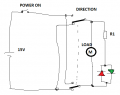
How to make a LED glow when the voltage is variable?

Thread Starter

rigerman

Joined Apr 25, 2014
44
Hi,

I am facing a problem in making a LED staying ON when the output voltage drops. So the output voltage is basically controlled by a pot and varies from -V to 15V DC. There is a DPDT switch that is used to route the voltage either normally or in reverse. So basically:

Main circuit (15V) -> Pot (0-15V) -> DPDT (+ - Reversal and center off) -> Load.

To know which load is being used, the only way I see is to use a 3 Pole 3 Position switch instead of a DPDT. However these switches are not easily available.

Is there anyway 2 LEDs can be connected with the DPDT and they switch on based on some switching transistors. I can loop in 15v with 1K resistor if it is needed.

Thanks.
 

dl324

Joined Mar 30, 2015
18,219
Main circuit (15V) -> Pot (0-15V) -> DPDT (+ - Reversal and center off) -> Load.
Even messy hand drawn schematics drawn on the back of a napkin are better than a text "schematic" or a lengthy verbal description.

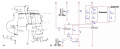
As messy as this Bob Pease schematic is, I couldn't imagine trying to understand a verbal description:
1720198277292.png
Paul Rako's redraw is much easier to read. I just wish he had printed to PDF and gotten rid of the silly colors and the unnecessary grid (and removed some of the unnecessary white space and stopped using that dubious offset connection method that I find more difficult to read because of the added messiness).
 
Last edited:

MisterBill2

Joined Jan 23, 2018
27,164
Certainly there are a few schemes that can provide an indication of when a voltage is withing some specific range.
BUT without any description of the actual purpose and actual goal they will not be provided. I am quite tired of being asked the wrong questions to solve what is not the problem.
The written description in words was quite enough to describe the requested functionality to me, but that is not the problem wanting to be solved, is it???
 

Thread Starter

rigerman

Joined Apr 25, 2014
44
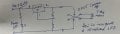
Hi sorry for not incorporating a drawing. I am attaching here now. The problem is the voltage drops with the adjustment so how to keep a LED glowing that will indicate which way the motor is spinning. The DPDT reverses the polarity of the output. LM317T adjusts the output from 0 to 12V DC. cir.jpg
 

WBahn

Joined Mar 31, 2012
32,703
What's the maximum current that the motor can draw?

How are you getting below an output of 1.25 V (which is the recommended minimum output voltage)?

As long as you are putting at least 0.7 V across the motor, you can simply put a transistor, with appropriate base resistance, between each motor terminal and you common. One transistor will be turned on and the other won't. Each transistor drives a separate LED to the Vcc supply, through an appropriate resistance.
 

MisterBill2

Joined Jan 23, 2018
27,164
OK, there is a simple but quite inefficient scheme to provide drive to a "BI-COLOR" 2-lead LED. The LED and a resistor of some value will be connected across the output side of that reversing switch. THEN, between that point and the motor, two strings of a few diodes so that there is a four-diode voltage drop in each direction. That will allow low speed operation of the motor while providing a higher voltage for the LED. BUT all the power dropped across the diodes is wasted.

A much more efficient scheme would be a PWM driver after the voltage adjuster, with the voltage set to provide the maximum required motor RPM at 100% duty cycle. . The LED brightness will still vary with the motor speed, but because the output is still the same voltage, the LED will still be lighted.
 

Thread Starter

rigerman

Joined Apr 25, 2014
44
What's the maximum current that the motor can draw?

How are you getting below an output of 1.25 V (which is the recommended minimum output voltage)?

As long as you are putting at least 0.7 V across the motor, you can simply put a transistor, with appropriate base resistance, between each motor terminal and you common. One transistor will be turned on and the other won't. Each transistor drives a separate LED to the Vcc supply, through an appropriate resistance.
200mA.

I have not measured but the motor stalls at 3.2V. However from 1.25V to 3.2V its a dead zone on pot.

As long as you are putting at least 0.7 V across the motor, you can simply put a transistor, with appropriate base resistance, between each motor terminal and you common. One transistor will be turned on and the other won't. Each transistor drives a separate LED to the Vcc supply, through an appropriate resistance.

Okay I will try this solution.
 

Thread Starter

rigerman

Joined Apr 25, 2014
44
OK, there is a simple but quite inefficient scheme to provide drive to a "BI-COLOR" 2-lead LED. The LED and a resistor of some value will be connected across the output side of that reversing switch. THEN, between that point and the motor, two strings of a few diodes so that there is a four-diode voltage drop in each direction. That will allow low speed operation of the motor while providing a higher voltage for the LED. BUT all the power dropped across the diodes is wasted.

A much more efficient scheme would be a PWM driver after the voltage adjuster, with the voltage set to provide the maximum required motor RPM at 100% duty cycle. . The LED brightness will still vary with the motor speed, but because the output is still the same voltage, the LED will still be lighted.
The motor does not operate good on PWM. It prefers linear supply.
 
Top