I'm apart of a school club and need to find out how to make a light blink at 2 different frequencies, 2Hz and 4Hz. I can figure out the numbers, jsut need a rough diagram or a very dumbed down paragraph. Thanks
The first (and often hardest) part of solving a problem is clearly stating and understanding just what the problem is.
It's a bit unclear what you are looking for. Do you mean to blink at two different frequencies at the same time? If so, you need to describe in a lot more detail just exactly you are looking for it to do. Or do you mean be able to selectively blink at one of two different frequencies? If so, how is the selection made?
You also need to define what you mean for it to "blink" at a frequency. If it is blinking at 2 Hz, does this mean that it is on for 0.25 s and then off for 0.25 sec (i.e., a square wave with a 0.5 sec period)? Or does it mean that it flashes very briefly twice a second? If so, how briefly?
What is the "light"? A small LED? Or a stage light? Very different issues. One of the very first designs I ever did in college was for the drama club to give them a way to flash a stage light for a special effect for the play they were doing that semester (the other was to give them a way to ring a telephone), so it's not a facetious question at all.
An excellent way to communicate your request is with a drawing.
Show a diagram of the light pattern, in other words, a waveform indicating all on and off times for a long sequence of ”blinks”.
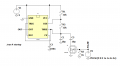
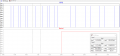
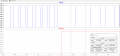
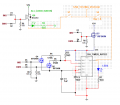
This circuit is an example of Frequency Shift Keying. The components have been chosen so that when the MOSFET is off, the 555 timer osscilates at 4Hz with a 66% duty cycle. When the MOSFET is turned on, another 10uF capacitor appears in parallel with the original 10uF capacitor for a total of 20uF. The result is a frequency of 2Hz with 66% duty cycle.
In other words, doubling the capacitance reduces the frequency by a factor of 2. My circuit switches in a capacitor but you can switch in resistance for the same effect. This circuit has the benefit of allowing an arbitrary number of frequencies as long as you have extra MOSFETs to do the switching.
If you want the frequency to change from 2Hz -> 4Hz -> 2Hz -> 4Hz automatically, connect a flip-flop from the output of the 555 timer to the MOSFET. The flip-flop will enable and disable the MOSFET on each rising edge of the 555 square wave.
This circuit is an example of Frequency Shift Keying. The components have been chosen so that when the MOSFET is off, the 555 timer osscilates at 4Hz with a 66% duty cycle. When the MOSFET is turned on, another 10uF capacitor appears in parallel with the original 10uF capacitor for a total of 20uF. The result is a frequency of 2Hz with 66% duty cycle.
In other words, doubling the capacitance reduces the frequency by a factor of 2. My circuit switches in a capacitor but you can switch in resistance for the same effect. This circuit has the benefit of allowing an arbitrary number of frequencies as long as you have extra MOSFETs to do the switching.
If you want the frequency to change from 2Hz -> 4Hz -> 2Hz -> 4Hz automatically, connect a flip-flop from the output of the 555 timer to the MOSFET. The flip-flop will enable and disable the MOSFET on each rising edge of the 555 square wave.
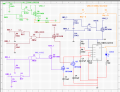
Sorry I should've been more clear with my instructions, I need a 555 timer to output 3 different frequencies (just changed the idea) that are controlled by two signals. When one signal goes high, I need it to blink at 2 Hz. If the other signal is high, I need it to blink at 4Hz. I'm not allowed to adjust it once it's on a board. This is the idea I had.
The IMD and BMS signals are active high and they're letting me know something went wrong, i need my led on the right of the 555 timer to blink at 3 different frequencies depending on if it's a IMD issue, a BMS issue or both. Is this valid and do you have any other ideas?
This circuit is an example of Frequency Shift Keying. The components have been chosen so that when the MOSFET is off, the 555 timer osscilates at 4Hz with a 66% duty cycle. When the MOSFET is turned on, another 10uF capacitor appears in parallel with the original 10uF capacitor for a total of 20uF. The result is a frequency of 2Hz with 66% duty cycle.
In other words, doubling the capacitance reduces the frequency by a factor of 2. My circuit switches in a capacitor but you can switch in resistance for the same effect. This circuit has the benefit of allowing an arbitrary number of frequencies as long as you have extra MOSFETs to do the switching.
If you want the frequency to change from 2Hz -> 4Hz -> 2Hz -> 4Hz automatically, connect a flip-flop from the output of the 555 timer to the MOSFET. The flip-flop will enable and disable the MOSFET on each rising edge of the 555 square wave.
This is the idea I had,
I'll be getting 2 signal lines, IMD and BMS. Its an active high signal letting me know when something is going wrong (dont worry about the green or yellow). The dark blue part of the circuit is making my 555 timer turn on a start blinking. Depending on if its an IMD issue, BMS issue or both. Would do you think?
The first (and often hardest) part of solving a problem is clearly stating and understanding just what the problem is.
It's a bit unclear what you are looking for. Do you mean to blink at two different frequencies at the same time? If so, you need to describe in a lot more detail just exactly you are looking for it to do. Or do you mean be able to selectively blink at one of two different frequencies? If so, how is the selection made?
You also need to define what you mean for it to "blink" at a frequency. If it is blinking at 2 Hz, does this mean that it is on for 0.25 s and then off for 0.25 sec (i.e., a square wave with a 0.5 sec period)? Or does it mean that it flashes very briefly twice a second? If so, how briefly?
What is the "light"? A small LED? Or a stage light? Very different issues. One of the very first designs I ever did in college was for the drama club to give them a way to flash a stage light for a special effect for the play they were doing that semester (the other was to give them a way to ring a telephone), so it's not a facetious question at all.
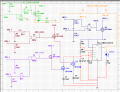
Yeah you're right. I should've been more clear. My job is to design a schematic that takes 2 signals as inputs. These signals being IMD and BMS (both are active high), the signals indicate a problem. If there's no issues with these inputs, then I output a green light. If there's a BMS issue, my board must blink a red led (2Hz and 50% duty cycle, ideally with a 555 timer). If there's a IMD issue, my board must blink a red led (4Hz and 50% duty cycle, ideally with a 555 timer). If there's a BMS and IMD issue, my board must blink a red led (5Hz and 50% duty cycle, ideally with a 555 timer).
Let me know what you think!
Yeah you're right. I should've been more clear. My job is to design a schematic that takes 2 signals as inputs. These signals being IMD and BMS (both are active high), the signals indicate a problem. If there's no issues with these inputs, then I output a green light. If there's a BMS issue, my board must blink a red led (2Hz and 50% duty cycle, ideally with a 555 timer). If there's a IMD issue, my board must blink a red led (4Hz and 50% duty cycle, ideally with a 555 timer). If there's a BMS and IMD issue, my board must blink a red led (5Hz and 50% duty cycle, ideally with a 555 timer).View attachment 336922
Let me know what you think!
a) What's the point of Q1 and Q2? I see they are sourcing the gates of Q5 and Q4 but they are redundant.
b) None of the MOSFETs have gate or pull-down resistors. It might be a good idea to limit inrush current and force a logic low by default.
c) IRF540 requires a gate voltage of at least 10V. You are driving the gates with logic ICs which are usually 5V. If this is the case, the MOSFETs will barely turn on if at all.
You can use the frequencies you wrote in #10 but I think you really meant a flash rate you can see, ie; 1s@50%, 2s@50%...etc
Use a CD4060B with an oscillator frequency of about 64Hz. That will produce Q outputs of frequencies of approx. 4hz, 2hz, 1hz, etc. Then use gate logic to select and prioritize the freq to flash the led. You'll only need one mosfet to drive the LED.
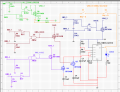
Yeah you're right. I should've been more clear. My job is to design a schematic that takes 2 signals as inputs. These signals being IMD and BMS (both are active high), the signals indicate a problem. If there's no issues with these inputs, then I output a green light. If there's a BMS issue, my board must blink a red led (2Hz and 50% duty cycle, ideally with a 555 timer). If there's a IMD issue, my board must blink a red led (4Hz and 50% duty cycle, ideally with a 555 timer). If there's a BMS and IMD issue, my board must blink a red led (5Hz and 50% duty cycle, ideally with a 555 timer).View attachment 336922
Let me know what you think!
This would be pretty trivial is you use an 8-pin microcontroller. The hardware set up would be ultra simple and the program would also be extremely simple.
a) What's the point of Q1 and Q2? I see they are sourcing the gates of Q5 and Q4 but they are redundant.
b) None of the MOSFETs have gate or pull-down resistors. It might be a good idea to limit inrush current and force a logic low by default.
c) IRF540 requires a gate voltage of at least 10V. You are driving the gates with logic ICs which are usually 5V. If this is the case, the MOSFETs will barely turn on if at all.
You can use the frequencies you wrote in #10 but I think you really meant a flash rate you can see, ie; 1s@50%, 2s@50%...etc
Use a CD4060B with an oscillator frequency of about 64Hz. That will produce Q outputs of frequencies of approx. 4hz, 2hz, 1hz, etc. Then use gate logic to select and prioritize the freq to flash the led. You'll only need one mosfet to drive the LED.
What problems are you having? It's hard for me to diagnose because I don't know what the logic chip inputs are doing. Try breaking the circuit into smaller chunks and simulate them individually.
That circuit can simplified using diodes for the gates and a p channel mosfet for Q6.
Another issue was switching the capacitors on the 555. Adding caps in parallel decreases the frequency.
The configuration on Q4 and Q5 provide 2hz, 4hz and 6hz by changing the resistance.
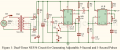
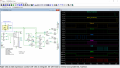
Here's an example using a CD4060B. See below.
The LED's are high efficiency low current (2V@2mA) type. The circuit uses 3 IC's total.
I've shown the supply as 9v but it can be operated at 12v as well. It will need to be bench tested.

 Facebook
 Google
 GitHub
 Linkedin